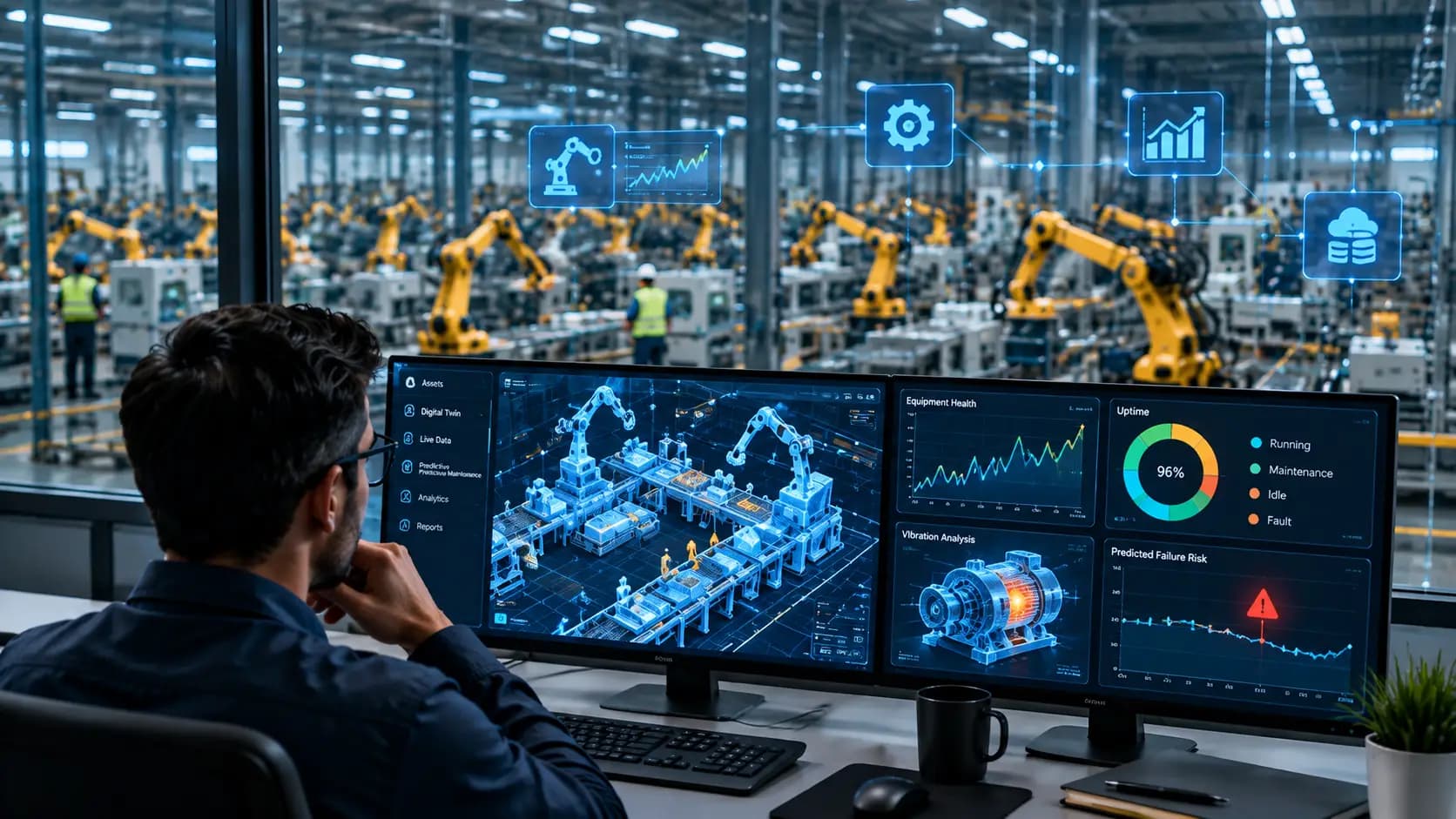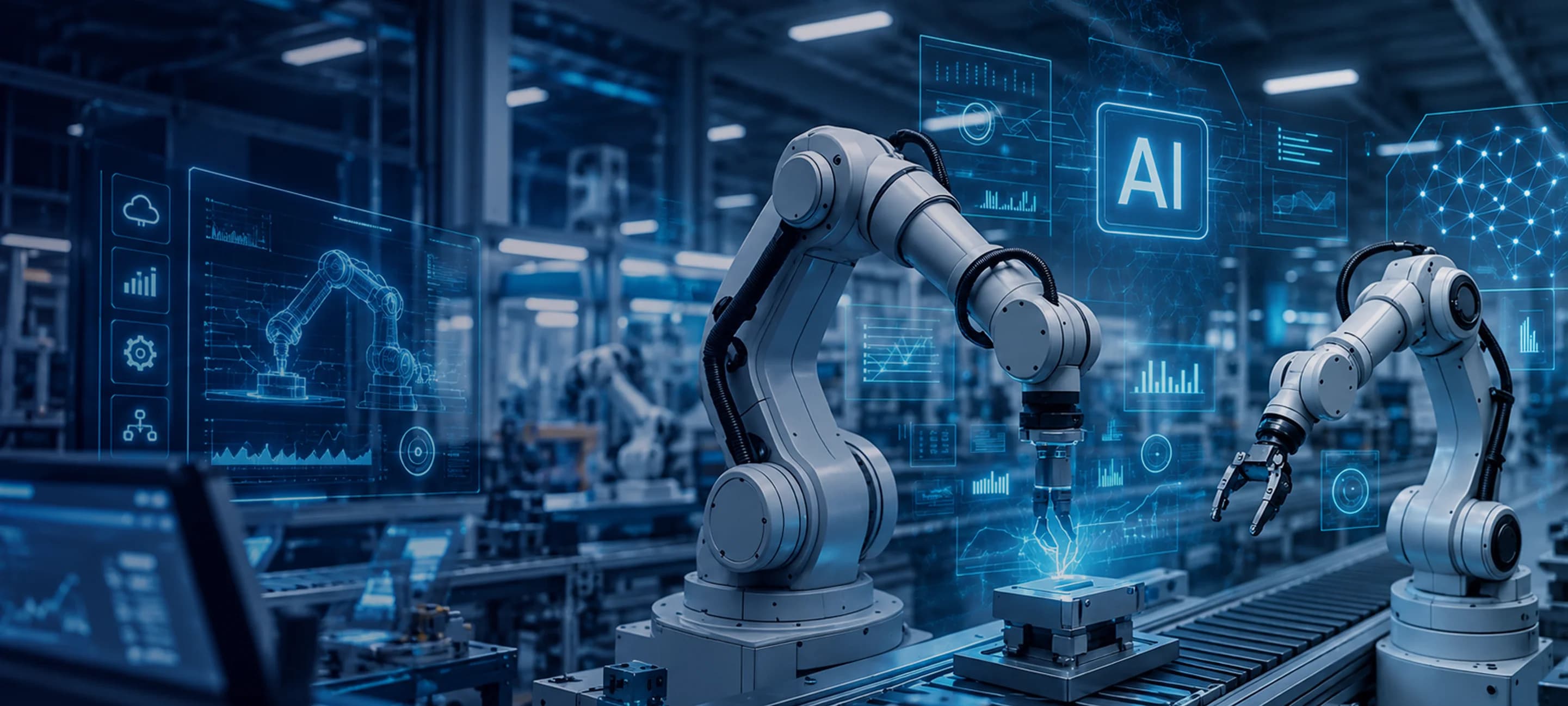
Most enterprise AI so far has worked on text, images, and data. It drafts, summarizes, classifies, and predicts, and a person usually decides what happens next. Physical AI is different because the output is action on machines and equipment.
Physical AI's adoption is already measurable.
In Deloitte's 2026 State of AI in the Enterprise survey of 3,235 leaders, 58% of companies reported at least limited use of physical AI. The figure is projected to reach 80% within two years. The qualifier matters. The examples Deloitte cites, including collaborative robots, inspection drones, and autonomous forklifts, show how broadly the term is applied.
That looseness causes confusion. Physical AI, generative AI, robotics, and industrial automation are often treated as one thing. They are different. This article separates the four.
So, what is physical AI?
Key Takeaways
- Physical AI senses, decides, and acts. It perceives through sensors, decides with learned models, and acts through machines such as robots, vehicles, or industrial equipment.
- Physical AI produces actions, while generative AI produces content. That raises the cost of a wrong output, because a machine acts on it.
- Robotics is the machine, and physical AI is one possible intelligence layer. The same intelligence can run factories, grids, and fleets, not only robots.
- Industrial automation runs on programmed logic, and physical AI typically works alongside it. Controllers keep running processes while learned models handle perception and decisions.
- Safety functions generally stay with conventional controllers. DGUV states that AI is no substitute for classical protective devices.
- Definitions agree on the core and differ at the edges. The field's boundaries are not standardized.
- The right question is which tasks need adaptation. Deloitte reports 58% of companies use physical AI at least in a limited way. But not every physical task should be automated.
What Is Physical AI?
Physical AI is artificial intelligence that senses the physical world through sensors, decides what to do using learned models, and acts through machines such as robots, vehicles, or industrial equipment. Unlike generative AI, which produces text, images, or code, physical AI produces actions that have real-world consequences.
Physical AI Meaning in Simple Terms
A system counts as physical AI when it passes three tests:
- It senses through physical sensors, such as cameras, lidar, or force sensors.
- It decides with learned models, not only fixed rules.
- It acts on a machine or a physical process.
Consider a vision-guided robotic arm that adjusts its grip when a part sits at a different angle. It sees the part, judges the offset, and changes its movement.
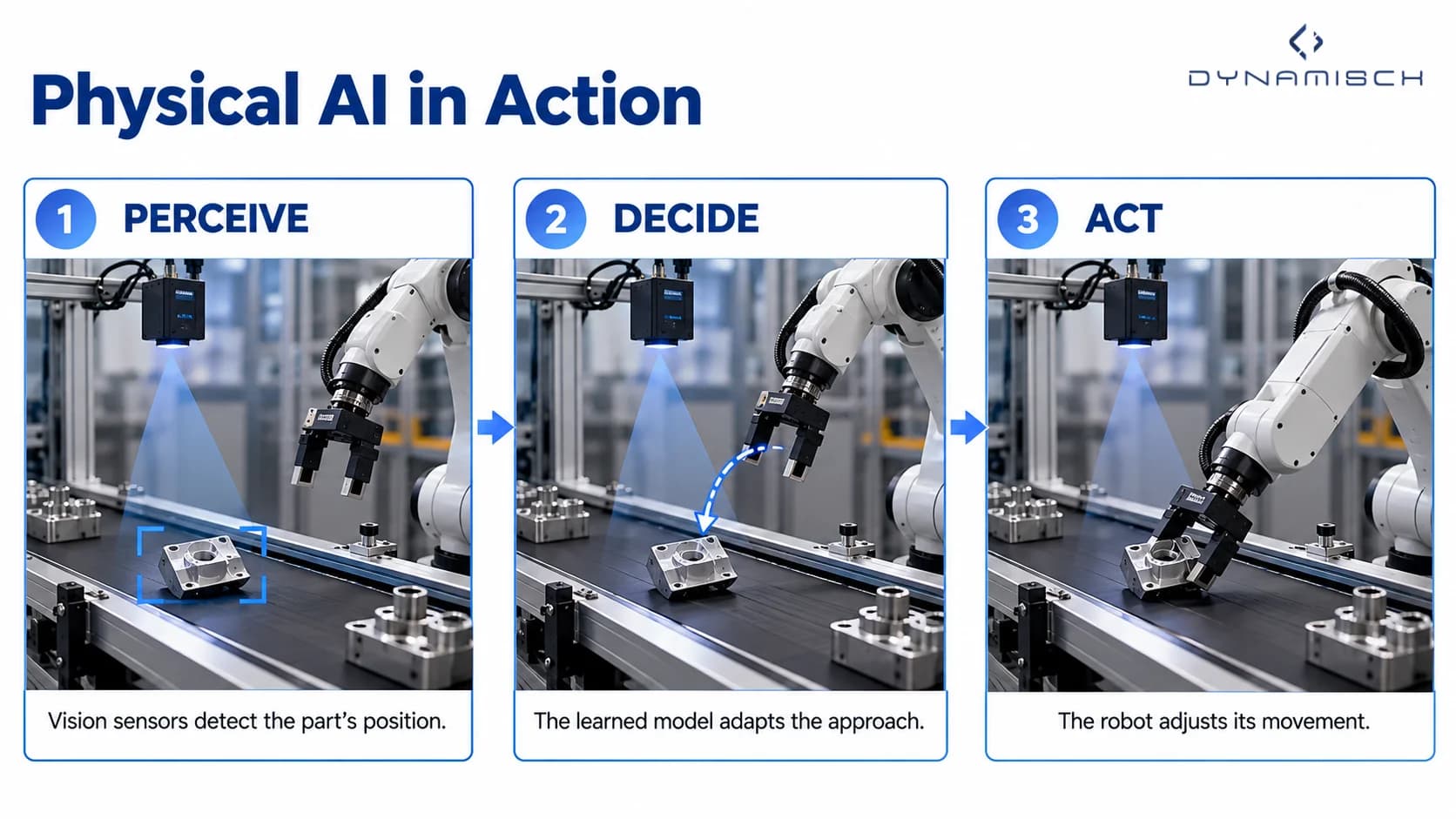
Seeing is not the same as acting. Analyzing a camera feed is one thing, and acting on what it shows is another.
Why Definitions Differ
IBM notes that NVIDIA CEO Jensen Huang is widely credited with popularizing the term.
Northeastern University quotes engineering professor Yanzhi Wang, who describes physical AI as AI designed to interact with its environment. It typically uses specialized sensors to do so. That wording does not require a robot. Other sources center on machines with actuators, and Wikipedia states that the field's boundaries are not standardized.
This article uses the three-test definition above. It separates physical AI from software-only AI and from machines that only follow scripts.
A Quick Terminology Map
| Term | Working meaning |
|---|---|
| Physical AI | The broader umbrella for AI that deals with physics, space, motion, sensors, control, and real-world execution |
| Embodied AI | Intelligence of an agent with a body, which learns by interacting with its environment |
| Generative physical AI | Physical AI that adds generative models for greater adaptability |
| Vision-language-action (VLA) model | A model that unifies visual perception and language processing to make decisions and act |
| World model | An internal representation of an environment that lets a system test scenarios and anticipate consequences before acting |
Physical AI vs Generative AI vs Robotics vs Industrial Automation at a Glance
The four differ mainly in what they produce and how they handle change.
| Factors | Generative AI | Robotics | Industrial Automation | Physical AI |
|---|---|---|---|---|
| Primary output | Text, images, code | Movement and manipulation | Controlled machine and process behavior | Actions in the physical world |
| How it is built | Trained on large digital datasets | Engineered mechanics and control software | Programmed logic (PLC, SCADA) | Trained models plus control and simulation |
| Handling variation | Varied inputs, digital only | Depends on programming or added AI | Fixed within designed conditions | Adapts within trained limits |
| Cost of a wrong output | Usually correctable before use | Physical damage possible | Handled by safety-rated layers | Physical consequence |
| Typical hardware | Data center GPUs, often cloud-hosted | Arms, mobile platforms | PLCs, drives, sensors | Edge compute, sensors, actuators |
Two rows deserve a closer look. IBM notes that when a language model gets a prediction wrong, a person can still choose whether to act on it. A physical system acts directly, so the same error can cause damage.
On the plant floor, NIST describes PLCs as controlling localized processes and SCADA systems as supervising geographically dispersed assets. That control layer is where industrial automation lives.
These are layers of one system more often than competing choices. A vision model can guide a robotic arm while existing controllers manage the rest of the production cell. A generative model can also help plan actions or train the robot's behavior.
How Does Physical AI Work?
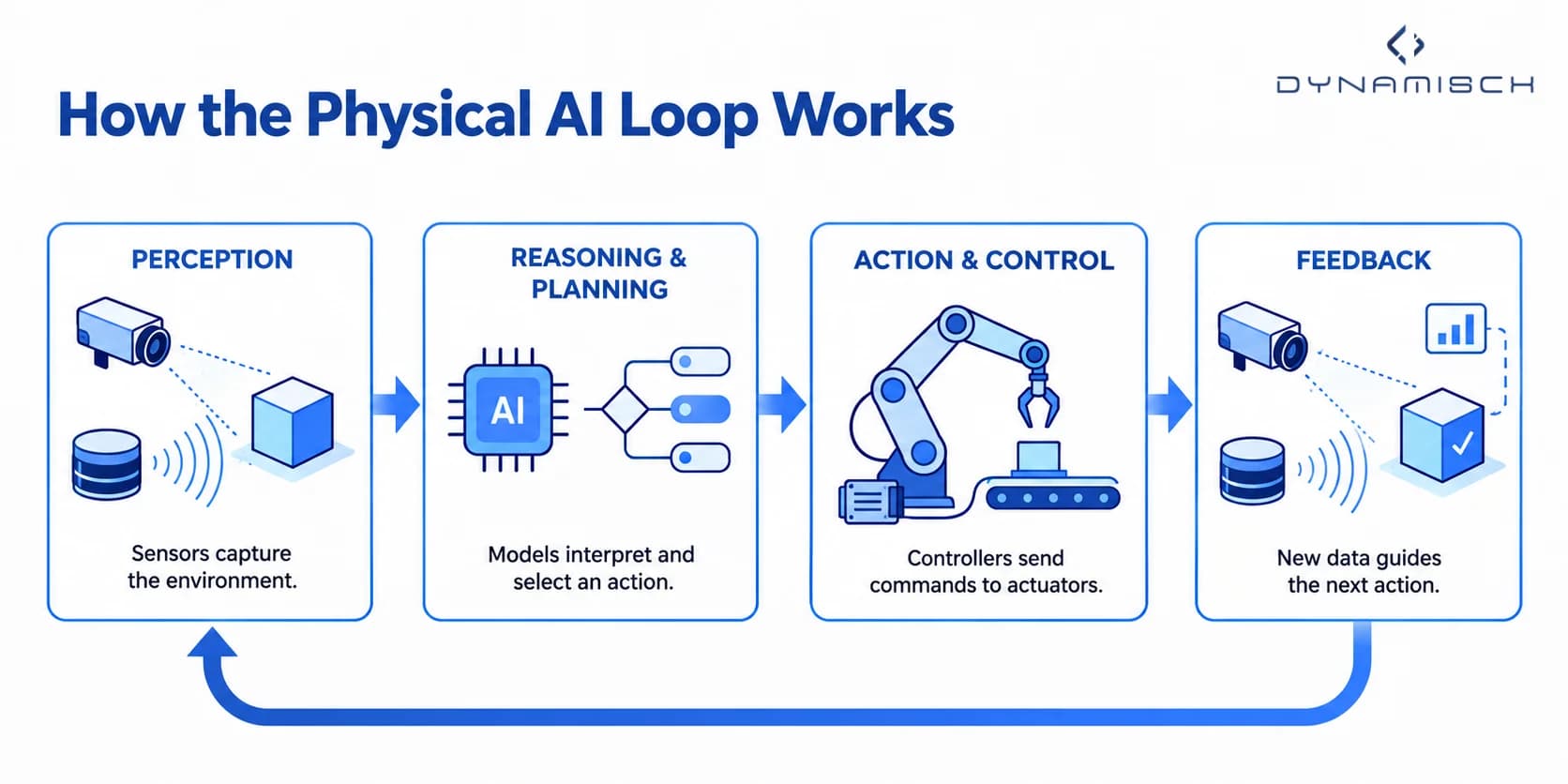
Physical AI works as a loop. It senses its surroundings, decides what to do, acts through a machine, and uses the result to adjust. Wikipedia describes the same continuous cycle of perception, planning, and action.
The Sense, Decide, Act Loop
Four stages repeat continuously:
- Perception: Cameras, lidar, and other sensors capture the environment, and models interpret it. This is where computer vision and embedded IoT devices feed the system.
- Reasoning and planning: The system chooses an action based on what it perceives.
- Action and control: Control software converts the plan into commands for motors, joints, or other actuators.
- Feedback: New sensor data shows whether the action worked, and the plan changes if conditions have shifted.
What Sits Underneath the Loop
Four layers support the loop: sensors, learned models, controllers and actuators, and compute close to the machine. The models range from perception networks to vision-language-action (VLA) and world models.
Cisco notes that physical AI relies on edge computing to reach the millisecond response times safety requires. That is why inference often runs on or near the machine, a trade-off covered in edge AI vs cloud AI. Hybrid designs often let simpler control algorithms ensure stability while learned models handle perception and decisions.
How Physical AI Models Learn
Real-world training is slow and expensive, so teams rely on simulation. IBM describes simulated environments and synthetic data as key tools for training physical AI. These environments often use a digital twin of a factory.
Reinforcement learning rewards behaviors that succeed across repeated trials. Domain randomization changes simulated conditions to help AI skills work in unpredictable real-world settings.
Transfer is the hard part. Models that look strong in simulation often fail in the field, a problem often called the sim-to-real gap.
Physical AI vs Generative AI
Generative AI produces content. Physical AI produces actions. The two differ in what they learn from, what a mistake costs, and how they combine.
Content vs Action
Generative models are trained on text and images. Much of this data comes from the internet. This limits their understanding of the physical world and its rules. Physical AI adds an understanding of spatial relationships and physical behavior.
IBM points out that physical AI often needs data collected from machines interacting with real environments. This type of data cannot simply be downloaded from the internet.
Why a Wrong Answer Costs More in the Physical World
A hallucinated sentence can be edited before anyone relies on it. A wrong actuator command cannot always be undone. When a language model makes a mistake in a digital setting, a person can decide whether to act on its output. But a self-driving car that misjudges the speed of the vehicle ahead can cause a serious accident.
Timing differs too. Physical systems run in real-time, and small delays between perception, decision, and action can cause failures. Latency and reliability expectations rise for that reason.
How the Two Work Together
They are complements. IBM describes robotic agents that use language models to draw on general knowledge. It also highlights world foundation models, which generate scenarios that account for physics and help train AI systems.
Vision-language-action models follow the same pattern. They are the systems that unify visual perception and language processing to act and make decisions.
Agentic AI fits the decision step. Cadence places it in the action layer, where goal-directed reasoning weighs possible actions in real time. Supermicro notes that every physical AI system can be considered an agent, though not every agent acts physically. For the software side, see Dynamisch's agentic AI implementation guide.
Physical AI vs Robotics
A robot is a machine. Physical AI is an intelligence approach that can be applied to one.
Robotics focuses on the mechanics and control of physical machines. Before AI, robots typically followed fixed rules or scripts. They performed narrow tasks in specially designed environments. For example, a robotic arm might weld the same seam all day.
Physical AI extends beyond individual robots to AI-powered factories, smart grids, and vehicle fleets. The same intelligence can run equipment that is not a robot.
A robot with no AI is still a robot. A learned model with no machine to act through is not physical AI under the definition used here.
The installed base shows why this matters. The International Federation of Robotics reports 542,000 industrial robots installed in 2024 and about 4.66 million in operation worldwide. The practical question is how an intelligence layer gets added to machines already on the floor.
Physical AI vs Industrial Automation
Industrial automation controls machines and processes through programmed logic. Physical AI adds learned perception and decision-making to that foundation. It does not replace it.
What Industrial Automation Actually Is
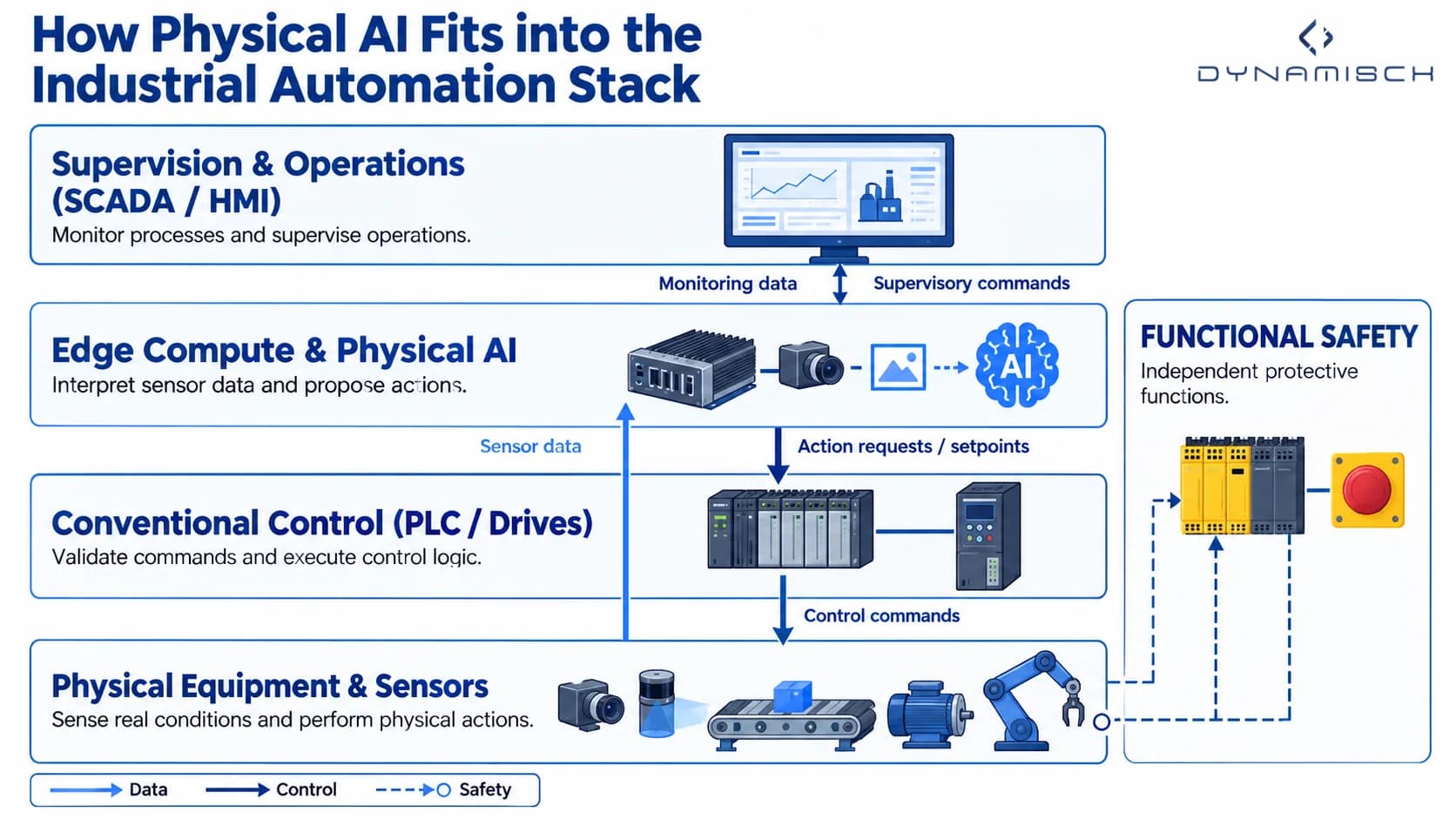
NIST describes industrial control systems as systems used to control industrial processes such as manufacturing and distribution. Programmable logic controllers (PLCs) typically manage local process control, while SCADA systems supervise geographically dispersed assets. Engineers define the behavior of this layer in advance.
Where Physical AI Sits in the Automation Stack
IBM talks about hybrid designs. In this approach, simple control algorithms keep the system stable, while learned models handle perception and decision-making. That arrangement places physical AI alongside the control layer, not in place of it.
Why Safety Functions Stay Outside the AI
Functional safety for machinery is specified in ISO 13849-1, IEC 62061, and IEC 61508.
In 2021, DGUV, Germany's social accident insurance body, issued guidance on AI and safety standards. It noted that these standards did not contain specific requirements for AI. It also stated that AI-based assistance systems cannot be classified as safety functions. AI should not replace traditional protective devices.
A standard written for the gap, ISO/IEC TS 22440, is still a committee draft on ISO's site. Until it matures, safety functions generally stay with conventional controllers, and AI operates around them.
Where Physical AI Shows Up Today
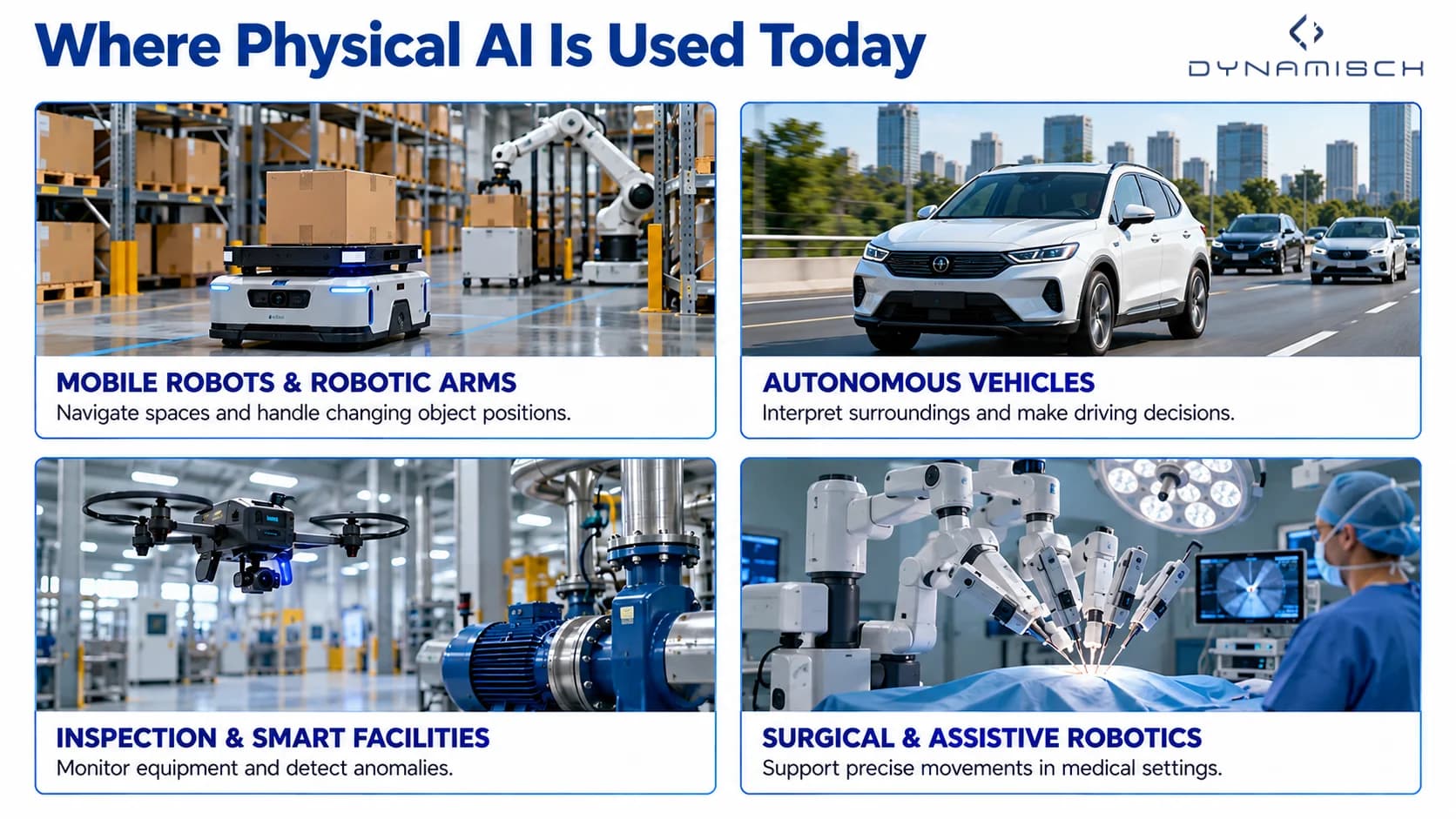
Physical AI examples span warehouses, roads, plants, and hospitals. Four categories cover most of what leaders encounter.
Mobile Robots and Robotic Arms
Autonomous mobile robots use onboard sensor feedback to navigate warehouses and avoid obstacles, including people. Robot arms adjust their grip strength and position based on the pose of objects on a conveyor.
Autonomous Vehicles
Vehicles process sensor data in real time to perceive their surroundings. Vision-language-action models then use that data to make driving decisions, from open freeways to city streets.
Inspection, Monitoring, and Smart Facilities
Fixed cameras and computer vision models track people, vehicles, and robots across factories and warehouses. NVIDIA notes the system can support route planning and flag anomalies with real-time alerts.
For the facility side, see Dynamisch's guide to smart facility management.
Surgical and Assistive Robotics
Surgical robots analyze real-time feedback to make micro-scale movements. It also cites assistive devices, such as exoskeletons, that adapt to a user's motion and environment.
Does Your Operation Actually Need Physical AI?
Not always. Physical AI earns its place where variation and the cost of failure are high, and many operations have neither.
When Programmed Automation Is Still the Better Choice
Traditional robotics performs best in stable, predictable environments and breaks down when conditions vary. Where conditions stay stable, fixed automation remains a strong fit.
Intretech, a manufacturing services firm, explains when traditional automation is the better choice. It usually offers lower costs per unit and greater reliability when a production line makes one product.
It's also useful in production lines that make a few stable variants in high volumes. This is especially true when parts are always positioned in the same way. It adds that physical AI systems generally need more ongoing tuning and monitoring than fixed automation.
Adoption among manufacturers is still early. There is a survey by the Manufacturing Leadership Council, cited in Deloitte's 2026 Manufacturing Industry Outlook. It found that 9% of manufacturers currently use physical AI. Another 22% plan to adopt it within the next two years.
It is a separate survey from the one cited earlier, with a different sample and scope.
Signs a Task May Benefit from Physical AI
Some tasks often require human judgment or involve variations that fixed rules cannot handle. Such tasks are usually the best candidates for physical AI. Four questions help test the fit:
- How much real variation does the line handle, measured by changeover frequency and part variation?
- What does a failure cost, such as a recall versus a routine return?
- Can your team support ongoing tuning and monitoring?
- Can the vendor prove the system on your parts, not demo parts?
Most lines end up with a mix. Fixed automation handles predictable steps in the process. Physical AI is used at stations where changing conditions or the cost of failure justify the extra investment.
What to Check Before You Start
Four checks come before any pilot: data, compute, safety, and integration. Deloitte's 2026 report found that 42% of companies see their AI strategy as highly prepared. Yet they feel less prepared on infrastructure, data, risk, and talent.
- Data: Physical AI needs structured, synchronized, high-quality data from sensors, operational platforms, digital twins, and historical records. Test whether machine data meets that bar today.
- Compute and connectivity: Small delays between perception, decision, and action can cause failures. Decide what has to run near the equipment, using the edge vs cloud trade-offs as a guide.
- Safety architecture: AI is no substitute for classical protective devices. Confirm which safety functions stay with conventional controllers.
- Integration: Pilots stall when they meet legacy APIs, authentication layers, and workflows never designed for them. Dynamisch explains this challenge in its guide to the integration wall.
Gaps in any of the four tend to surface after the demo, not during it.
Building Physical AI Capabilities with Dynamisch
Physical AI depends on the layers underneath it: sensing, vision, edge compute, and simulation.
Dynamisch's work sits in those layers. The team deploys computer vision and AI models on edge hardware, including NVIDIA Jetson platforms. It then connects the models' outputs to existing sensor pipelines and control systems. It also builds IoT-connected digital twins on NVIDIA Omniverse for simulation and validation.
Through forward deployed engineering, engineers work inside the client's own systems. They stay with the project from pilot to handoff. That model targets the integration gaps covered earlier.
To discuss where your operation stands, contact the team.
Frequently Asked Questions

Sanket Prabhu
Vice President of Engineering
As Vice President of Engineering at Dynamisch, Sanket Prabhu stands at the intersection of Generative AI, Spatial Computing, and enterprise-scale innovation. With over 15 years of experience driving innovation across AI, XR, IoT, Digital Twins, and Gaming, he transforms emerging technologies into high-growth business engines. His leadership reflects both technical depth and strategic precision.