
An embedded IoT system is a specialized computing node that combines dedicated hardware, real-time firmware, sensor interfaces, network connectivity, and edge analytics to collect, process, and act on data locally. Unlike traditional embedded systems that perform isolated tasks, embedded IoT systems operate as intelligent, connected nodes within larger enterprise ecosystems.
Key Takeaways
- Edge Intelligence is the Standard: An embedded IoT system is no longer just a connected device; it is a smart computing node capable of processing and acting on data right where it is collected.
- TinyML Redefines Efficiency: Machine learning models are now optimized to run directly on tiny, low-power microcontrollers, cutting down cloud bills and reducing data latency from over 80ms to sub-1ms levels.
- Security Starts in Silicon: With rising cyber threats and strict regulations like the EU Cyber Resilience Act, security must be built directly into the device hardware via Secure Elements and Secure Boot pipelines.
- Local Compute Saves Cash: Processing data locally instead of streaming gigabytes of raw telemetry over cellular networks reduces bandwidth requirements by up to 90%, cutting costs and ensuring smooth offline operations.
What Is an Embedded IoT System?
To understand where we are today, it helps to separate traditional embedded systems from modern embedded IoT.
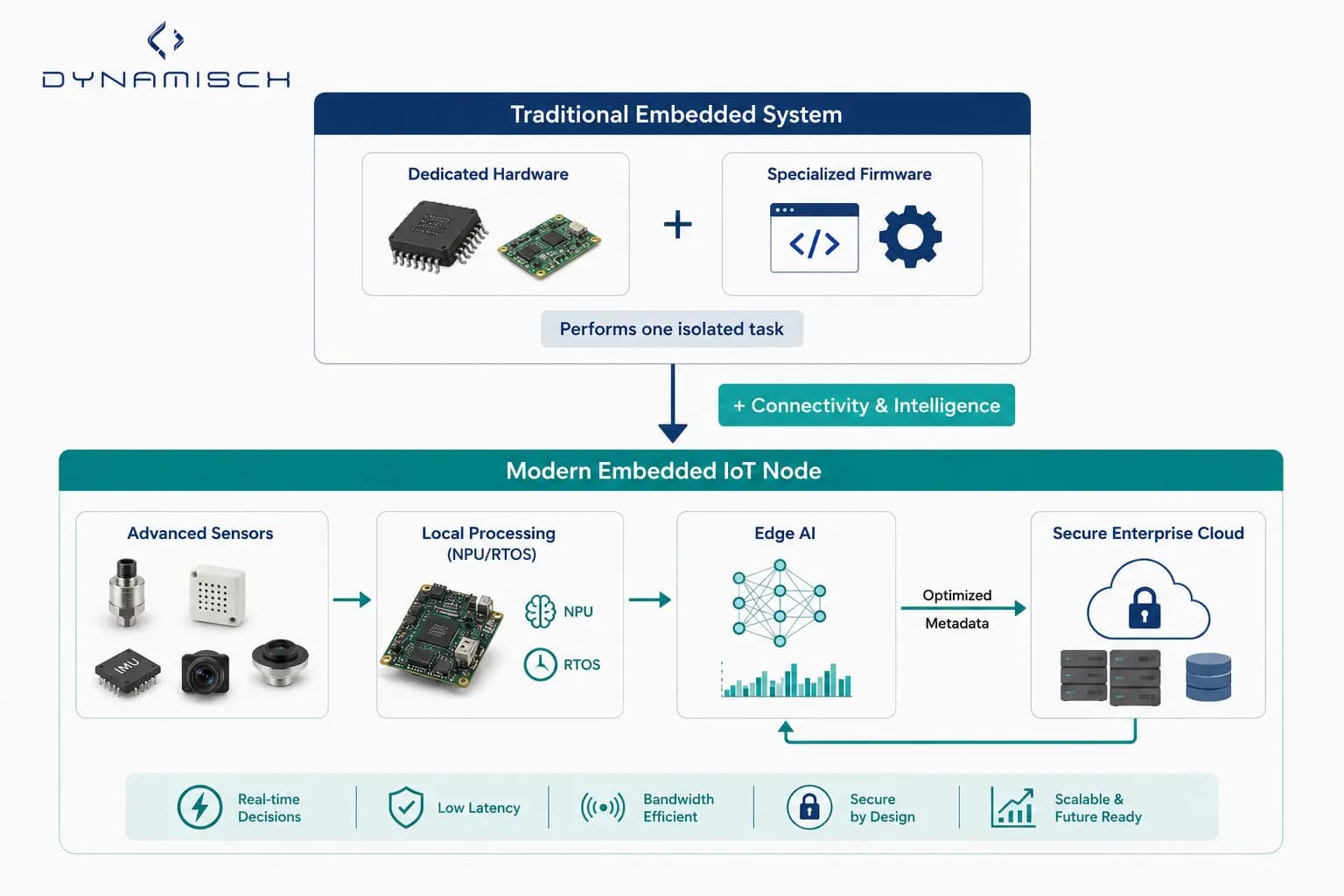
A standard embedded system is a dedicated combination of hardware and software built to do one specific job. Think of the electronic controller that manages the anti-lock braking system (ABS) in your car or the internal logic of a washing machine. It is reliable and deterministic, but it is isolated.
An Embedded IoT System takes that reliable core and adds advanced sensors, local processing power, network connectivity, and edge analytics. It becomes an autonomous, connected node within a larger business framework.
How Embedded IoT Systems Have Evolved
In 2026, embedded IoT systems have evolved beyond traditional sensor-connected devices that continuously stream raw telemetry to centralized cloud environments. Modern architectures prioritize distributed intelligence, localized processing, deterministic response times, and reduced infrastructure dependency.
An embedded IoT system combines dedicated hardware platforms, real-time firmware, sensor interfaces, connectivity modules, and edge analytics capabilities to execute autonomous functions within a larger digital ecosystem.
This architectural shift is driven by several operational realities:
- Rising cloud compute and data transfer costs
- Increased demand for real-time decision execution
- Regulatory pressure around data residency and privacy
- Bandwidth limitations in large-scale industrial deployments
- The need for resilient offline-capable systems
As a result, enterprise engineering teams are moving compute closer to the data source through edge-native embedded architectures.
Core Architecture of a Modern Embedded IoT System
A modern embedded IoT architecture can be viewed as a four-layer execution model:
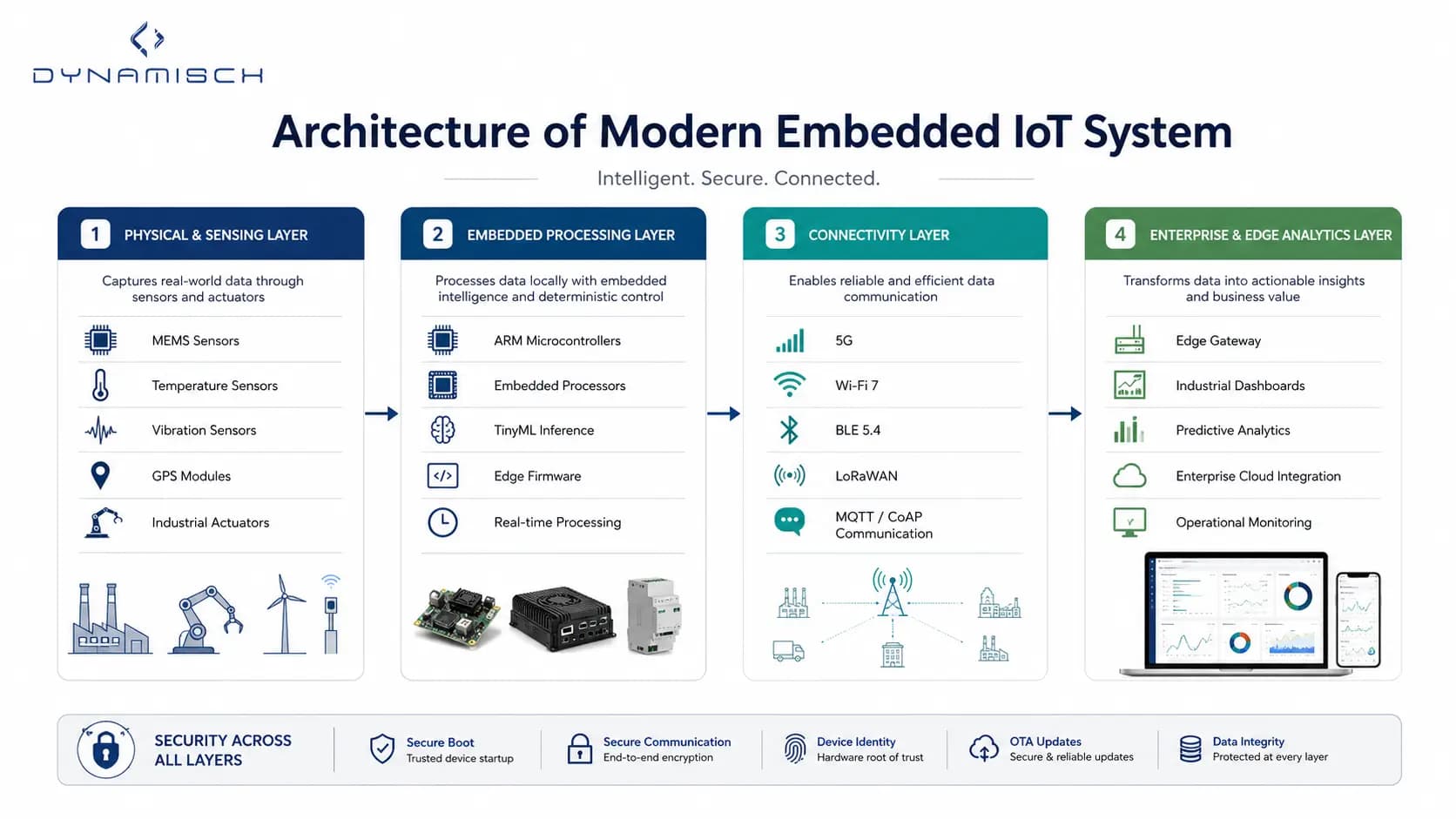
Building a reliable, industrial-grade embedded IoT system requires balancing a complex hardware and software stack. Let's break down the four essential layers that make these systems tick.
1. The Physical Sensing Layer
This is where the system touches the real world. In industrial plants, medical facilities, and shipping fleets, sensors must capture physical changes with perfect accuracy.
- Smart MEMS Sensors: Micro-electromechanical systems (MEMS) now come with their own tiny, built-in controllers. This means a sensor can monitor vibration or temperature on its own and only wake up the main processor when a specific safety threshold is crossed.
- Sensor Fusion: Devices rarely rely on just one data point anymore. Modern systems use sensor fusion, combining data from acoustic microphones, 3-axis accelerometers, and thermal sensors simultaneously to get a complete picture of an asset's health.
2. The Core Processing Layer
This is the machine's brain. The choices made here dictate how long the device can run on a single battery and how much logic it can handle.
- MCUs vs. MPUs: For deeply resource-constrained and ultra-low-power applications, engineers often use Microcontroller Units (MCUs), especially in battery-operated devices designed to run for years. For more compute-intensive workloads such as video processing or advanced UI rendering, Microprocessor Units (MPUs) are commonly used. However, modern low-power MPUs, such as the NXP i.MX RT series can also deliver efficient power consumption.
- The Dominance of 32-Bit Processing: In the embedded space, 32-bit processors account for 47.6% of the global market. This architecture strikes the perfect balance, providing enough performance clearance to run real-time operating systems and edge computer vision without draining power reserves.
- Neural Processing Units (NPUs): Chip makers now include dedicated hardware accelerators, or NPUs, right on the silicon. These specialized cores handle the heavy math required for artificial intelligence at a fraction of the power a regular processor would use.
- Real-Time Operating Systems (RTOS): General-purpose operating systems like Windows or standard Linux can pause tasks unexpectedly to run background updates. That doesn't work in industrial settings. An RTOS (like Zephyr, FreeRTOS, or ThreadX) ensures that critical safety tasks execute within precise, predictable microsecond windows.
3. The Connectivity Layer
Networks are chosen based on the deployment environment, balancing range, power consumption, and bandwidth.
- 5G Advanced & Massive IoT: Designed to support millions of industrial edge devices simultaneously, 5G provides the bandwidth and low latency that dense IoT deployments demand. Most deployments still route traffic through local gateways or edge nodes, though LPWAN standards like NB-IoT and LTE-M do support direct tower connection for low-bandwidth, low-power devices where a gateway is not practical.
- Wi-Fi 7 & Bluetooth 6.0: These offer ultra-fast speeds and secure, short-range connections inside smart factories and commercial buildings.
- LoRaWAN & NB-IoT: The go-to choice for wide-open areas like smart farms, utility grids, and city-wide tracking, where signals need to travel miles and pierce through concrete walls.
4. The Edge Analytics & Platform Layer
The edge analytics layer transforms raw telemetry into contextual operational intelligence.
Typical responsibilities include:
- Event filtering
- Embedded AI inference
- Fault classification
- Threshold-based control
- Localized automation
- Metadata generation
Instead of transmitting continuous high-volume telemetry streams, the embedded platform forwards only actionable insights or summarized operational states to enterprise systems.
What Is TinyML and Why It Matters for Embedded IoT
The most significant tech breakthrough in recent years is the rise of TinyML, running fully operational ML models directly on small microcontrollers using less than 1 milliwatt of power.
Historically, running AI required massive, power-hungry graphics cards in a cloud data center. Today, smart optimization techniques allow us to compress these models so they fit cleanly into a device's local flash memory.
The most common technique for making this work is quantization. A model that was trained using 32-bit floating point numbers gets converted into a version that uses 8-bit integers instead. It loses a tiny amount of precision, but the model weights become four times smaller as a result. This reduction in weight size means the model loads faster, consumes significantly less RAM during inference, and runs more efficiently on hardware with no floating-point unit.
Two frameworks dominate this space right now. TensorFlow Lite Micro from Google and Edge Impulse, which provides a full end-to-end pipeline from data collection through to deployment on a physical chip. Both support common microcontroller families from STMicroelectronics and Nordic Semiconductor.
The practical ceiling is rising quickly. A few years ago, running a keyword-spotting model on a microcontroller was considered impressive. Today, businesses are deploying anomaly detection models for rotating machinery, gesture recognition for industrial controls, and fall detection for wearable health monitors, all running on chips that cost less than two dollars and draw under one milliwatt of power.
Why Moving AI to the Device Matters
Instant Responses: If a robotic arm on an assembly line malfunctions, or a medical wearable detects a heart issue, waiting for a cloud response is too dangerous. While typical cloud processing causes an end-to-end network delay of 80ms to 160ms, edge computing drops response times to sub-1 millisecond levels.
Slash Bandwidth Costs: Streaming hours of raw, high-frequency sound or vibration data from thousands of machines creates massive network congestion and giant cloud bills. Embedded IoT systems run the analysis locally and only use network data to send alerts when something goes wrong.
Privacy by Design: By analyzing data locally and destroying the raw files immediately after making a decision, companies completely avoid data-privacy risks. Sensitive video or audio never travels over the internet, making compliance with strict regulations straightforward.
Real-World Embedded IoT Use Cases by Industry
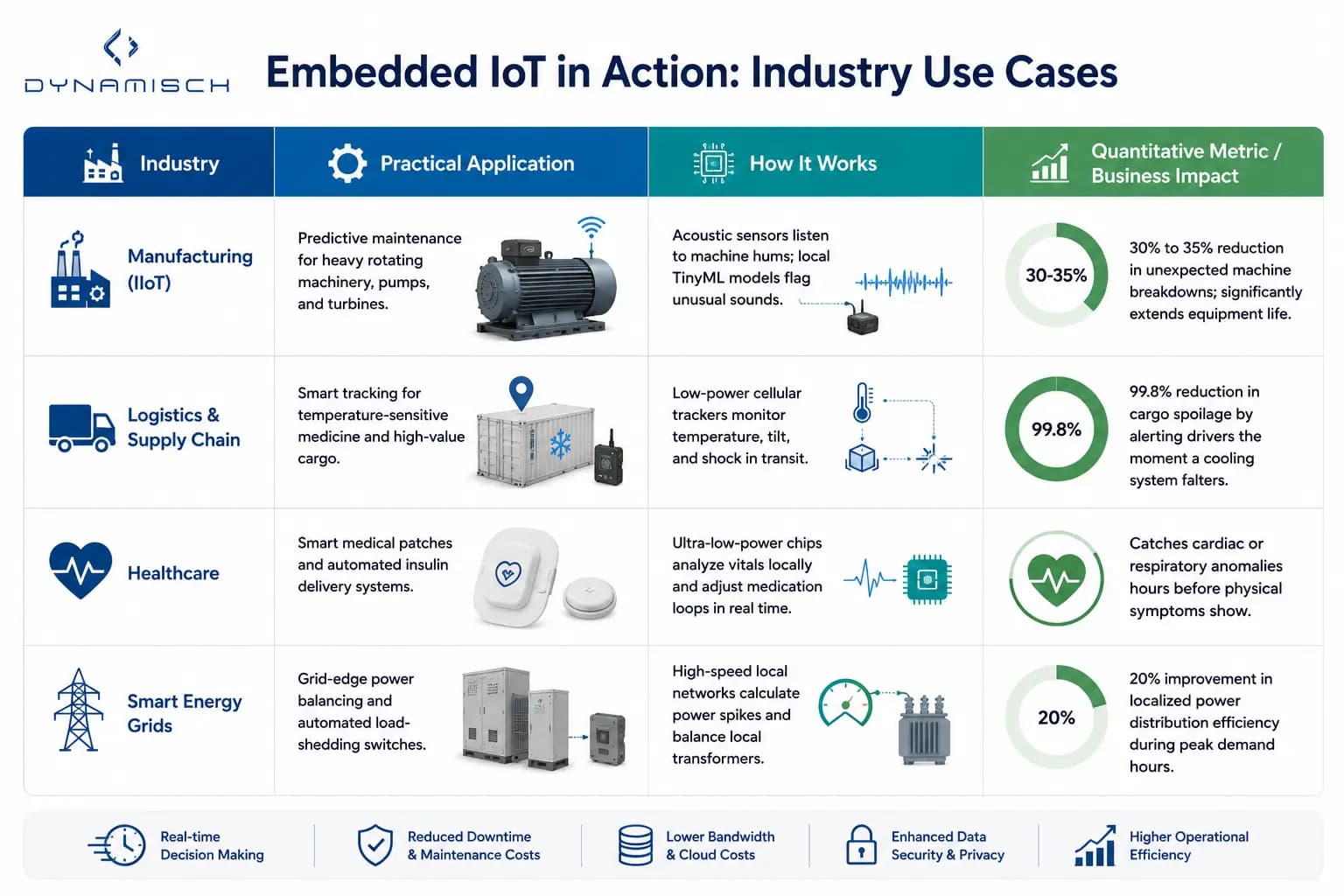
To see how these concepts scale, let's look at how different sectors use intelligent embedded systems alongside concrete operational metrics.
Industry Performance Comparison:
Key Engineering Challenges and How to Solve Them
Designing an embedded IoT system means balancing the harsh realities of physical environments with code. Unlike web software, you can't just throw more RAM or server capacity at a problem.
The Trade-offs of Technical Architecture
When choosing how to build your system, you must weigh the exact pros and cons of your hardware and network choices. There is no one-size-fits-all setup.
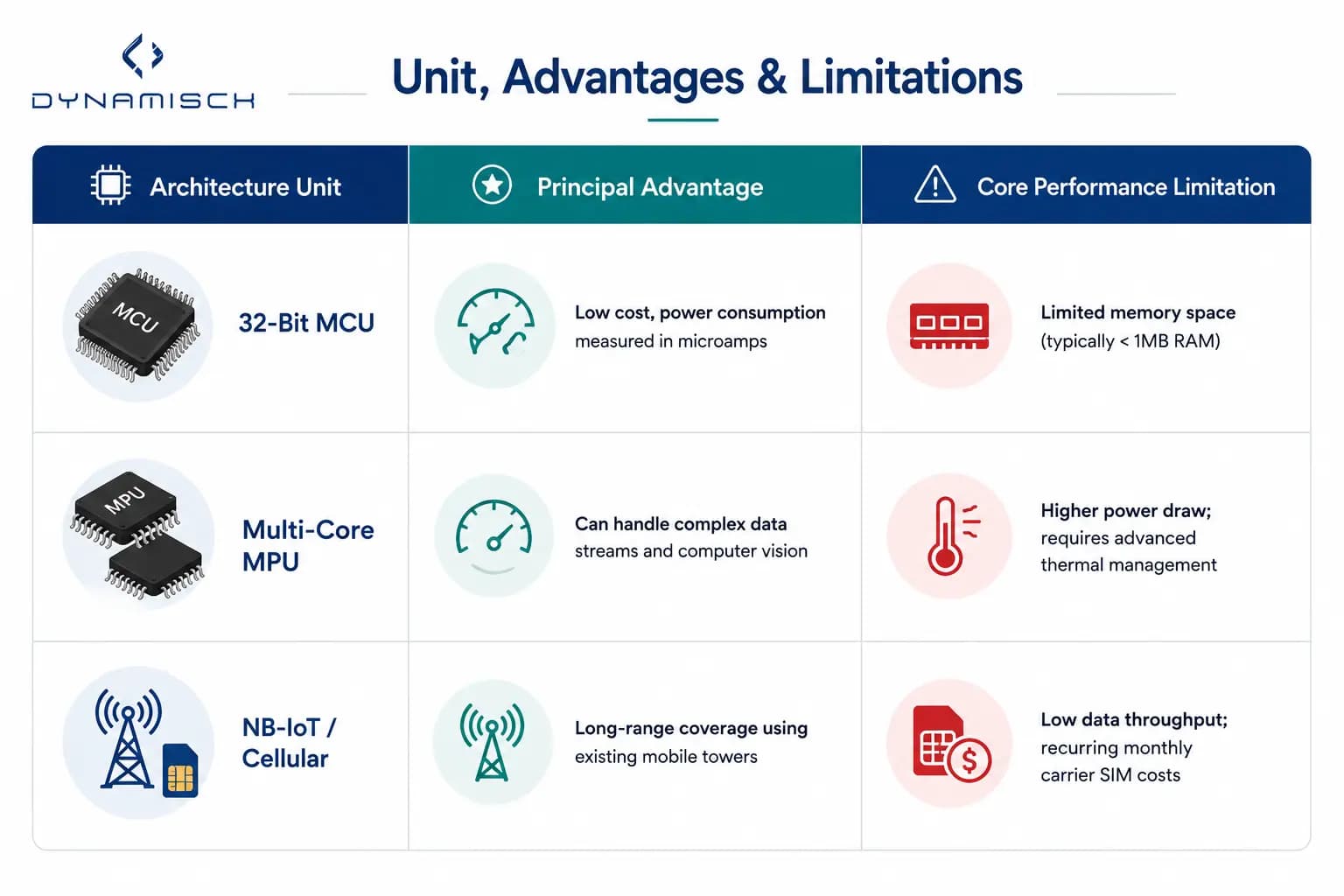
Technical Challenges and Best Practices
- The Battery Life vs. Performance Challenge: Devices stuck out in fields or deep inside concrete walls must run reliably for 5 to 10 years on a single small battery. To achieve this, software must keep components in a deep sleep state 99% of the time. The chip wakes up for a few milliseconds to read a sensor, runs an optimized line of code, and drops right back into low-power mode.
- Bridging Modern Software and Old Machinery: Modern enterprise software speaks languages like MQTT or REST APIs. Old factory equipment speaks protocols designed forty years ago, like Modbus or CAN bus. The fix is deploying smart gateways that act as translators, converting raw bitstreams into clean, compressed JSON structures locally.
- Reliable Remote Firmware Updates (OTA): Sending updates to thousands of distributed devices is risky because a power failure during installation can permanently "brick" a device. To reduce this risk, many systems use dual-bank flash memory, where the update is downloaded into a backup partition while the main firmware continues running safely. The device validates the update and performs a test boot before switching over, although some low-cost MCUs lack native dual-bank flash support.
Embedded IoT Security and Global Compliance Requirements
Building secure embedded IoT systems now requires both strong technical safeguards and regulatory compliance from the design phase onward.
Key security foundations include:
- Hardware Root of Trust (HRoT): Establishes a trusted hardware-based security anchor for secure boot, device identity, and cryptographic key protection.
- TLS/DTLS Encryption: Protects device-to-device and device-to-cloud communication from interception and tampering across wired and wireless networks.
- Side-Channel Attack Mitigation: Modern secure embedded designs increasingly include protections against power analysis, fault injection, and timing-based attacks targeting cryptographic operations.
New regulatory frameworks now reinforce these security requirements:
- EU Cyber Resilience Act (CRA): Imposes strict hardware security baselines, demands fast reporting of known vulnerabilities, and requires manufacturers to guarantee security updates for years.
- U.S. IoT Security Mandates: Requires a clear Software Bill of Materials (SBOM) detailing every line of code used in a device and completely bans default, unchangeable passwords on connected hardware.
- UK Product Security and Telecommunications Infrastructure (PSTI) Act 2022: Bans universal default passwords, requires manufacturers to provide a public vulnerability reporting contact, and mandates clear disclosure of how long devices will receive security updates. For embedded IoT products sold in the UK, PSTI compliance is now a mandatory market access requirement.
For organisations operating across both the UK and Europe, much of the compliance work overlaps between PSTI and the EU Cyber Resilience Act. The main difference is enforcement, with UK manufacturers regulated by the Office for Product Safety and Standards (OPSS) and EU products overseen by national authorities. Engineering teams targeting both markets should build to the stricter standard from the start rather than retrofit compliance later.
How to Get Started with Embedded IoT Development
Focus on Business Value First: Avoid building an IoT platform just because it sounds advanced. Start with a concrete goal, like cutting machine downtime by 20% or lowering shipping spoilage rates.
Push Logic to the Edge: Question any architecture that relies on sending raw data streams to the cloud. By filtering out routine data on-device, you can achieve up to 90% bandwidth savings, reducing both network congestion and cloud computing costs.
Adopt Modern, Memory-Safe Languages: Move firmware engineering away from legacy languages prone to crashes and memory bugs. Transitioning to modern ecosystems like embedded Rust drastically reduces software vulnerabilities and runtime errors before devices ever ship.
Choose an Architecture Partner: Designing custom silicon boards, writing highly efficient real-time code, and managing thousands of field assets requires a broad range of deep technical skills.
How Dynamisch Can Help
We help enterprises design and deploy secure and edge-optimized embedded IoT systems across industrial, healthcare, logistics, and smart infrastructure environments. From embedded firmware and edge AI integration to connectivity architecture and secure device management, our team supports the complete embedded product lifecycle.
Whether you are modernizing legacy systems or building next-generation intelligent devices, we enable faster deployment, lower infrastructure overhead, and reliable real-time operations. Book a free consultation to discuss your embedded IoT and edge AI requirements.
Frequently Asked Questions

Sanket Prabhu
Vice President of Engineering
As Vice President of Engineering at Dynamisch, Sanket Prabhu stands at the intersection of Generative AI, Spatial Computing, and enterprise-scale innovation. With over 15 years of experience driving innovation across AI, XR, IoT, Digital Twins, and Gaming, he transforms emerging technologies into high-growth business engines. His leadership reflects both technical depth and strategic precision.