Enterprises that operate factories, energy networks, hospitals, or large facilities most of the time make critical decisions with only a partial view of what is happening across their physical assets. Maintenance departments respond after equipment fails, operations people work with fragmented data, and chiefs struggle to predict the downstream impact of disruptions.
This operational blind spot explains why interest in digital twins has accelerated. Market analysts estimate the global digital twin market will reach roughly USD 34–49 billion in 2026 and continue growing rapidly through the next decade, driven by the maturation of Industrial IoT, wider adoption of edge AI, and enterprise efforts to scale AI across operations. Multiple forecasts project annual growth rates exceeding 30%.
Yet many organizations still fail to move beyond pilot programs. Frequent obstacles in adoption include integration complexity, unclear digital twin cost models, and uncertainty around implementation priorities.
In this guide, we'll see what a digital twin is, how it works, typical digital twin implementation costs across different scopes, and the practical steps enterprises can take to build a scalable business case for digital twin technology.
Key Takeaways
-
A digital twin is a real-time virtual representation of a physical asset, system, or process that continuously updates using data from sensors, enterprise systems, and operational data feeds.
-
Digital twin implementation costs range from approximately USD 10,000 for a proof of concept to more than USD 10 million for large enterprise deployments, with complex infrastructure projects potentially costing substantially more.
-
Most organizations begin with a focused pilot costing between USD 50,000 and USD 200,000 to validate business value before scaling.
-
Manufacturing, energy, aerospace, and smart infrastructure are among the fastest-growing adopters of digital twin technology because of their need for predictive maintenance and operational optimization.
-
The largest digital twin cost drivers are enterprise system integration, IoT sensor infrastructure, and simulation model complexity.
-
Successful digital twin ROI depends on selecting a high-value use case, ensuring data readiness, and driving operational adoption across teams.
-
AI-native digital twins that combine real-time operational data, predictive analytics, and conversational interfaces are emerging as the next phase of enterprise adoption.
What Is a Digital Twin?
A digital twin is a dynamic, continuously synchronized virtual representation of a physical asset, system, or process. Unlike a static 3D model, a true digital twin continuously receives data from sensors, engineering models, operational systems, and historical records to accurately reflect the current condition and behavior of the physical asset.
This allows organizations to monitor performance, run simulations, predict failures, and optimize operations without directly intervening in the physical environment.
The Core Concept of Digital Twin
The defining characteristics of digital twin technology are real-time data connectivity and bidirectional information exchange. Data from the physical asset is continuously fed into the virtual model, while insights from the model can help guide actions and decisions in the real world.
Digital twins typically fall into three broad categories:
- Product Twins: These are the models of individual assets or components, such as turbines, vehicles, or medical devices.
- Process Twins: These represent workflows, production lines, or business operations.
- System Twins: These models are designed for interconnected environments, such as factories, energy grids, airports, or smart city infrastructure.
Industry standards now consider real-time synchronization and lifecycle management to be essential parts of a digital twin.
How a Digital Twin Works
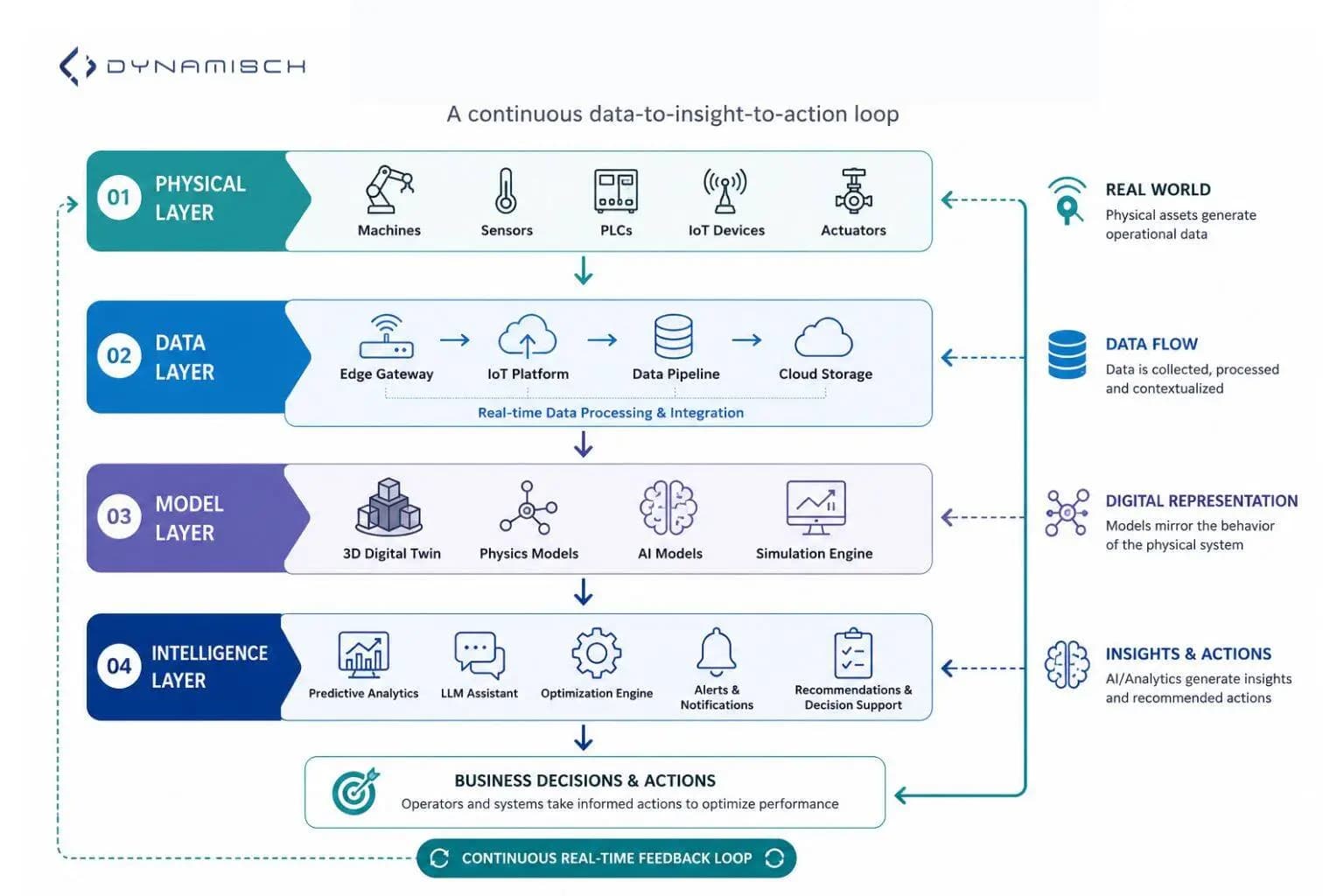
Organizations implementing digital twins generally build around four architectural layers:
-
Physical Layer: Machines, Sensors, embedded systems, and actuators capture operational conditions such as temperature, vibration, location, pressure, or energy consumption.
-
Data Layer: Industrial IoT platforms, edge or cloud infrastructure, and real-time data pipelines aggregate, process, and contextualize incoming data.
-
Model Layer: AI models, physics-based models, digital representations, and simulation engines mirror the behavior of the physical system.
-
Intelligence Layer: Predictive models, analytics, LLM-based interfaces, and optimization algorithms generate recommendations, insights, and forecasts.
This results in a continuous feedback loop. A digital twin may detect an emerging equipment issue, generate a predictive maintenance alert, or automatically adjust operating parameters to improve efficiency.
When real-time response is critical, such as in closed-loop manufacturing control or power grid management, where the digital twin runs matters as much as how it is built. See our deep dive into edge-deployed digital twins for the full architecture.
Digital Twin vs. Simulation - Key Differences
Traditional simulations are only useful for design and planning. A digital twin builds on these capabilities by staying continuously connected to the physical system. It enables ongoing operational decisions instead of one-time analysis.
Some key differences are as follows:
| Dimension | Digital Twin | Traditional Simulation |
|---|---|---|
| Data connection | Real-time, continuously synchronized | Static or historical data |
| Update frequency | Continuous | Event-triggered or manual |
| Scope | Mirrors an actual physical asset or system | Models hypothetical scenarios |
| Decision support | Operational, predictive, and prescriptive | Analytical and planning-focused |
| Feedback loop | Often bidirectional | Typically one-way |
Why Digital Twins Are a 2026 Enterprise Priority
Digital twins have moved beyond experimental Industry 4.0 initiatives and into mainstream enterprise technology portfolios.
Market Momentum and Enterprise Investment Signals
Recent market estimates place the global digital twin market at approximately USD 49.5 billion in 2026, with projected annual growth exceeding 30% through the early 2030s. This reflects sustained investment across sectors like manufacturing, healthcare, energy, transportation, and infrastructure.
Large enterprises account for the majority of digital twin deployments because they have the resources, technical expertise, and operational scale needed to implement them across entire plants and multiple sites.
The conversation has also evolved. Early adopters focused basically on asset monitoring and predictive maintenance. But now, second-generation programs combine digital twins with AI, machine learning, and conversational interfaces and allow operations departments to interact with complex systems through natural language.
Research from McKinsey suggests that digital twins can accelerate AI development and deployment cycles by up to 60%. They can also reduce certain operational costs by up to 15%, strengthening the business case for organizations pursuing enterprise-wide AI initiatives.
Regulatory pressures are adding momentum. Sustainability reporting requirements, including the European Union's Corporate Sustainability Reporting Directive (CSRD), are driving investments in lifecycle monitoring, emissions tracking, and operational optimization across industrial environments.
The Cost of Inaction
For many asset-intensive organizations, delaying digital twin implementation creates a growing visibility gap.
Maintenance after any issue happens typically costs substantially more than planned or predictive maintenance because failures often trigger production interruptions, safety risks, emergency repairs, and faster parts purchasing.
As infrastructure ages and operational complexity increases, retrofitting legacy environments becomes progressively more expensive.
The strategic risk extends beyond maintenance costs. Organizations lacking real-time operational intelligence are more likely to struggle with slower product iteration cycles, supply chain disruptions, and inefficient resource utilization.
Key Industry Drivers in 2026
Several technology trends have made it possible to deploy digital twins at enterprise scale:
-
Industrial IoT maturity: Global IoT connections are projected to exceed 40.8 billion by 2030, providing the data foundation required for high-fidelity digital twins.
-
Edge AI adoption: Running analytics closer to physical assets reduces latency and enables real-time decision-making in manufacturing plants, utilities, and critical infrastructure.
-
5G expansion: Wider deployment of private and public 5G networks supports high-bandwidth, low-latency sensor connectivity across distributed operations.
-
AI-driven simulation: Generative AI and large language models are emerging as conversational interfaces for digital twins, making operational intelligence accessible to a broader workforce.
Organizations exploring these capabilities should also examine how digital twins intersect with smart manufacturing, Edge AI, and Generative AI & Machine Learning initiatives as part of a broader digital transformation strategy.
Digital Twin Use Cases by Industry
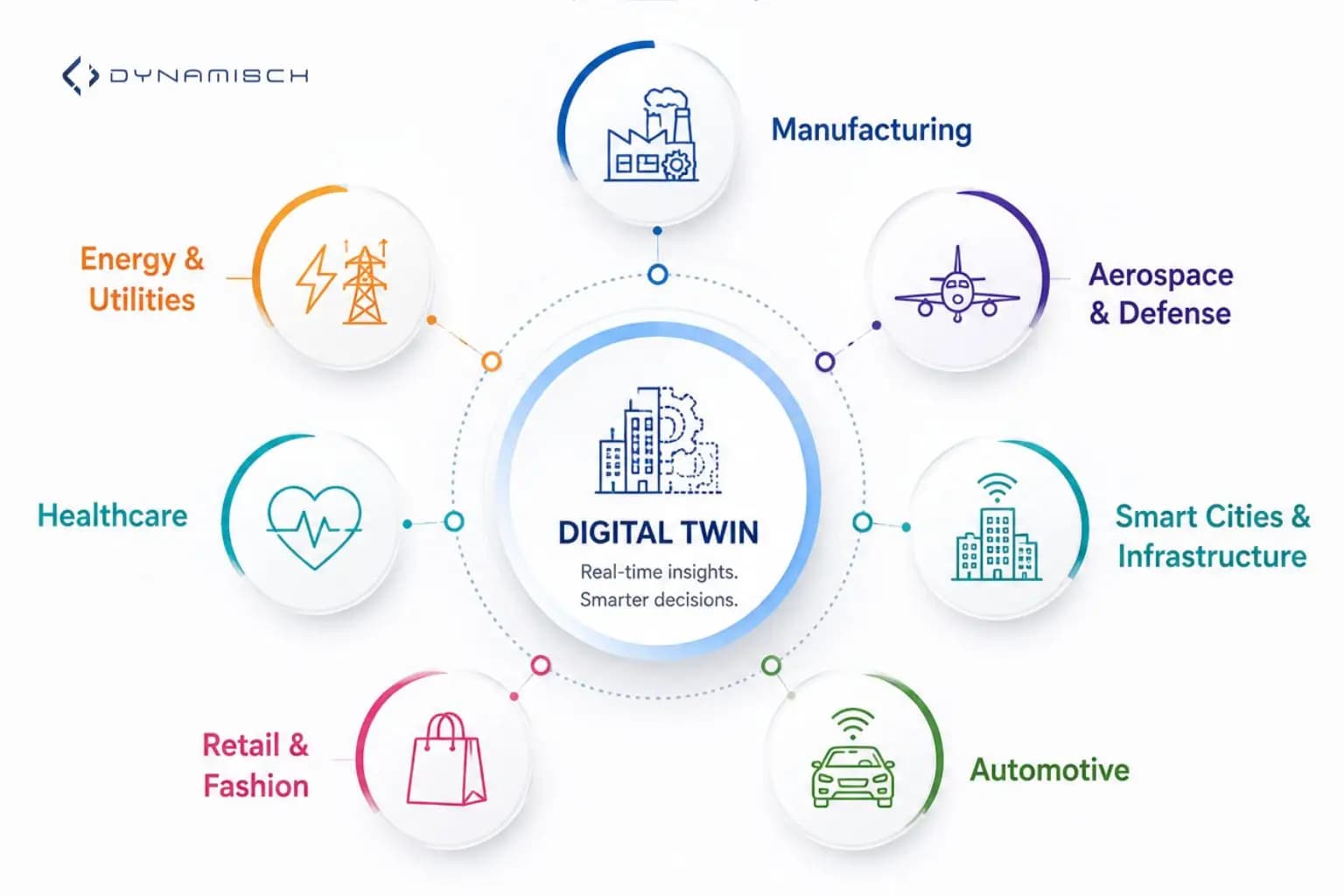
Digital twin technology is no longer confined to advanced manufacturing. Businesses across asset-intensive industries are using digital twins to improve operational visibility, optimize performance, and reduce risk.
Different industries may implement digital twins in different ways, but the objective is the same: to maintain an up-to-date representation of physical operations that supports better decisions and results.
Manufacturing & Industrial Operations
Manufacturing remains the largest adopter of digital twins, accounting for roughly one-third of global market revenue. Organizations use digital twins to predict equipment failures, simulate quality outcomes, monitor production lines, and optimize throughput.
For example, production-line twins have helped manufacturers increase throughput and reduce material waste by identifying loopholes before they affect output.
Business leaders evaluate digital twin ROI through metrics such as downtime reduction, overall equipment effectiveness (OEE), and scrap reduction.
For manufacturing operations where real-time closed-loop control is required, edge-deployed digital twins unlock capabilities that cloud-hosted architectures cannot match.
Energy & Utilities
Utilities and energy producers use digital twins to monitor turbines, pipelines, substations, and power grids in real time. The oil and gas sector is among the fastest-growing adopters as operators seek to optimize reservoir performance, improve asset integrity, and reduce unplanned outages in harsh operating environments.
Energy applications requiring immediate fault response, such as power grid relay management, depend on edge-hosted twins.
Healthcare & Life Sciences
Healthcare organizations like GE HealthCare & Philips Healthcare are developing patient-specific digital twins to support personalized treatment modeling, surgical planning, and disease progression analysis.
Hospitals are also adopting infrastructure twins to manage facilities, improve energy efficiency, optimize HVAC performance, and strengthen regulatory compliance.
Smart Cities & Infrastructure
Governments and infrastructure operators are deploying urban digital twins to model transportation networks, improve long-term infrastructure planning, and optimize energy systems.
Initiatives such as the UK's National Digital Twin Programme and the European Union's Destination Earth program demonstrate how digital twins are becoming foundational to large-scale public infrastructure management.
Retail & Built Environments
Retailers and commercial property owners use digital twins to optimize store layouts, improve facility operations, and simulate customer movement.
In smart buildings, digital twins support predictive maintenance, energy management, sustainability initiatives, and occupancy planning, often delivering significant reductions in energy consumption and operating costs.
Dynamisch in Practice: We Built Human Digital Twins for Apparel Retail
At Dynamisch, we deployed a parametric digital twin solution for an apparel retailer struggling with inaccurate size recommendations. Traditional 2D camera systems could not capture the body geometry data needed for reliable fit prediction, leading to high return rates and inventory inefficiencies.
The solution combined a multi-sensor Intel RealSense LiDAR system with a machine learning engine to generate accurate body measurements and match customers to brand-specific size charts.
The results were significant: an 85% reduction in size-related returns, a 22% increase in eCommerce conversions, 97% size recommendation accuracy, and 20× higher engagement at in-store smart kiosks. The system also followed a privacy-first approach by storing only anonymized measurement data and no photographs.
This case highlights a key principle of digital twins: their value depends on the quality of the real-world data feeding them. High-precision LiDAR capture enabled a level of accuracy that traditional measurements and 2D scans could not achieve.
Read the full case study: Transforming Apparel Retail with Human Digital Twins
Aerospace & Automotive
Aerospace and automotive companies use digital twins throughout the product lifecycle. This ranges from virtual prototyping and design validation to supply chain optimization and predictive maintenance.
Rolls-Royce's connected aircraft engine program remains one of the most widely referenced examples that demonstrates how real-time operational data can improve maintenance planning, asset availability, and lifecycle performance.
What Does It Cost to Implement a Digital Twin?
The short answer is that digital twin costs vary widely based on scope, asset complexity, data maturity, and integration requirements. A basic proof of concept may cost less than USD 50,000. In contrast, enterprise-scale digital twin implementations for large industrial facilities, hospitals, or refineries can cost several million dollars or more.
The Direct Answer - Cost by Scope
To reduce risk, most organizations begin with a limited pilot and then expand it across facilities or business units if it proves successful.
| Implementation Scope | Estimated Cost Range | Typical Timeline |
|---|---|---|
| Proof of Concept (single asset) | USD 10,000–50,000 | 4–8 weeks |
| Single-use-case pilot | USD 50,000–200,000 | 2–4 months |
| Single asset or production line | USD 50,000–500,000 | 3–6 months |
| Facility-level implementation | USD 500,000–2 million | 6–12 months |
| Enterprise-wide or multi-site deployment | USD 2 million–10 million+ | 12–24 months |
| Complex infrastructure (refineries, hospitals, airports) | USD 4 million–45 million+ | 18–36 months |
The Five Major Cost Drivers
The most important drivers of the above costing are:
Enterprise System Integration
Connecting the digital twin to ERP, MES, SCADA, CMMS, CRM, and data platforms is frequently the most underestimated budget item. Middleware, custom APIs, and legacy system modernization can add approximately USD 30,000–200,000 or more, particularly in brownfield environments.
IoT Sensor Infrastructure
Sensor procurement, installation, networking, and retrofitting typically range from USD 20,000 to several hundred thousand dollars, depending on asset count and operating conditions. Existing connected infrastructure significantly lowers implementation cost.
Platform Licensing
Enterprise platforms such as Siemens Xcelerator, PTC ThingWorx, Microsoft Azure Digital Twins, and NVIDIA Omniverse generally introduce annual licensing or subscription costs ranging from tens of thousands to several hundred thousand dollars, depending on deployment scale and usage.
3D Modeling and Simulation Builds
High-fidelity 3D models, physics-based simulations, and engineering validation often cost between USD 40,000 and USD 400,000. LiDAR-based capture and spatial computing technologies are helping accelerate environment modeling, although specialized expertise remains essential.
Ongoing Cloud Infrastructure and Compute
Digital twins generate continuous operational data streams. Real-time processing, cloud storage, AI inference, and model retraining typically create annual operating expenses ranging from approximately USD 10,000 to USD 150,000+, depending on data volume and analytics complexity.
Hidden Costs Decision-Makers Overlook
Three cost categories regularly derail budgets:
-
Data readiness and governance: Poor data quality often necessitates months of cleansing, normalization, and master data alignment before development can begin.
-
Change management and workforce adoption: Training operators and redesigning workflows are essential for realizing digital twin ROI.
-
Cybersecurity and compliance: OT/IT convergence expands the attack surface, requiring dedicated security architecture, particularly in regulated industries.
Digital Twin ROI - The Business Case in Numbers
Organizations often achieve the best results by first focusing on predictive maintenance, energy savings, or production efficiency. According to McKinsey, digital twins can lower operational costs by up to 15% in some applications.
In addition, industry studies show that mature predictive maintenance programs can reduce unplanned downtime by 30–50%. Well-scoped industrial implementations commonly achieve payback within 12–36 months, although outcomes depend heavily on use case selection, data quality, and organizational adoption.
For most enterprises, the question is not simply how much a digital twin costs, but which use case delivers the fastest and most measurable return.
How to Implement a Digital Twin
Successful digital twin implementation rarely starts with technology selection. Those organizations that follow a phased approach, starting with a business problem, early value validation, and incremental scaling, achieve measurable ROI.
Phase 1: Define the Use Case and Business Objective
Start by identifying the operational question the digital twin must answer. Is the goal to improve energy efficiency, reduce unplanned downtime, eliminate quality defects, or increase supply chain visibility?
The initial deliverable should be a concise business case that defines:
- The target KPI (for example, Overall Equipment Effectiveness or energy consumption)
- The current baseline
- A measurable success threshold
- Expected financial impact
Beginning with a narrowly scoped, high-value use case significantly improves the likelihood of adoption and long-term digital twin ROI.
Phase 2: Assess Data and Infrastructure Readiness
The root cause of many digital twin projects' success or failure is data quality and not the modeling sophistication.
Identify and review existing sensors, PLCs, historian databases, SCADA systems, operational data flows, and ERP platforms. Identify where critical data is missing, delayed, inaccessible, or unreliable. This assessment frequently uncovers infrastructure gaps that can be resolved before development begins, reducing overall implementation cost and project risk.
Phase 3: Select Technology Stack and Delivery Model
Organizations must decide whether to adopt a commercial platform, build a custom solution, or pursue a hybrid approach.
Commercial platforms accelerate time-to-value for standard use cases. Custom-built digital twins are often justified when assets, processes, or intellectual property create unique requirements.
In practice, many enterprises now adopt hybrid architectures, using established platforms for connectivity and visualization while developing proprietary simulation and analytics layers.
Delivery models typically include in-house development, co-development with a digital engineering partner, or managed twin-as-a-service arrangements.
Phase 4: Build, Integrate, and Validate
Build incrementally. Begin with monitoring and visualization capabilities before introducing simulation, predictive analytics, or autonomous optimization.
Each release should provide standalone business value. Before expanding functionality, validate that the virtual model accurately reflects physical system behavior under real operating conditions.
Phase 5: Scale, Govern, and Continuously Improve
Many digital twin projects do not move beyond the pilot stage because no team or individual has clear ownership. Define governance early by assigning responsibility across operations, IT, engineering, and data teams.
As adoption matures, connect asset-level twins into system-level and enterprise-wide twins to create end-to-end operational visibility.
Establish a continuous improvement cycle that reviews KPI performance against the original business case on a quarterly basis and feeds operational insights back into the physical environment.
Long-term success increasingly depends on disciplined MLOps, cloud optimization, and AI governance practices that keep models accurate, secure, and aligned with changing business conditions.
Conclusion
Digital twins have evolved from experimental projects into essential operational tools for organizations that manage large physical assets. Understanding what a digital twin is is now only the starting point.
The greater challenge for business leaders is determining how to build the data, organizational capabilities, and integration required to scale digital twin technology across the enterprise.
The good news is that adoption no longer requires a multi-million-dollar commitment on day one. Most organizations can validate a high-value use case through a focused pilot in the USD 50,000–200,000 range before expanding to broader deployments.
The competitive implications are becoming clearer. Organizations that began digital twin implementation programs several years ago are already combining twins with AI, predictive analytics, and autonomous decision support to improve operational performance. Those delaying investment may face a steeper and more expensive modernization journey later.
If you are evaluating digital twin initiatives, the first step is not selecting a platform; it is identifying the operational problem that matters most to your business. From there, a structured implementation roadmap can turn physical operations into a continuously improving source of enterprise intelligence.
Ready to explore the opportunity? Explore our digital twin services to assess the right implementation path for your organization.
Frequently Asked Questions

Sanket Prabhu
Vice President of Engineering
As Vice President of Engineering at Dynamisch, Sanket Prabhu stands at the intersection of Generative AI, Spatial Computing, and enterprise-scale innovation. With over 15 years of experience driving innovation across AI, XR, IoT, Digital Twins, and Gaming, he transforms emerging technologies into high-growth business engines. His leadership reflects both technical depth and strategic precision.