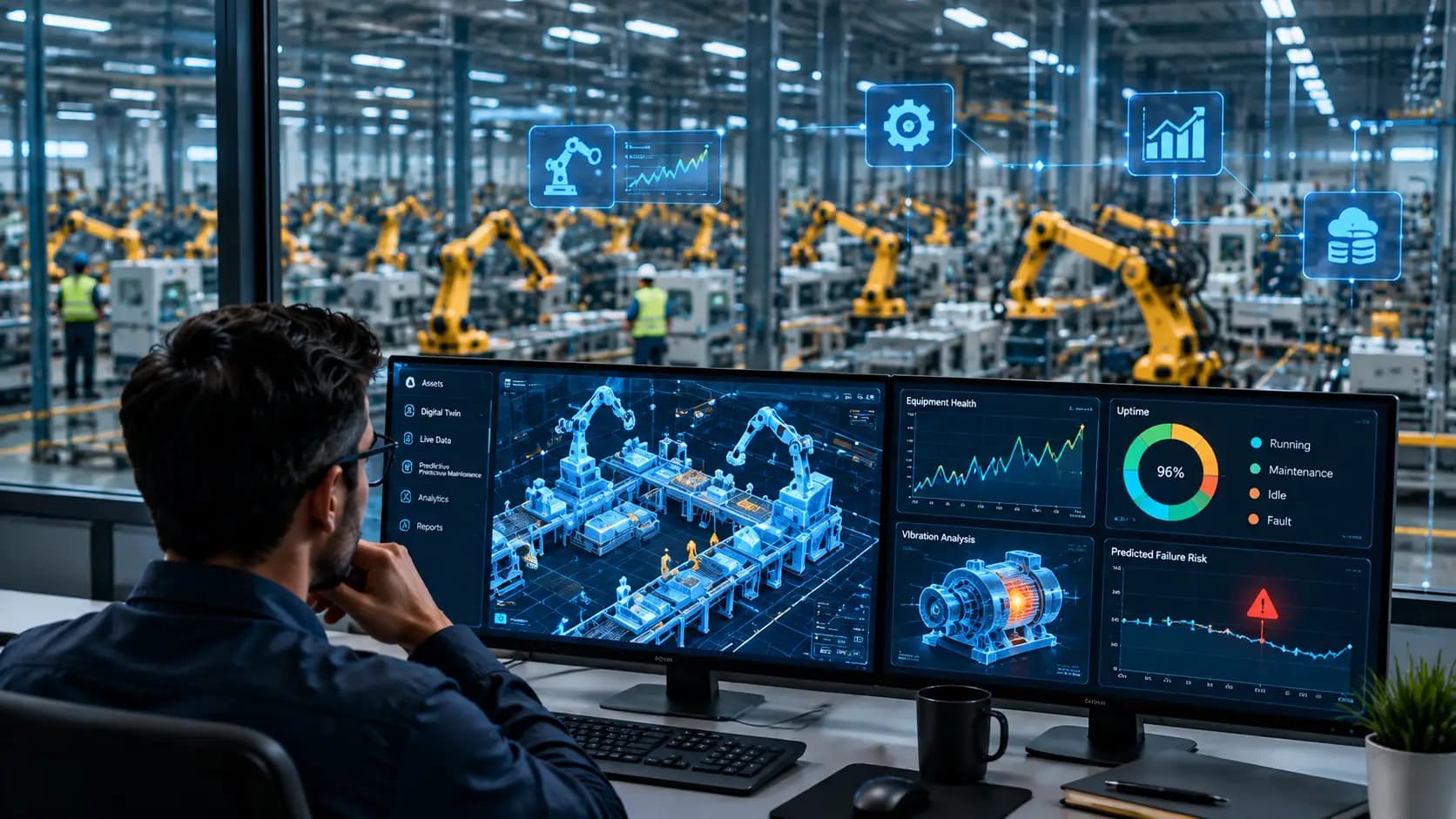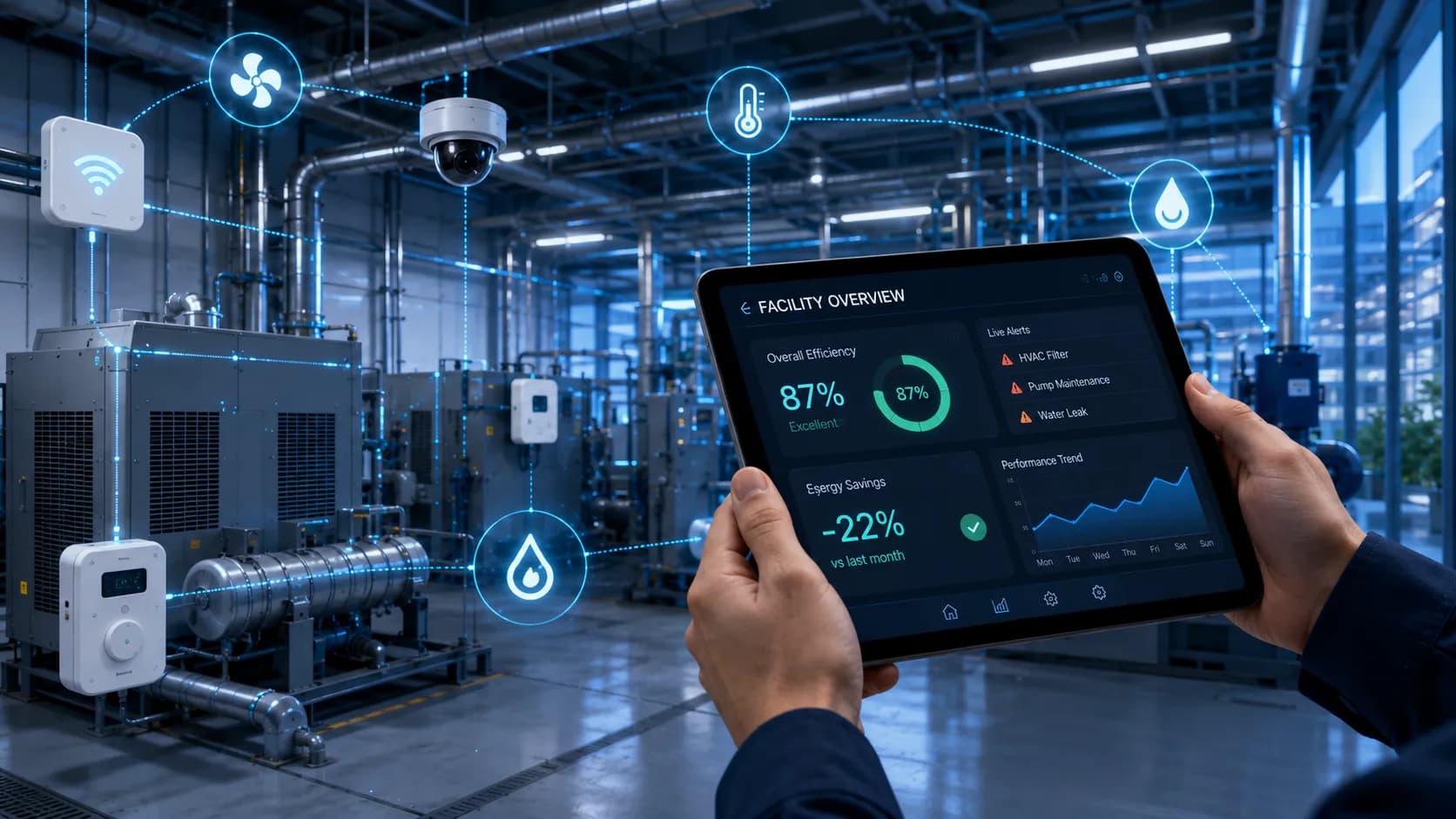
Many businesses around the world have their buildings well-connected, but their facility operations are still fragmented. Disconnected work-order processes, spreadsheets, siloed BMS, CMMS, IWMS platforms, and manual inspections can give your teams plenty of data but very limited operational context.
The result is often a gap between what a building can sense and what its operators can act on. This gap is the driving force behind why businesses are moving towards smart facility management. They are investing in edge computing, IoT sensors, AI/ML, cloud platforms, digital twins, data engineering, and automation altogether to turn facility data into actionable intelligence.
In a 2026 Johnson Controls survey, 65% of business leaders and 67% of facility managers said their organizations were already using AI to improve facility operations, maintenance, or utilization.
Better maintenance decisions, stronger resilience, more efficient buildings, and greater visibility across complex portfolios are the main goals behind adopting smart FM.
In this guide, we’ll see what smart facility management is, its architecture, use cases, challenges, and how to implement it for your organization.
Key Takeaways
-
Smart facility management combines IoT, connected building systems, AI, automation, and analytics to improve how facilities are monitored, maintained, and operated.
-
IoT in facility management provides data on energy use, assets, environmental conditions, and occupancy, creating the operational visibility needed for smarter decisions.
-
AI in facility management can analyze facility data to support fault detection, optimization, and more proactive operations.
-
Digital twins for facility management connect physical assets and building information with operational data, creating a richer digital representation of the facility.
-
Edge computing can process data closer to connected devices, making it useful for facility applications that require timely local responses.
-
High-value applications of smart FM include predictive maintenance, space utilization, energy optimization, safety monitoring, automated workflows, and fault detection.
-
A successful smart facility management system depends on integration, cybersecurity, reliable data, and a phased implementation strategy, and not only on technology deployment.
Traditional Facility Management vs. Smart Facility Management
There are some key differences between smart FM and traditional FM.
| Factors | Traditional FM | Smart FM |
|---|---|---|
| Maintenance | Reactive / Scheduled | Predictive / Condition-based |
| Data | Manual / Siloed | Connected / Real-time |
| Monitoring | Periodic | Continuous |
| Decision-making | Experience Driven | Data- and AI-assisted |
| Energy | Static Schedules | Dynamic Optimization |
| Asset Visibility | Building-level | Portfolio-wide |
| Workflows | Manual | Automated |
The distinction is way beyond simply replacing old tools with new ones. Smart facility management connects operational data across systems, so your team can prioritize interventions, identify conditions earlier, and coordinate responses.
AI-assisted predictive maintenance, for example, has been associated with a 35–45% reduction in total downtime in IBM's synthesis of predictive-maintenance benefits, although results vary by data quality, asset, and implementation.
The Shift From Reactive to Predictive Operations
Facility operations typically mature through five stages: reactive → preventive → predictive → prescriptive → autonomous. Each step moves maintenance decisions closer to real-time asset condition and, ultimately, automated action. Rather than full autonomy, the practical objective is to use IoT in facility management, analytics, and AI, where they can improve decision quality and reliability.
What Is Smart Facility Management?
Smart facility management uses connected technologies, including IoT, data analytics, AI, automation, and digital twins, to manage, monitor, and optimize buildings, operations, and assets using real-time or near-real-time data.
The operating model can be summarized as sensing, collecting, analyzing, predicting, acting, and continuously learning from operational data. The objective is to move from scattered information and reactive interventions toward more informed and proactive operational decisions.
What Makes a Facility "Smart"?
A facility is smart when it combines connected assets, interoperable systems, continuous data collection, analytics, automated workflows, and AI. The defining characteristic is not any single device or platform, but the ability to turn data from building systems and assets into operational insight and action.
Smart Facility Management vs. CMMS, IWMS and BMS
These technologies are complementary rather than interchangeable. A CMMS mainly focuses on maintenance operations and work management. An IWMS manages broader workplace, facility processes, and real estate. A Building Management Systems (BMS) or Building Automation and Control Systems (BACS) monitors and controls building systems. Smart FM connects these capabilities with IoT data, AI, analytics, and automation to create a more integrated operating model.
The Core Smart FM Technology Stack
The stack typically spans sensors and IoT → connectivity → edge computing → data platforms → AI and analytics → digital twins → automation. Together, these layers provide the foundation for AI-powered facility management and more connected smart building management.
Why Are Businesses Investing in Smart Facility Management?
Businesses are investing in smart facility management because facility operations sit at the intersection of asset reliability, cost control, workforce capacity, portfolio complexity, and sustainability.
Rising Facility, Energy and Maintenance Costs
Energy is a major operating consideration: the IEA estimates that buildings account for around 30% of global energy demand. For enterprises, the opportunity is not limited to reducing consumption; better operational data can also reduce avoidable emergency work, improve maintenance planning, and support better asset lifecycle decisions.
The Shift From Scheduled to Predictive Maintenance
Scheduled maintenance still has an important role, but condition-based and predictive approaches can help your team focus attention where asset data indicates greater risk. By combining IoT data, AI, and analytics, you can identify emerging equipment issues earlier rather than relying solely on fixed intervals or waiting for failures.
Workforce and Skills Shortages
Talent shortage is a persistent challenge that many facility teams face, with IFMA highlighting both skilled-labor shortages and an aging workforce. AI-assisted diagnostics, remote monitoring, and automated workflows can help extend the reach of specialized expertise without removing human accountability.
Sustainability and Building Performance Pressure
Energy efficiency, building performance, and decarbonization are becoming very important management priorities. Digital systems can provide the operational data needed to monitor performance and identify opportunities for improvement.
Increasing Multi-Site Facility Complexity
If your organization manages multiple buildings, fragmented systems and inconsistent data can make portfolio-wide visibility difficult. A connected smart facility management system can bring operational information together, creating a stronger foundation for centralized analytics, standardized processes, and more consistent decision-making across sites.
A 6-Layer Smart Facility Management Architecture
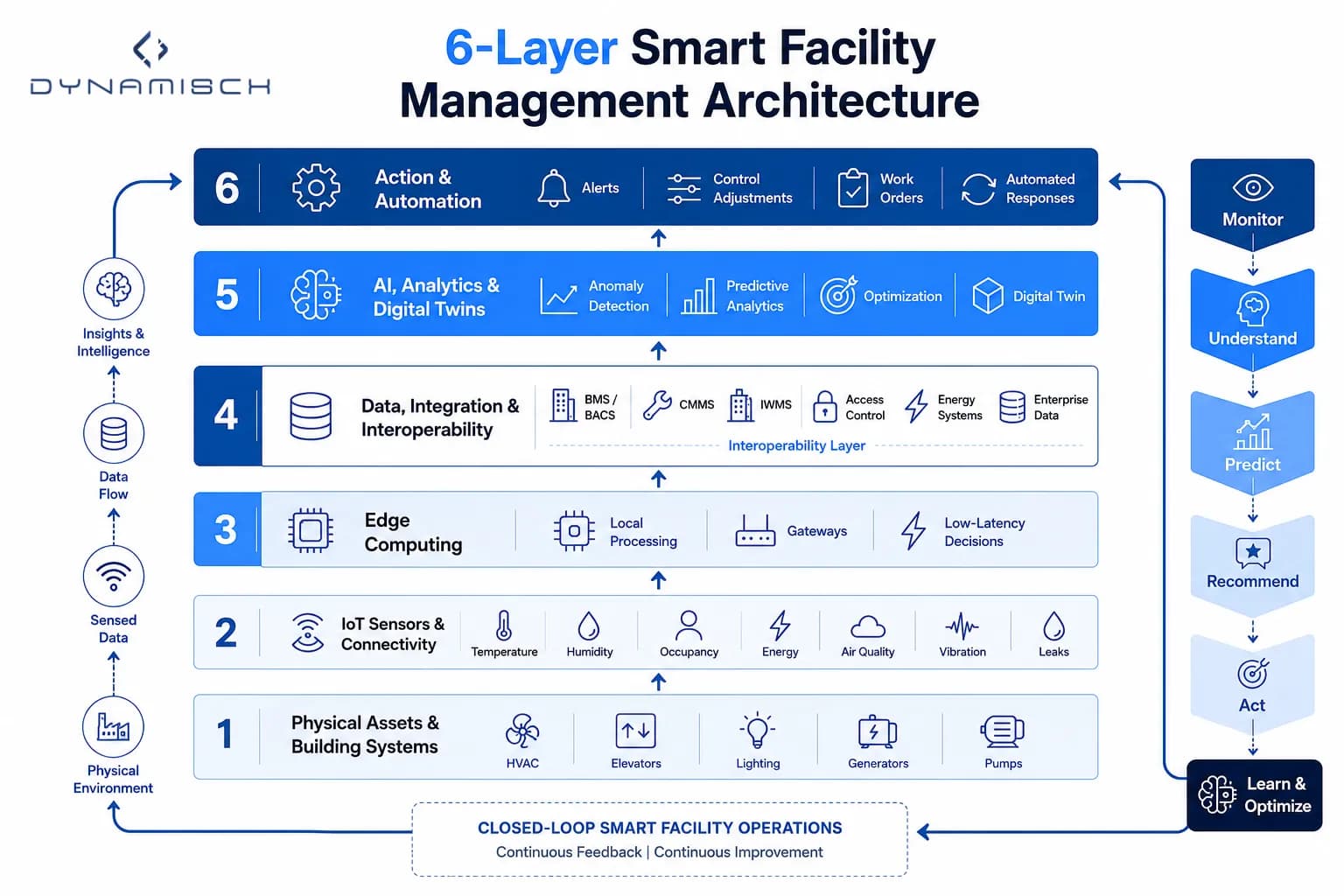
A layered architecture provides a useful way to understand how a smart facility management system works. Each layer turns physical conditions into really useful information and ultimately into operational action.
Layer 1: Physical Assets and Building Systems
This is the foundation layer. It includes HVAC, elevators, lighting, generators, pumps, and other critical equipment. Building controls already provide monitoring and control across many of these systems.
Layer 2: IoT Sensors and Connectivity
Sensors and connectivity form the next layer. Sensors capture conditions such as humidity, temperature, occupancy, energy use, air quality, vibration, and leaks. Connectivity makes those signals available to downstream applications and analytics.
Layer 3: Edge Computing
Edge processing places computation closer to devices and systems, reducing bandwidth requirements. It supports timely local analysis and reduces dependence on constant cloud connectivity for every decision that needs to be taken quickly.
Layer 4: Data and Integration
The architecture connects BMS/BACS, IWMS, CMMS, access control, energy systems, and enterprise data. Interoperability and semantic models are critical because building data is often heterogeneous and difficult to integrate at scale.
Layer 5: AI, Analytics, and Digital Twins
This layer transforms operational data into insights and recommendations. Analytics and AI support anomaly detection, predictive insights, and optimization. A digital twin can provide a synchronized digital representation of physical systems and support simulation, monitoring, and decision-making.
Layer 6: Action and Automation
The final layer closes the loop: Monitor → Understand → Predict → Recommend → Act. Actions may include alerts, control adjustments, work orders, or automated responses, subject to appropriate operational and cybersecurity safeguards.
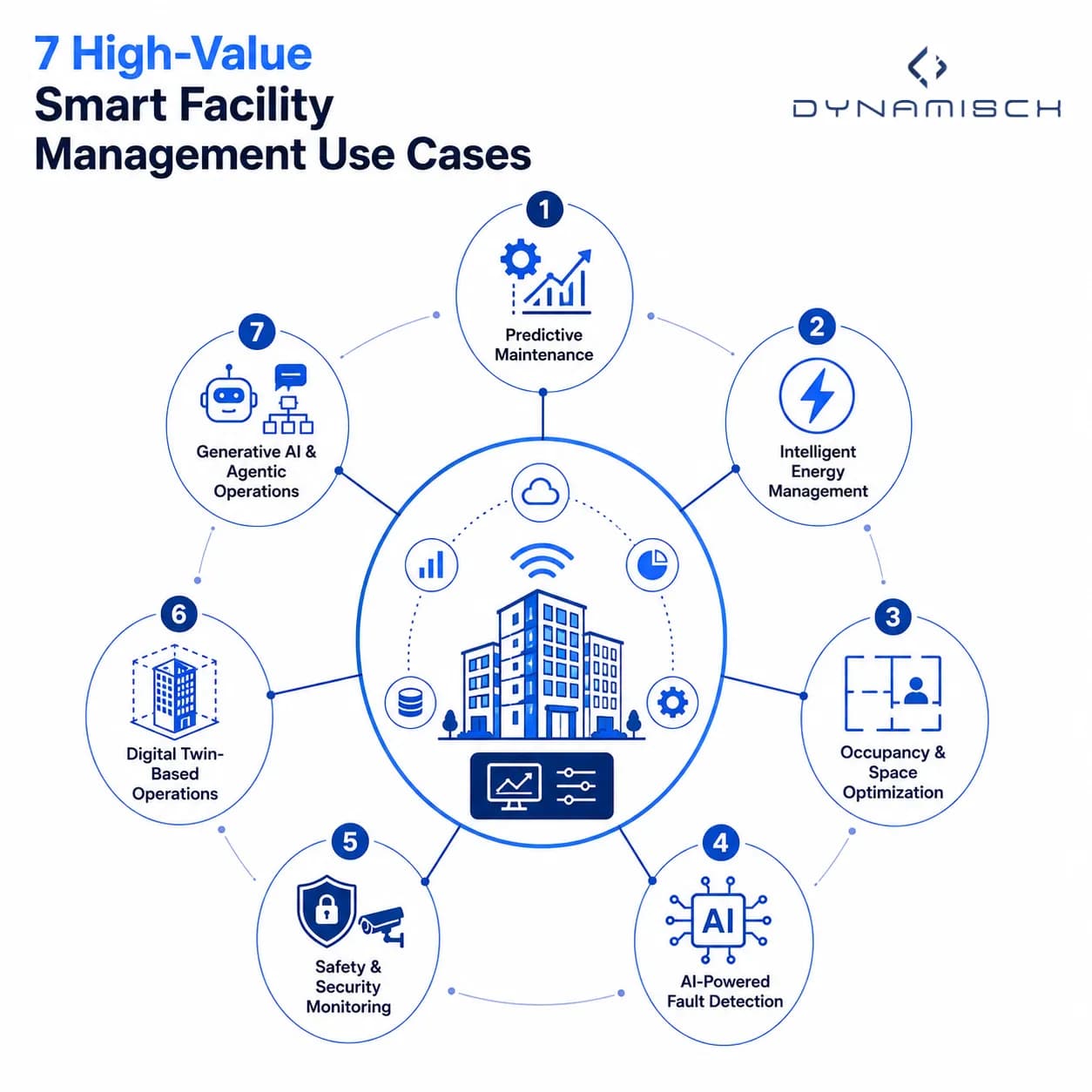
7 High-Value Smart Facility Management Use Cases
The strongest business cases for smart facility management emerge when connected building data is tied to a specific operational decision. The following use cases are among the most practical applications of IoT, automation, AI, digital twins, and analytics.
1. Predictive Maintenance
Predictive maintenance uses historical records, equipment condition data, current operating conditions, and analytics to identify signs of degradation before failure. In practice, this can support asset health monitoring, condition-based maintenance, anomaly detection, and earlier intervention. The value depends heavily on data history, sensor quality, and the criticality of the equipment being monitored.
2. Intelligent Energy Management
Smart building technology can combine environmental sensors, occupancy data, equipment telemetry, and building controls to optimize lighting, HVAC, and other energy-consuming systems.
The IEA reports that buildings account for around 30% of global energy demand, making operational efficiency a significant area of focus. DOE research also highlights advanced sensing, fault detection, controls, and optimization as important pathways for reducing building energy use.
3. Occupancy and Space Optimization
Occupancy sensing and spatial analytics can provide a more accurate view of how rooms and work areas are actually used. This can inform space planning and, where appropriate, dynamic control of lighting and HVAC.
For organizations managing hybrid workplaces or large property portfolios, the goal is to align physical capacity with observed demand and not rely solely on static assumptions.
4. AI-Powered Fault Detection and Diagnostics
Automated fault detection and diagnostics (AFDD) continuously analyzes building-system data to identify abnormal behavior and help diagnose its likely cause.
DOE describes AFDD as an advanced capability that can reduce the time required to identify faults compared with manual trend analysis. Applications of AFDD mainly include HVAC and other critical mechanical systems.
5. Safety and Security Monitoring
Computer vision, access-control data, and environmental sensors support applications such as restricted-area monitoring, incident detection, and environmental alerts.
These systems should be designed with privacy by design, appropriate data minimization, clear governance, and human oversight, particularly where monitoring can affect employees or other occupants.
6. Digital Twin-Based Facility Operations
A digital twin is used in facility management to bring together physical asset information, operational data, spatial context, and system relationships in a digital representation of a facility.
This helps in visualization, maintenance planning, scenario analysis, and lifecycle decisions. Its value increases when the underlying data is reliable and kept sufficiently synchronized with the physical environment.
7. Generative AI and Agentic Facility Operations
Generative AI can provide natural-language interfaces for facility data, assist with work-order workflows, and help technicians interpret documentation. More advanced agentic AI approaches can coordinate workflows across multiple systems, but enterprise adoption should progress carefully: human-in-the-loop → bounded automation → agentic workflows.
The objective should not be unrestricted autonomy but controlled orchestration. Any automated action affecting critical building systems should operate within validation rules, explicit permissions, and cybersecurity controls.
What Are the Business Benefits of Smart Facility Management?
A well-designed smart FM program can help organizations improve maintenance planning, manage energy more effectively, reduce avoidable downtime, and create better visibility across distributed facilities.
-
Lower Operating and Maintenance Costs: Connected asset data can help you prioritize maintenance based on actual equipment condition without relying only on fixed schedules. AI-assisted predictive maintenance has been associated with 25–30% lower maintenance costs and 35–45% lower total downtime in IBM's synthesis of predictive-maintenance benefits.
-
Better Energy and Sustainability Performance: Smart building management can combine controls, sensors, and analytics to identify inefficient operating conditions. The IEA estimate of buildings accounting for around 30% of global energy demand makes energy performance a significant enterprise concern.
-
Improved Asset and Portfolio Decisions: A connected smart facility management system can consolidate operational data across sites to help you track asset health, energy use, work-order performance, and portfolio-level trends. This creates a stronger basis for lifecycle planning and capital decisions.
-
Faster, Data-Driven Operations: AI and analytics can help your team move from manual investigation toward faster anomaly detection, prioritization, and decisions. The benefit is more than just data; it is better context at the point of decision.
-
Smart FM ROI Metrics: You should measure outcomes using metrics such as MTBF, unplanned downtime, MTTR, energy consumption, work-order completion time, maintenance cost per asset, space utilization, automation rate, and carbon emissions. These measures connect technology investment to operational and financial performance.
What Are the Challenges of Implementing Smart Facility Management?
The hardest part of smart facility management is integrating new capabilities into complex physical environments while maintaining security, reliability, privacy, and business continuity.
Legacy Systems and Technical Debt
Many organizations still rely on older building management systems (BMS), proprietary technologies, and outdated equipment that cannot connect with modern smart platforms.
Upgrading these systems requires integrating different technologies, adding new sensors, and carefully planning the transition. This makes the process more complex than simply installing new software.
Data Silos and Interoperability
A smart facility management system may need to connect CMMS, energy systems, BMS/BACS, access control, IWMS, and enterprise applications.
But inconsistent data models, proprietary interfaces, and limited APIs can make interoperability a significant architectural challenge. NIST's current digital-building work explicitly focuses on interoperable approaches for modern digital buildings.
Cybersecurity and IT/OT Convergence
Connecting building systems expands the cybersecurity boundary. Elevators, HVAC, lighting, and other building services are increasingly connected internally and externally, making access control, identity, secure device onboarding, lifecycle security, and network architecture essential considerations.
NIST's 2026 cybersecurity work on building systems reinforces that security must be addressed throughout the building lifecycle.
Privacy and Responsible AI
Occupancy analytics and computer vision can introduce privacy concerns, particularly when systems process information about employees or other visitors. Data minimization, appropriate retention, purpose limitation, and privacy-by-design should therefore be built into the architecture from the outset.
Scalability, Cost, and Skills
Upfront investment is only one consideration. You must also consider sensor deployment, integration, data engineering, cybersecurity, AI operations, change management, and multi-site governance. Scaling from one pilot to a portfolio requires repeatable architecture and operating models.
The Cost of Not Modernizing
The alternative to smart FM also carries costs like reactive maintenance, inefficient energy use, fragmented asset visibility, cybersecurity blind spots, and technical debt.
The potential value of predictive maintenance can be substantial, but published figures such as 35–45% reductions in unplanned downtime or around 30% lower maintenance costs should be treated only as indicative outcomes from specific implementations.
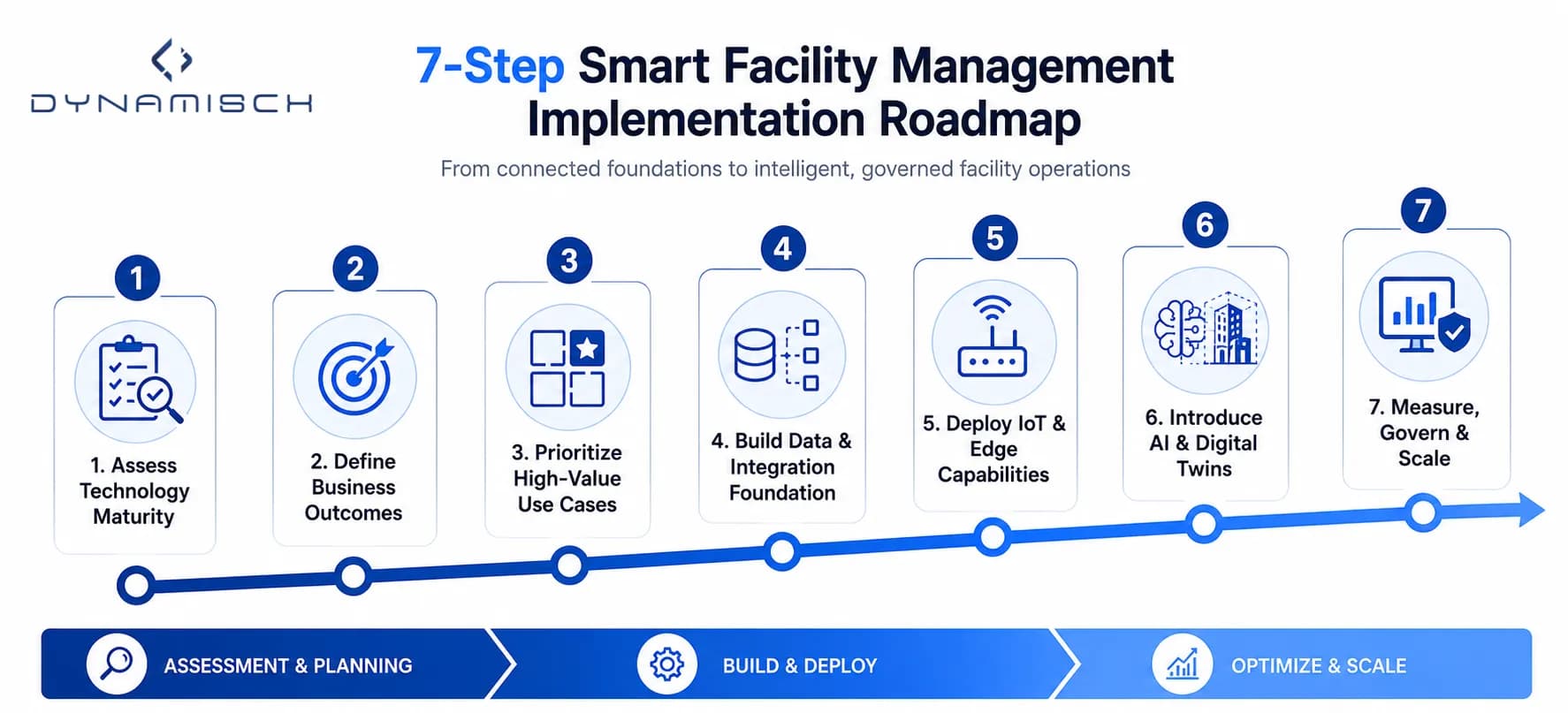
How to Implement Smart Facility Management: A 7-Step Enterprise Roadmap
A successful smart facility management program should be treated as an operating-model transformation. The strongest approach is to establish the data, security, integration, and governance foundations before scaling AI and automation.
Step 1: Assess Your Current Facility Technology Maturity
Create a baseline across physical assets, CMMS/IWMS, IoT devices, BMS/BACS, connectivity, integrations, data quality, and cybersecurity. Identify where information is available, where it is fragmented, and which systems constrain future integration.
Step 2: Define Business Outcomes
Translate technology ambitions into measurable objectives. The objectives could be reducing downtime, improving asset uptime, strengthening compliance visibility, enhancing occupant experience, or lowering energy consumption. Each initiative should have a clear baseline and success metric.
Step 3: Prioritize High-Value Use Cases
Rank opportunities using Business Impact × Data Readiness × Technical Feasibility × ROI. Start with critical equipment, energy-intensive systems, high-cost assets, or environments where failures carry significant operational consequences.
Step 4: Build the Data and Integration Foundation
Establish APIs, asset hierarchies, common data models, governance, data-quality rules, and integration patterns. Interoperability is a practical prerequisite for scaling smart building services; NIST identifies standardized, machine-readable building data as a key requirement for scalable analytics and automation.
Step 5: Deploy IoT and Edge Capabilities
Introduce sensors, connectivity, edge processing, device management, and gateways where they solve a defined operational problem. Avoid instrumenting assets simply to generate more data.
Step 6: Introduce AI and Digital Twins
Progress your smart facility management from visibility and analytics to prediction, prescription, and eventually automation. AI can support anomaly detection and prediction, while a digital twin can connect physical assets with synchronized digital representations and operational context.
Step 7: Measure, Govern and Scale
Track energy, MTTR, downtime, maintenance costs, MTBF, occupancy, carbon, and automation. Establish model governance, lifecycle controls, cybersecurity, and human oversight before expanding across the portfolio.
NIST's current building-systems work emphasizes that cybersecurity must be considered throughout the facility lifecycle as connectivity increases.
Smart Facility Management Technology Selection Checklist
Choosing a smart facility management system requires evaluating the architecture behind the product. Use this checklist when assessing platforms, integrators, and technology partners.
-
Integration: Can the solution connect with your existing CMMS, ERP, IWMS, energy, BMS/BACS, and access-control systems?
-
Interoperability: Does it support open interfaces, documented APIs, and appropriate industry standards? Interoperability and semantic data models can reduce the effort required to integrate building data and applications.
-
Scalability: Can the architecture move from a single facility to a multi-site portfolio without creating new integration silos?
-
Edge and Cloud: Can it support local processing where timely responses matter while using centralized infrastructure for portfolio analytics and management?
-
AI Readiness: Can the platform support reliable data pipelines for AI, predictive analytics, generative AI, and controlled agentic workflows?
-
Security and Governance: Assess device identity, data protection, lifecycle security, auditability, access controls, and the ability to manage risks introduced by connected IoT products.
-
Total Cost of Ownership: Evaluate hardware, cloud infrastructure, integration, licensing, cybersecurity, maintenance, and skills, not simply the initial software price.
The Future of Smart Facility Management Beyond 2026
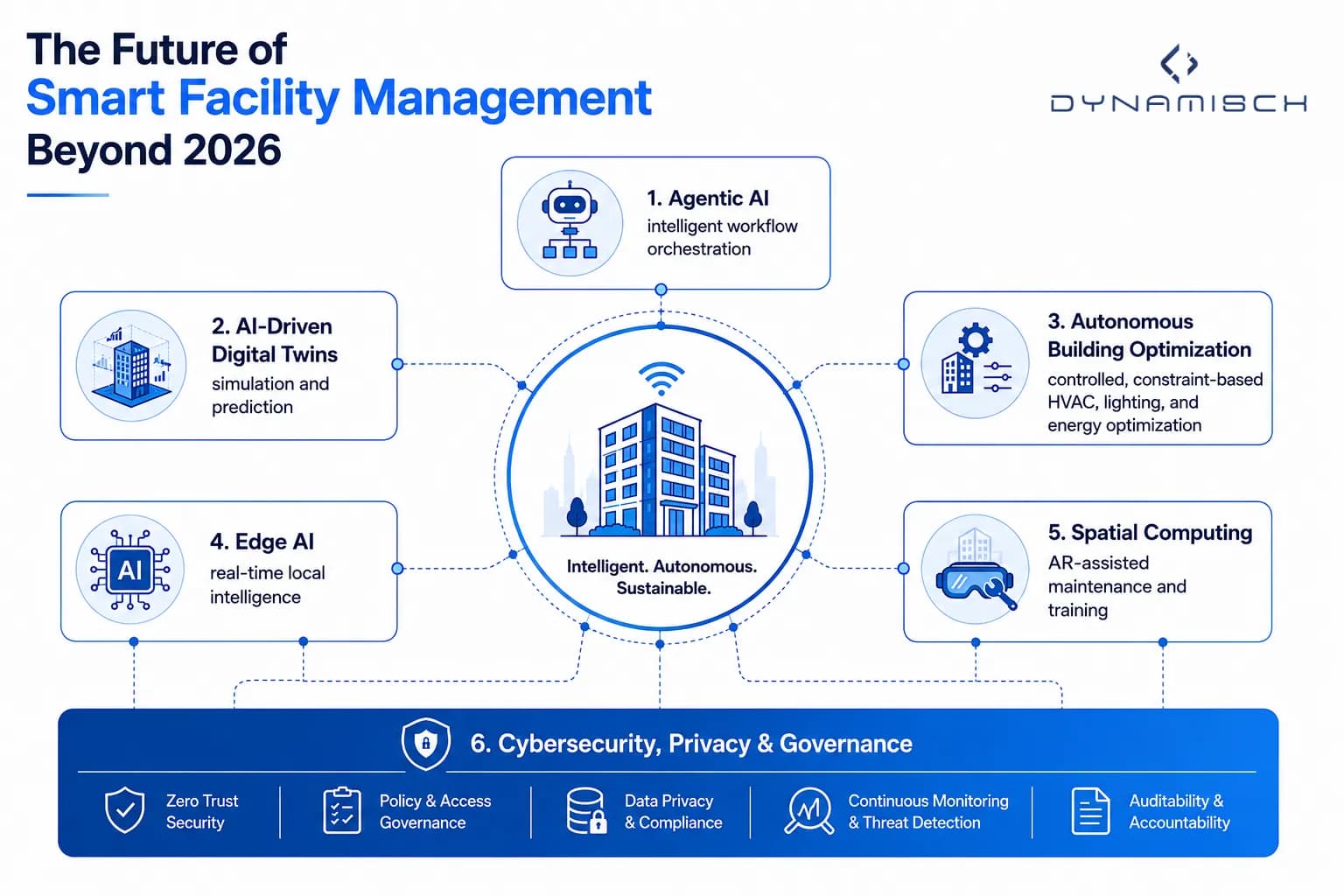
In the future, the success of smart facility management will be defined by connecting intelligence, automation, simulation, and security into a coherent operating model.
Agentic AI for Facility Operations
AI agents are expected to evolve from answering questions and analyzing data to recommending actions and, eventually, carrying out approved tasks across different facility systems.
However, high-risk actions should remain subject to explicit permissions and human oversight. NIST's 2026 work on AI-agent identity and authorization highlights the need to control what agents can access and do.
AI-Driven Digital Twins
Digital twins are likely to evolve beyond visualization toward simulation, prediction, and decision support. Forecasting is a foundational capability of digital twins, while also their potential for monitoring, simulation, and optimization.
Autonomous Building Optimization
As sensing, controls, and analytics mature, more building operations could become dynamically optimized across HVAC, energy, lighting, and maintenance, within defined operational and safety constraints.
Edge AI at the Facility Level
Edge AI can support low-latency applications such as real-time or near-real-time equipment monitoring, computer vision, and safety detection, processing inference workloads closer to where data is generated.
Spatial Computing for Facility Teams
AR and spatial interfaces could make remote expert assistance, digital work instructions, immersive training, and context-aware maintenance more practical for facility teams.
Cybersecurity Becomes Core Facility Infrastructure
As IT and operational technology converge, cybersecurity becomes part of the facility architecture itself. There will be a growing need to secure connected HVAC, elevators, lighting, and other building services throughout their lifecycle.
Final Thoughts
Smart facility management is an ecosystem in which IoT creates visibility into physical assets and conditions, edge computing can support timely data processing and decision-making, AI helps generate predictions and decision support, data engineering provides the foundation for reliable integration, digital twins add operational context, and automation turns insight into action.
NIST likewise identifies interoperable digital infrastructure and synchronized digital twins as foundations for scalable, intelligent building services.
For most enterprises, it's not a practical way to transform every facility at once. Start with measurable use cases, prove its value in operations, strengthen the data foundation, and then scale deliberately from reactive to connected and predictive to prescriptive and finally autonomous.
If you are looking for a team that can assess your Smart Facility Readiness, then Dynamisch can help you with our expertise in smart facility management.
Frequently Asked Questions

Sanket Prabhu
Vice President of Engineering
As Vice President of Engineering at Dynamisch, Sanket Prabhu stands at the intersection of Generative AI, Spatial Computing, and enterprise-scale innovation. With over 15 years of experience driving innovation across AI, XR, IoT, Digital Twins, and Gaming, he transforms emerging technologies into high-growth business engines. His leadership reflects both technical depth and strategic precision.