
Agentic AI enterprise implementation is one of the fastest-moving and most misunderstood challenges in technology right now. Organizations are deploying AI agents at record speed, yet only 11% of those agents run in production. The gap between ambition and execution is not a model quality problem. It is a data, governance, and infrastructure problem.
This article covers six structural realities that determine whether an agentic AI program reaches production or quietly gets shelved, drawn from the most current research and deployment data available in 2026.
Key Takeaways
- 79% of enterprises have adopted AI agents in some form, yet only 11% run them in production. The implementation gap is the defining challenge of 2026.
- Gartner predicts that by the end of 2027, more than 40% of agentic AI projects will fail or be cancelled due to escalating costs, unclear business value, or insufficient risk controls.
- 97% of enterprise leaders expect a material AI-agent-driven security or fraud incident within the next 12 months yet only 6% of security budgets are currently allocated to this risk.
- Agents that successfully reach production deliver an average 171% ROI the challenge is not agent intelligence; it's the infrastructure and governance that separates success from failure.
- 46% of organizations cite integration with existing systems as their primary implementation challenge, ahead of model quality, cost, and even data readiness.
- Organizations lacking AI governance policies pay an average of $670,000 more per breach and 63% of breached organizations had no AI governance policies in place at all.
Why Agentic AI Enterprise Deployment Is Failing in 2026
Agentic AI is no longer a research prototype or a vendor pitch. It is running inside enterprise environments today scheduling tasks, querying databases, executing multi-step workflows, and taking actions across systems without waiting for a human to approve each step. The shift from AI that responds to AI that acts is one of the most consequential architectural changes to hit enterprise technology in a decade.
That acceleration is creating a dangerous gap. Most organizations are deploying agents faster than they are building the infrastructure, governance, and data foundations those agents actually need to function reliably. The result is a landscape where ambition is high, production rates are low, and the failure modes are increasingly costly.
Asking which AI model to use is the wrong first question. The right question is: are your data, your governance, and your security posture ready to support an autonomous system that acts on your behalf ,inside your most sensitive enterprise systems?
Let’s look at the six structural realities that separate agentic AI implementations that reach production from those that quietly get shelved.
1. Enterprise Data Architecture Is Not Ready for Agentic AI
Enterprise data architectures were built for a different era. Most organizations run on extract-transform-load (ETL) pipelines, data warehouses, and reporting systems optimized for human analysts who query data on request.
Agentic AI has a fundamentally different relationship with data: it needs to understand context, make inferences, and retrieve the right information at the right moment without being told exactly where to look.
A 2025 Deloitte survey found that nearly half of organizations cited the searchability of data (48%) and reusability of data (47%) as the primary challenges to their AI automation strategy.
These are not data quality problems in the traditional sense. They are architectural problems. The data exists; it is just not positioned to be consumed by a system that needs to understand business context and make decisions.
The solution involves a shift from traditional data pipelines to what practitioners describe as enterprise search and indexing making organizational data discoverable through knowledge graphs and contextual indexes, rather than pre-defined ETL workflows.
Think of it as applying the logic of Google Search to your internal data estate. Agents cannot use data they cannot find, and they cannot act correctly on data that lacks context.
What To Do Before You Start
Conduct a data discoverability audit before agent deployment, not after. Map which systems your intended use cases will need to query, assess how searchable and machine-readable that data actually is, and identify where contextual metadata is missing.
A retrieval-augmented generation (RAG) architecture with a proper semantic layer, rather than a direct prompt against raw data, is currently the most reliable approach for grounding agent decisions in accurate enterprise information.
Organizations waiting for a perfectly clean data estate before deploying agents will wait indefinitely. The goal is not perfect data; it is data that is discoverable, contextual, and auditable enough to support the specific use cases you are starting with.
2. Agentic AI Multiplies Your Enterprise Security Attack Surface
Traditional enterprise security was built around an assumption: threats come from humans, either external attackers or internal actors. Security frameworks were designed to authenticate people, assign them roles, and monitor their actions. Agentic AI breaks that model entirely.
An AI agent operating inside your enterprise is a non-human identity with API credentials, access to production systems, and the authority to act without direct human instruction.
It can read sensitive documents, initiate transactions, trigger workflows, and interact with external services, all through channels that most identity management and security monitoring systems were never designed to observe.
The numbers here are not subtle. A global survey of 300 enterprise leaders conducted in early 2026 found that 97% of respondents expect a material AI-agent-driven security or fraud incident within the next 12 months.
Nearly half expect one within six months. Yet only 6% of security budgets are currently allocated to this category of risk. The threat is clearly understood. The preparation is not.
The insider threat of 2026 does not need badge access. It already has API credentials. Every agent introduced into an enterprise environment is a non-human identity that needs to be secured and most organizations are not yet equipped to handle that at scale.
The OWASP Top 10 for Agentic Applications, released in December 2025, is the first security framework dedicated specifically to autonomous AI systems.
Its top-ranked risk, Agent Goal Hijacking, describes a class of attack where malicious instructions are embedded in data the agent processes, causing it to execute harmful actions while appearing to function normally. Prompt injection, privilege escalation through API abuse, and cross-agent data leakage complete the top tier.
Organizations that treat agentic AI as a standard software deployment and apply existing security controls without modification are accepting risk they have not quantified. Zero-trust identity management extended to non-human identities is the baseline requirement, not a future improvement.
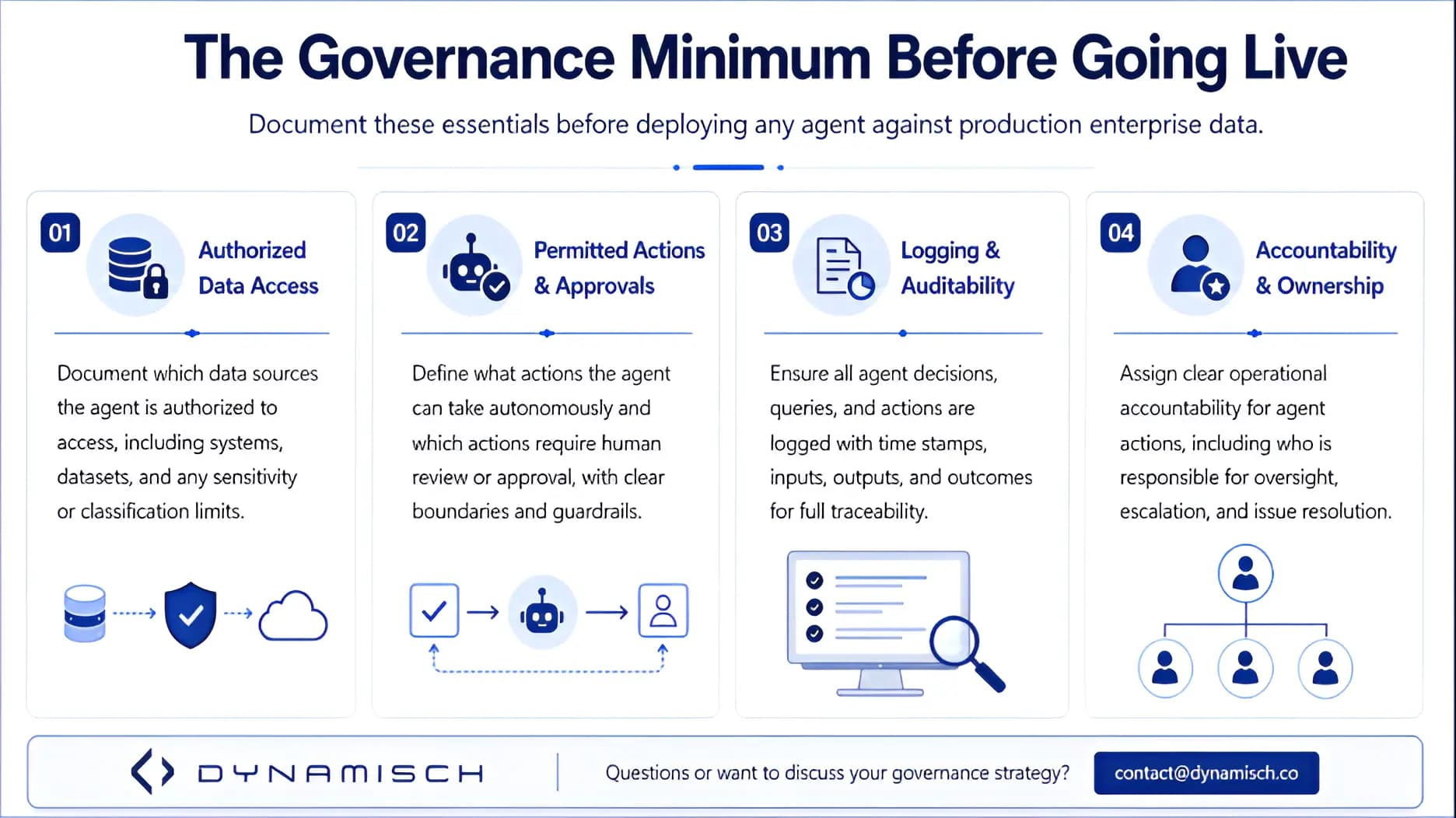
3. AI Governance Framework Must Come Before Agentic AI Deployment
The natural instinct in most enterprise AI programs is to deploy something, see what happens, and build governance around what you observe. With traditional software, it is inefficient but recoverable. With agentic AI, it is genuinely dangerous.
An autonomous system that takes actions across your enterprise data creates accountability questions that are structurally different from any prior technology category.
When an agent queries the wrong dataset, drafts a contract with incorrect terms, or routes a customer case through the wrong process, who is responsible? What is the audit trail? What were the boundaries the system was authorized to operate within? If those answers do not exist before deployment, they will not be easier to construct after an incident.
McKinsey's 2026 AI Trust Maturity Survey, drawing on approximately 500 organizations, found that only about one-third of organizations report maturity levels of three or higher in governance and agentic AI controls.
Governance and agentic AI oversight were the two dimensions lagging furthest behind the technical implementation capabilities of the same organizations, a consistently global pattern across all regions surveyed.
IBM's research adds a financial dimension: organizations lacking AI governance policies pay an average of $670,000 more per breach. And 63% of breached organizations had no AI governance policies in place at all. The cost of retrofitting governance after an incident is substantially higher, financially and reputationally, than building it before deployment.
4. Enterprise System Integration Is the Real Agentic AI Bottleneck
The most common question in enterprise agentic AI programs is "which model should we use?" It is also, by a wide margin, the least important question to resolve first.
Across independent surveys and analyst research from 2025 and 2026, a single challenge dominates all others as the primary barrier to successful agentic AI deployment: integration with existing enterprise systems.
The 2026 State of AI Agents report found that 46% of organizations cite this as their primary challenge, ahead of security concerns, data quality, cost, and model selection combined.
The reason is structural. Enterprise environments are built on decades of accumulated systems: CRMs, ERPs, ticketing platforms, identity stores, data lakes, communication tools, and proprietary internal APIs, many of which were never designed to expose their data to an external autonomous system.
An agentic AI platform that cannot securely and reliably read from and write to these systems is, regardless of how capable the underlying model is, an impressive demonstration that delivers no operational value.
Multi-agent architectures, which represent 66.4% of enterprise agentic deployments according to Market.us, add a layer of complexity. How does a data analysis agent hand off findings to a workflow automation agent? How do they resolve conflicts? How does the orchestration layer manage agent handoffs without losing context or creating permission gaps?
These are engineering problems, and they require engineering investment before the first agent is pointed at production data.
Technology is not the bottleneck. Integration, workflow redesign, real-time data architecture, and organizational change are. Vendor selection is the start of the work, not the end of it.
The Model Context Protocol (MCP), which reached 97 million downloads within months of its release, is emerging as a critical infrastructure layer for agent-to-system integration, providing standardized connections that allow agents to interact with enterprise data sources through governed, auditable channels.
Organizations investing early in MCP-compatible integration architecture are building the foundation that multi-agent systems will depend on at scale.
5. Human-in-the-Loop Oversight Cannot Scale Without the Right Infrastructure
Human-in-the-loop is the oversight model most enterprises plan for when they begin agentic AI programs. A human reviews agent decisions before they are executed. It sounds like a responsible guardrail. In practice, it rarely survives contact with operational reality.
Agents operate at a speed and scale that human review cannot match. An agentic system handling customer inquiry, processing data requests, or managing workflow queues will make thousands of decisions per day.
The humans assigned to review those decisions face a volume problem: review becomes cursory, then symbolic, then effectively absent, not through negligence, but through the fundamental limits of human attention at production scale.
This is not a failure of discipline. It is a structural reality that leading practitioners have named explicitly. The more effective model, increasingly called human-on-the-loop, shifts the human role from approving individual decisions to setting policies.
It defines boundaries, monitors for anomalies, and intervenes when the system operates outside expected parameters. The agent executes. The human governs.
The practical implication is that organizations need to design for the oversight model that will actually operate in production, not the one that feels most comfortable in a planning document.
That means investing in observability infrastructure tools that give humans meaningful visibility into what agents are doing, where they are deviating from expected behaviour, and which decisions are approaching the boundaries of their authorization.
Organizations that deploy agents under the assumption that human review will provide meaningful oversight, without the tooling to support that review at scale, will find themselves operating without effective oversight at all within weeks of going live.
6. Why 88% of Agentic AI Implementations Fail and What the 12% Do Differently
The headline statistic for agentic AI in 2026 is uncomfortable: 88% of AI agents fail to reach production. That number comes from a broad dataset of enterprise deployments and reflects the reality that the path from proof-of-concept to reliable, production-grade agentic systems is significantly harder than most organizations anticipate when they begin.
The same data carries an equally important counterpoint. The 12% that do reach production deliver an average of 171% ROI, and 192% in U.S. enterprises. The technology, when implemented correctly, delivers on its promise. The challenge is implementation, not the underlying capability.
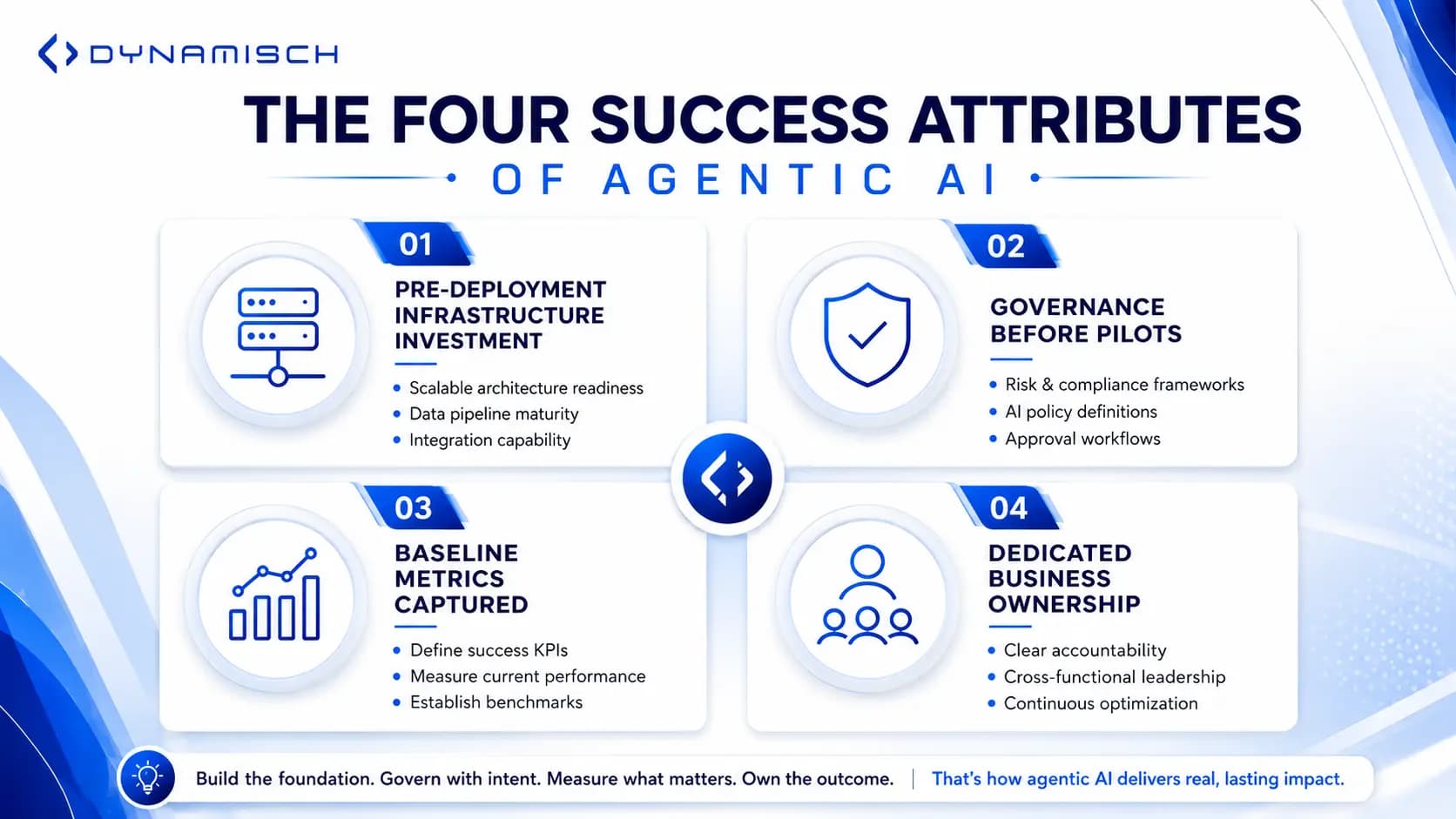
Research into what distinguishes the organizations that succeed from those that do not reveals a consistent set of four attributes shared by successful deployments:
- Pre-deployment infrastructure investment. Successful implementations build the data architecture, integration layer, and security controls before the first agent is deployed against production systems, not in parallel.
- Governance documentation before pilots begins. Authorization boundaries, audit requirements, and accountability structures are defined and documented in advance of the first production use case.
- Baseline metrics captured before deployment. Organizations that succeed measure the performance of the processes being automated before deployment, so they can quantify improvement, and detect when agents underperform or drift from expected behaviour.
- Dedicated business ownership with post-deployment accountability. Agentic AI deployments that succeed have a named business owner accountable for outcomes, not just a technical team accountable for uptime.
Gartner projects that by 2028, 33% of enterprise software applications will contain agentic AI capabilities, up from less than 1% in 2024. That trajectory is real. But Gartner also projects that by the end of 2027, more than 40% of agentic AI projects will be cancelled or fail due to escalating costs, unclear business value, or insufficient risk controls.
Both things are true simultaneously, and the difference between ending up in the 33% and the 40% is determined by decisions made before deployment begins, not after.
Final Thoughts on Agentic AI Enterprise Readiness
Agentic AI is not a capability question anymore. The models exist. The tooling exists. The documented use cases and ROI evidence exist. What is missing in most enterprise programs is the foundation that lets those capabilities operate reliably at production scale.
This means data architecture built for machine consumption, and security posture extended to non-human identities. It also means governance defined before deployment, and integration infrastructure that connects agents to the systems they need to act on.
Finally, it requires oversight models that scale, and a structured approach to implementation that learns from what the successful 12% already know.
The organizations getting ahead in 2026 are not the ones with the most ambitious AI strategies. They are the ones who spent time on the unglamorous infrastructure work before pointing an autonomous system at their enterprise data.
Agents that act on your behalf, inside your most sensitive systems, at a speed no human can review that is a significant capability. It deserves a foundation built to support it.
Deploying agentic AI on enterprise data requires the right foundation before the first agent goes live. Our team helps organizations assess data readiness, build governance frameworks, and engineer agentic systems that reach production reliably. Talk to our AI engineers.
Frequently Asked Questions

Mushtak Gadkari
AI/ML Lead
Mushtak is the AI/ML Lead with extensive experience in Machine Learning, Deep Learning, Natural Language Processing, Generative AI, and Agentic AI. He specializes in delivering robust end-to-end intelligent solutions - from model development and fine-tuning to scalable production deployment.