
Ninety-five percent of enterprise generative AI pilots deliver no measurable profit and loss impact, according to MIT's 2025 NANDA research. IDC has put the proof-of-concept-to-production failure rate at 88 percent. RAND's analysis of AI project outcomes found a failure rate above 80 percent, roughly double that of conventional IT projects. Three separate research bodies, three different methodologies, one consistent signal: production is where AI pilots go to die.
The instinct is to blame the model. That's rarely the actual cause. Most pilots fail because nobody engineered the path from a controlled demo into a live environment full of inconsistent data, legacy APIs, and workflows that were never designed to accommodate a new system, let alone a non-deterministic one.
We call this the integration wall: the point where a pilot's assumptions stop holding. It's invisible during the demo, because demos are built on curated data with a small, forgiving user group. It becomes visible the moment real data, real systems, and real ownership requirements enter the picture. What follows breaks down what the wall actually is, why it stays hidden until it's too late, and what it takes to get past it.
Key Takeaways
- 88% of AI proofs-of-concept never reach wide-scale deployment, roughly 4 in every 33 launched (IDC, 2025).
- AI project failure rates exceed 80%, about double the failure rate of non-AI IT projects (RAND Corporation, 2025).
- 42% of companies abandoned most of their AI initiatives in 2025, up from 17% in 2024 (S&P Global Market Intelligence).
- Most pilots fail from unresolved integration, ownership, and data issues, not from poor model performance.
- The "integration wall" is the point where a pilot must connect to real production systems: legacy APIs, authentication layers, permissioning, and live workflows it was never tested against.
- Six recurring failure points: no real business case, no named production owner, no workflow integration, demo data instead of production data, late governance, and no testing for failure modes.
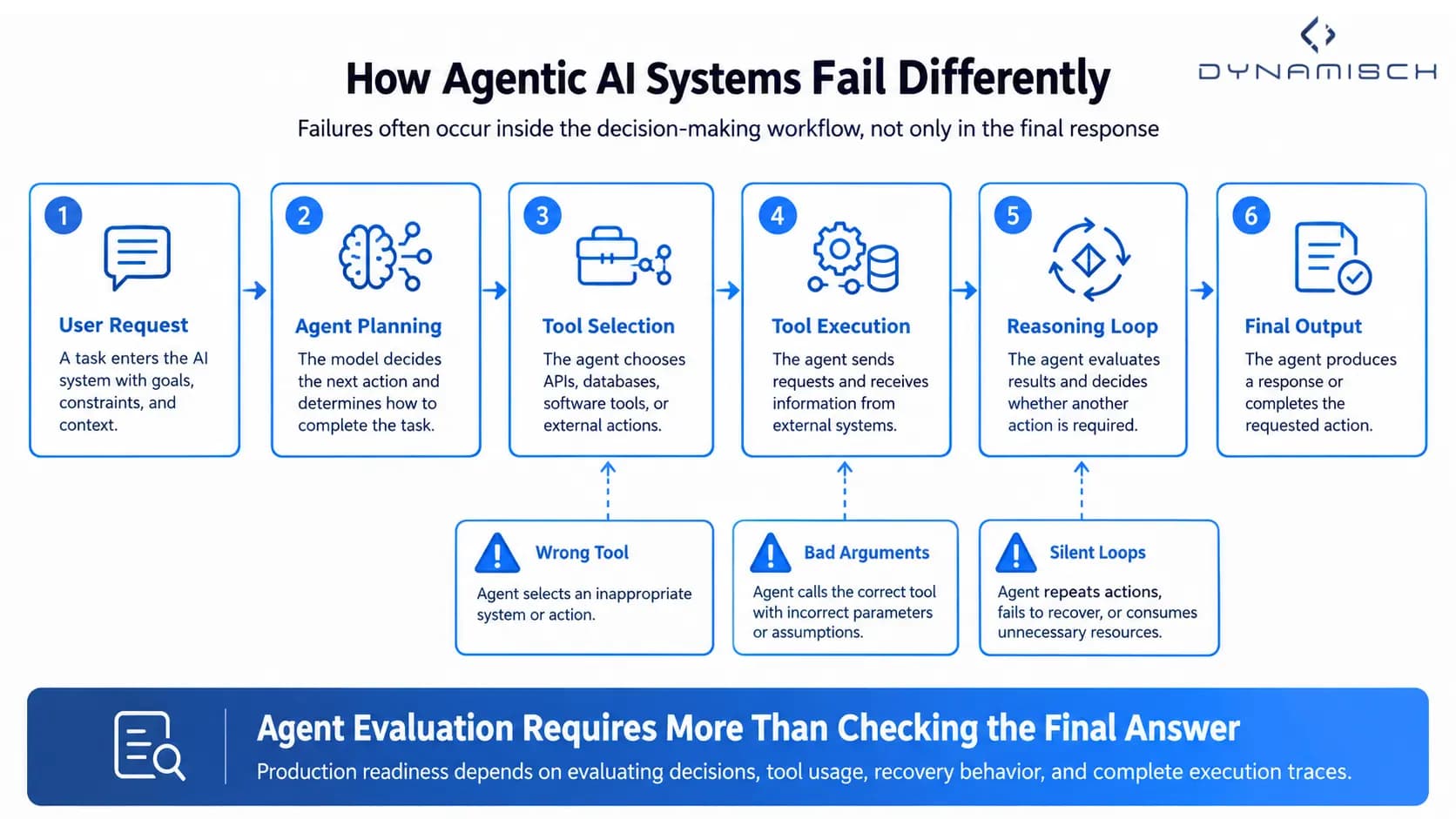
- Agentic AI systems fail differently: errors happen mid-process (wrong tool, bad arguments, silent loops) rather than in a visible final output, making them harder to evaluate and sign off on.
- Breaking through requires five decisions made early: define the business metric, design the integration point, test on real data early, build governance in from day one, and name a production owner before launch.
- Forward deployed engineering closes the gap by keeping the same team accountable from pilot through legacy integration, data pipeline work, and handoff to a named owner.
What Is the "Integration Wall" in AI Deployment?
The integration wall is the point where an AI pilot, built on curated data and a narrow, controlled scope, has to connect to real production systems: legacy APIs, authentication layers, permissioning rules, and live workflows it was never tested against.
That connection is where most enterprise AI pilot failure actually happens, not in the model's accuracy, but in everything the model has to plug into.
Why it's called a "wall" and not a "gap"
Many industry writings call this a "pilot-to-production gap," which is a misleading way to describe it. A gap implies distance: keep moving, and eventually you close it. A wall implies something specific and structural in the way, something you have to identify and engineer around, not just push through with more budget or time.
It is something that matters when enterprises plan AI initiatives. Teams treating this as a gap tend to respond by extending the pilot, waiting for the model to improve, or adding more testing cycles.
Teams that recognize it as a wall ask a different question: which specific dataset, system, or workflow dependency is blocking this from going live, and what needs to be built to get past it.
The second framing is the one that actually produces a path to enterprise AI integration that works.
The Numbers: How Common Is This Problem, Really?
The short answer is that pilot failure isn't the exception; it's the baseline outcome, confirmed by four separate research bodies using different methodologies.
| Source | Year | Metric measured | Figure |
|---|---|---|---|
| MIT Project NANDA | 2025 | GenAI pilots with no measurable P&L impact | 95% |
| IDC (with Lenovo) | 2025 | AI proofs-of-concept that never reach wide-scale deployment | 88% |
| RAND Corporation | 2025 | Enterprise AI projects that fail to deliver intended business value, roughly double the failure rate of non-AI IT projects | 80%+ |
| S&P Global Market Intelligence | 2025 | Companies that abandoned most of their AI initiatives, up from 17% in 2024 | 42% |
These numbers get quoted interchangeably, which is a mistake, because they're measuring different things.
MIT's figure is about value delivered after deployment rather than deployment itself. IDC's 88% is specifically about pilots that never make production at all, or, as its research puts it, for every 33 AI proofs-of-concept a company launches, only four graduate.
RAND's figure covers the full AI project lifecycle instead of just generative AI pilots, and includes projects abandoned at any stage. S&P Global's 42% tracks abandonment rates year over year, and the jump from 17% is the more alarming data point: enterprises aren't just struggling to get pilots to production; they're walking away from them faster than they did twelve months earlier.
Read together, these figures describe the same underlying pattern from four angles: pilots are cheap and easy to start, and expensive and hard to finish.
Why "The Model Isn't the Problem" Keeps Coming Up
MIT's Project NANDA report on the GenAI Divide is direct about this: the divide isn't driven by model quality or regulation; it's driven by what the researchers call a "learning gap." Many generative AI systems don't adapt to context, retain feedback, or improve with use, which means they can run correctly and still never become a real business capability.
Several experienced engineers describe the same failure from the ground up. In an MLOps thread on r/ArtificialIntelligence, engineers pointed to a pattern that has nothing to do with model accuracy: pilots get built with the most complex version of every layer in the stack, before anyone has confirmed the use case is worth solving. One engineer called it "resume-driven development," teams building sophisticated architecture to prove technical skill, not to serve a validated business need.
That's the real story behind why AI pilots fail to reach production. The technology performs as advertised in the demo. What's missing is a defined problem, a workflow it needs to fit into, and a path that was engineered before the pilot was built, not after it succeeded.
The Real Reasons AI Pilots Hit the Wall
Most explanations of why AI pilots fail to reach production stop at generic categories like "technical debt" or "change management." The real picture is more specific. Across developer accounts, research, and enterprise engineering experience, six recurring failure points show up again and again.

Reason 1: The Business Case Was Never Real
Ask what metric the pilot was supposed to move, by how much, and by when. If nobody can answer cleanly, the pilot was never really a business initiative; it was a demonstration.
This shows up constantly in professional discussions. In a Reddit thread on r/ArtificialIntelligence where MLOps engineers discussed pilot failure, one contributor put it bluntly: most LLM pilots exist so a leadership team can say they're "doing AI," with no cost analysis or defined impact attached. Another described the pattern as engineering teams building the most technically complex version of every layer in the stack before anyone had validated a use case worth solving, calling it "resume-driven development."
Few organizations run the full cost math before greenlighting a pilot: the combined salaries of ML engineers, data scientists, and MLOps staff, plus infrastructure spend, plus the opportunity cost of the time spent.
Fewer still run that math after the pilot to check whether it was worth it. Without a named metric and an honest cost comparison, there's no way to know if a pilot succeeded, which means there's no case for funding its move to production.
Reason 2: No One Owns Production
A pilot has a builder. Production needs an owner, and those are not the same role.
Ownership means three concrete things: budget authority to fund the system past launch, a committed production date, and a named escalation path when something breaks. Without all three, a successful pilot has nowhere to go. The engineer who built it moves to the next project, the executive sponsor moves to the next priority, and the system sits in what practitioners increasingly call "pilot purgatory."
This has to be decided before the pilot starts, not after it proves itself. Waiting until a pilot succeeds to ask who will own it in production means starting that conversation from zero, at the exact moment momentum is hardest to rebuild.
Reason 3: The AI Was Never Integrated into the Actual Workflow
There's a meaningful difference between an AI tool being available to use and an AI system being embedded in how work actually gets done. Most pilots achieve the first and never reach the second, which is the core of the integration wall.
Technically, this is where things break in identifiable ways:
- Authentication for machine callers: Legacy systems were built assuming a human logs in through a UI. An AI agent calling that same system through an API needs its own permissioning, credentialing, and audit trail, which often doesn't exist yet.
- Rate limits: Systems sized for occasional human queries choke when an agent calls them repeatedly in a workflow loop.
- Schema drift: Pilots are built against a data schema frozen for testing. Production schemas change, and brittle integrations break silently when they do.
- API contracts never designed for non-human callers: Many enterprise APIs were built for predictable, low-volume human use, not for an agent making decisions about when and how often to call them.
One user in the same Reddit discussion pointed to a related and often-overlooked cause: operations and DevOps teams get brought in too late. A simple AI demo can quickly turn into a production system that needs monitoring, version control, and regular maintenance. These requirements should be planned from the beginning instead of being added at the last minute.
Reason 4: Production Data Is Not Demo Data
Pilots run on curated datasets, often hand-selected to represent the best-case scenario. Production data is incomplete, inconsistent, constantly changing, and duplicated across systems. A model that performs well against a curated pilot dataset is being tested against conditions it will rarely see again once it's live.
Data readiness for production is a specific, checkable list, not a vague aspiration:
- Reliable access to the systems holding the data, not a one-time export
- Permissioning that matches who and what is allowed to see which fields
- Schema consistency across the sources the system depends on
- Data freshness that matches the decision the AI is being asked to make
Skipping this step is one of the most consistent findings across enterprise AI research: IDC's research points to insufficient AI-ready data as a leading reason pilots never convert to full deployment.
Reason 5: Governance and Security Arrive Too Late
In many organizations, governance is treated as a checklist to clear right before launch. They don't consider it a factor that shapes how the system gets built. That ordering causes the problem.
By the time a pilot moves to production review, legal and compliance teams usually need to see three things: a record of what the system did and why, clear access controls showing who can perform which actions, and an explanation of decisions that impact customers, employees, or regulated processes.
If none of that was built into the architecture from the start, it has to be retrofitted, and retrofitting governance into a system that was never designed for it is significantly slower, harder, and more expensive than designing for it upfront.
Reason 6: Nobody Tested What Happens When It's Wrong
A pilot proving high accuracy in a demo is not the same as a system that is safe to run unsupervised. Many pilot evaluations stop at the first question and skip the second entirely.
One use in the Reddit discussion illustrates this well: an agentic system built for a client went live and, within ten minutes, users had already started probing it with unusual input. Each request triggered the full agentic workflow, running SQL queries and other downstream actions, and vague or adversarial dialogue ended up costing the company several dollars per request, a cost nobody had modeled before launch.
This is the argument for defining escalation paths and human-in-the-loop review as part of the initial design, not as a response after something goes wrong in production. Testing what a system does when it's confidently incorrect, or when someone deliberately tries to break it, is not optional hardening. For any system making decisions or taking actions with real consequences, it's part of what "production-ready" actually means.
Why Agentic AI Hits the Wall Differently Than Traditional Models
Agentic AI failure follows a different pattern than a standard model failing in production, and it's worth understanding why before scaling one.
The Non-Deterministic Core Problem
An agent doesn't return one prediction; it makes a sequence of decisions, and each one can vary. One engineer in a widely shared MLOps discussion on Reddit described the practical effect: once you build a system around a non-deterministic core, handling every edge case becomes its own project, and at some point the effort required makes you question whether AI was the right tool for the task at all. For narrow, well-defined tasks, a conventional software approach is often simpler and more reliable.
Agents Fail in the Middle, Not at the Output
A traditional classifier produces one answer, and a wrong answer is usually visible. An agent chooses a tool, calls it, reads the result, and decides what to do next, often across several steps, before producing a final response. It can select the wrong tool, call the right tool with the wrong arguments, discard a correct intermediate result, or loop unnecessarily, and still return an answer that looks reasonable.
That's what makes agentic pilots hard to sign off on: you can't spot-check a final answer the way you can with a simpler model, because the failure often happened several steps earlier.
What Changes in How You Evaluate Agents
Evaluation has to shift from grading the final answer to grading the whole trace: whether the agent picked the right tool, whether it recovered correctly from a failed call, and whether it stopped at the right point, checked against a labeled set of real cases rather than a single accuracy score.
Explore the detailed guide on Agentic AI Enterprise Implementation.
What Breaking Through the Wall Actually Requires
Crossing the integration wall comes down to five decisions made early instead of fixes applied late.
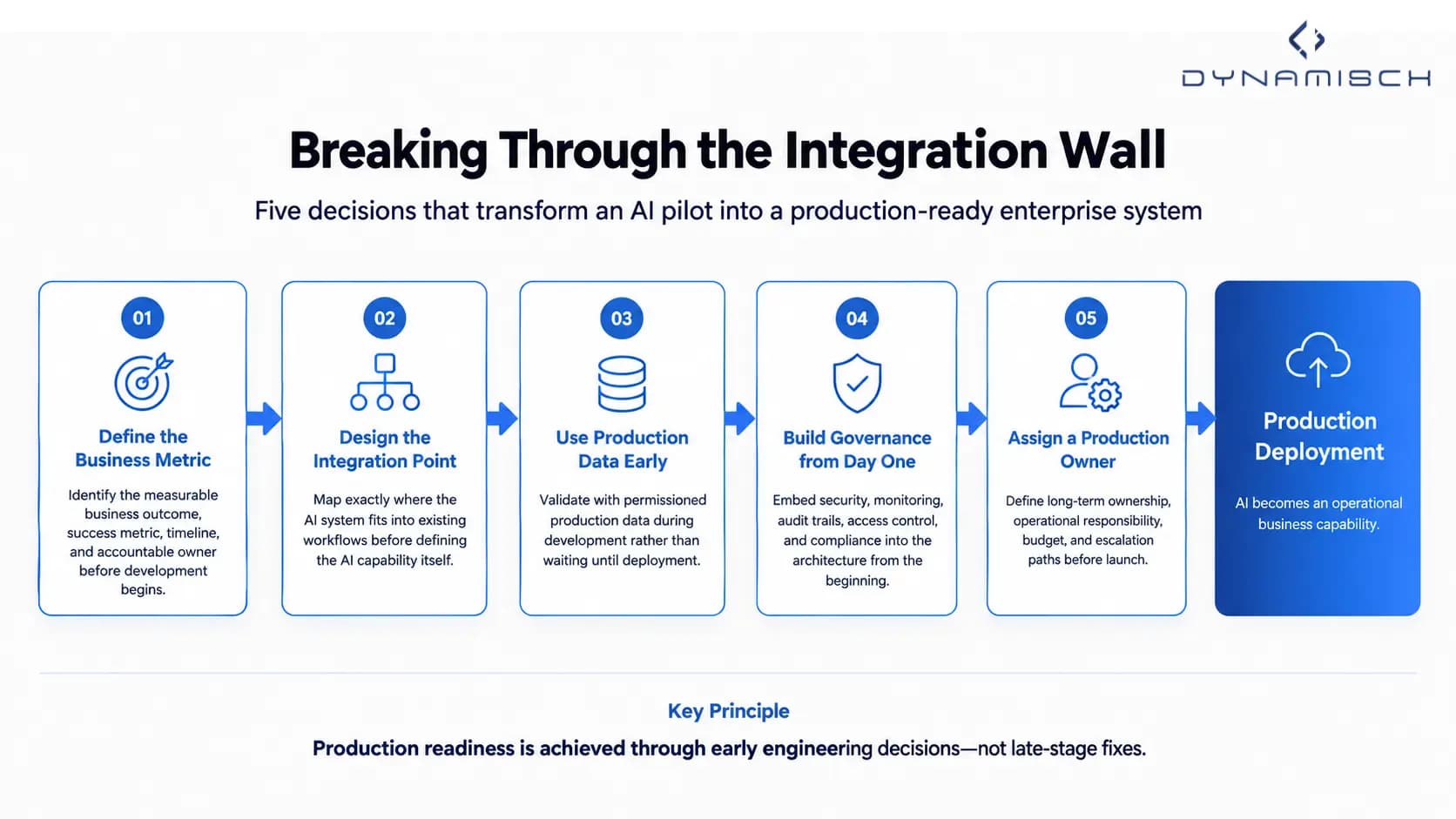
Define the Business Metric Before You Build
Name the number the system needs to move, the timeframe for moving it, and who is accountable for the result, before writing the first line of pilot code. This is the foundation step of an AI initiative strategy. A pilot without this is an experiment that rarely gets funded into production. These experiments cannot be a business initiative.
Design the Integration Point Before the AI Capability
Identify exactly where in the existing workflow the system needs to sit and what it needs to connect to before scoping what the AI itself will do. With the integration architecture in place, you can determine feasibility. AI capability is easy to adjust after the fact; a poorly chosen integration point is not.
Test Against Production Data Early, Not at the End
Bring in permissioned, real, sampled production data from early in the build instead of validating only against a curated demo set. Data readiness issues found in week two are a design adjustment. The same issues found at launch are a rebuild.
Build Governance and Monitoring from Day One
Role-based access, rollback plans, and audit trails belong in the initial architecture. They should not be the checklist items added before sign-off. Adding governance into a finished system takes longer and costs more than designing it in from the start.
Name the Production Owner Before Launch
Before the pilot goes live, decide who runs this system twelve months from now, with what budget and what escalation path. A pilot with no named owner has nowhere to go once it succeeds, regardless of how well it performs.
How Forward Deployed Engineering Closes the Integration Gap
Forward deployed engineering is a delivery model built around this exact problem. Instead of a vendor building a prototype in isolation and handing it off at the end, engineers work embedded inside the client's own systems and workflows. They build and integrate in place from the start.
This is the structural difference that closes the integration gap. In a typical pilot engagement, the team that builds the demo isn't the team that cleans up the production data pipeline, deals with legacy API constraints, or sits through the security review, so accountability for the hard part gets split across groups that were never in the room together.
In a forward deployed model, it's the same team from first prototype through data pipeline work, legacy integration, security and governance review, and the handoff to a named internal owner. Nobody has to re-explain the system to a new team partway through, and nothing gets lost in a handover that was never properly scoped.
This is really important for the parts of AI production readiness that are hardest to outsource in pieces: data access that requires ongoing coordination rather than a one-time export, authentication against systems that weren't built for machine callers, and monitoring that needs to be designed alongside the system from the initial phase itself.
Forward deployed engineering treats getting past the integration wall as the actual deliverable, not an afterthought once the model works.
Conclusion
The integration wall isn't a technology limitation. Many enterprise pilots today use technically capable foundation models yet still fail to produce business value because the surrounding systems never reach production readiness. What stopped them was an unclear business case, an integration path that was never engineered, no named production owner, data that wasn't ready, and governance that showed up after the architecture was already fixed. That's an engineering and ownership problem, and unlike model performance, it's one an organization has direct control over.
Crossing it comes down to proper sequencing. Define the metric before writing pilot code, design the integration point before the AI capability, test against real data early, and name an owner before launch.
For organizations already stuck at this point, the constraint usually is engineering capacity to do this work inside complex, legacy-heavy environments. That's the specific gap forward deployed engineering and hands-on data engineering support are built to close by embedding directly in the systems the AI has to work inside of, not around them.
Frequently Asked Questions

Sanket Prabhu
Vice President of Engineering
As Vice President of Engineering at Dynamisch, Sanket Prabhu stands at the intersection of Generative AI, Spatial Computing, and enterprise-scale innovation. With over 15 years of experience driving innovation across AI, XR, IoT, Digital Twins, and Gaming, he transforms emerging technologies into high-growth business engines. His leadership reflects both technical depth and strategic precision.