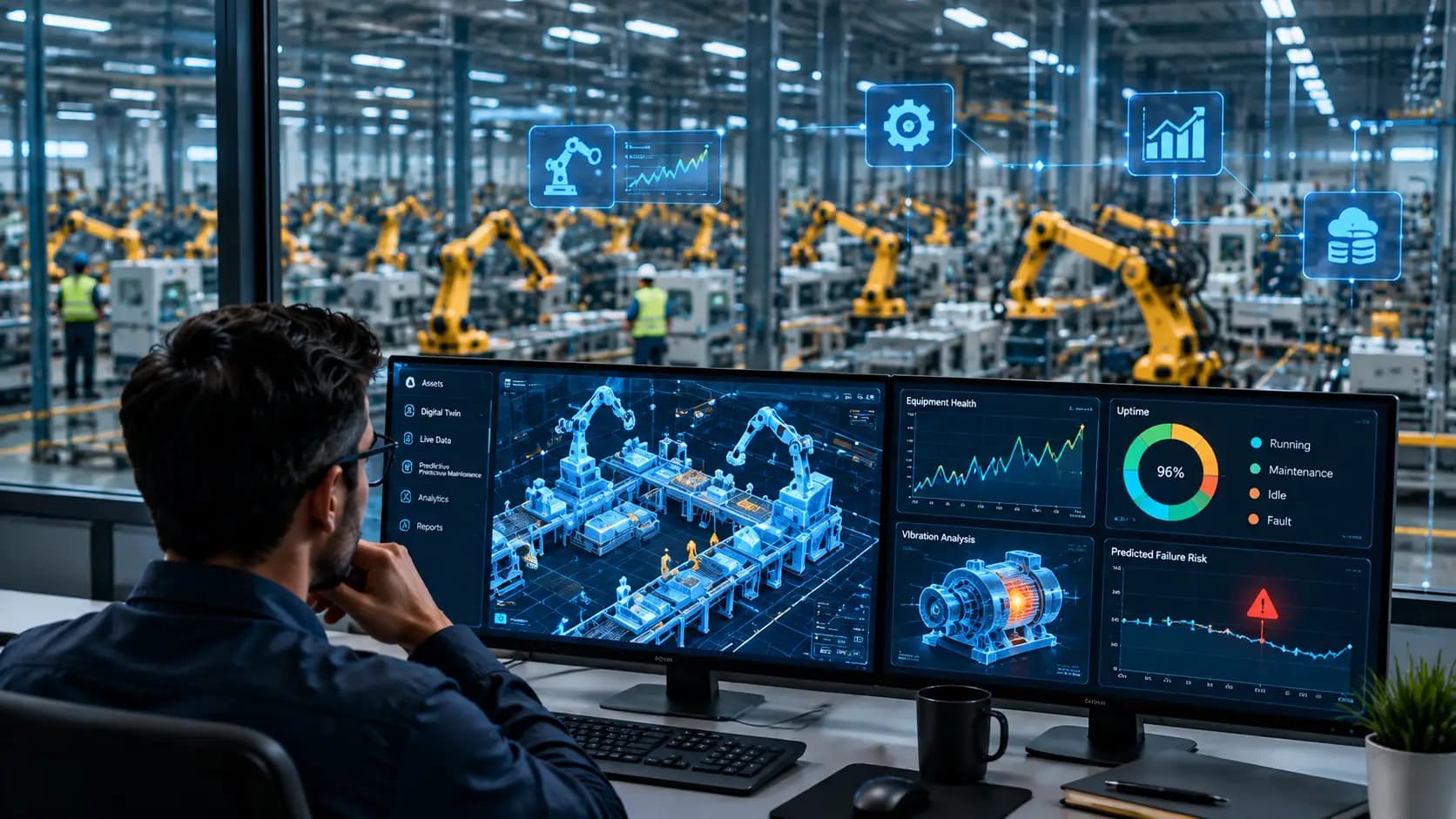
Industrial organizations are moving AI closer to operations because milliseconds matter more than ever before. Whether the goal is predictive maintenance for critical assets, defect detection on a production line, or worker safety monitoring, cloud-only AI can struggle with intermittent connectivity, network latency, data residency requirements, and bandwidth costs.
As a result, enterprise leaders are rethinking where AI inference should run and whether edge AI vs cloud AI is the right architecture for each workload.
That shift is reflected in market investment as well. The global edge AI market was estimated at USD 24.9 billion in 2025, rising to USD 30.0 billion in 2026 and projected to reach USD 118.7 billion by 2033.
Meanwhile, the broader edge computing market is forecast to grow from USD 658.1 billion in 2026 to USD 1.87 trillion by 2031, driven by industrial automation, real-time processing, and increasing data sovereignty requirements.
In this guide, we'll check out the differences between edge AI and cloud AI, when each architecture delivers the greatest business value, how a hybrid edge-cloud architecture helps modern IIoT AI deployment, and what enterprise decision-makers should evaluate before standardizing their AI strategy.
Key Takeaways
-
Edge AI vs cloud AI is a workload placement decision rather than a technology competition. Edge AI performs real-time AI inference close to machines and sensors, whereas cloud AI provides centralized compute for large-scale model training, fleet management, and analytics.
-
Industrial edge AI is the right choice when applications require sub-100 ms response times, reliable operation despite intermittent connectivity, on-premises data processing, or when transmitting high-volume video and sensor data to the cloud becomes impractical.
-
Predictive maintenance is one of the strongest edge AI use cases, with real-time anomaly detection helping reduce unplanned downtime in manufacturing deployments.
-
Most Industry 4.0 projects are adopting a hybrid edge-cloud architecture, using the edge for inference and the cloud for MLOps, model training, and enterprise-wide analytics.
-
The right architecture depends on data sensitivity, latency, connectivity, and total cost of ownership, evaluated one industrial use case at a time.
Edge AI vs Cloud AI at a Glance
A quick look at the key differences between Edge AI and Cloud AI:
| Factor | Edge AI | Cloud AI |
|---|---|---|
| Latency | Sub-100ms, processed on-site | Network round-trip dependent |
| Data residency | Stays on-premises / on-device | Transmitted to centralized data center |
| Best for | Real-time safety, quality, and process decisions | Model training, cross-site analytics, large-scale workloads |
| Connectivity dependency | Low to none | High - requires a stable network |
| Upfront cost | Higher (hardware, NPUs, edge nodes) | Lower (pay-as-you-go, elastic) |
| Scalability | Harder to standardize across many sites | Elastic, centrally managed |
| Typical industrial use case | Defect detection, predictive maintenance, safety monitoring | Demand forecasting, fleet-wide analytics, model retraining |
What's the Real Difference Between Edge AI and Cloud AI?
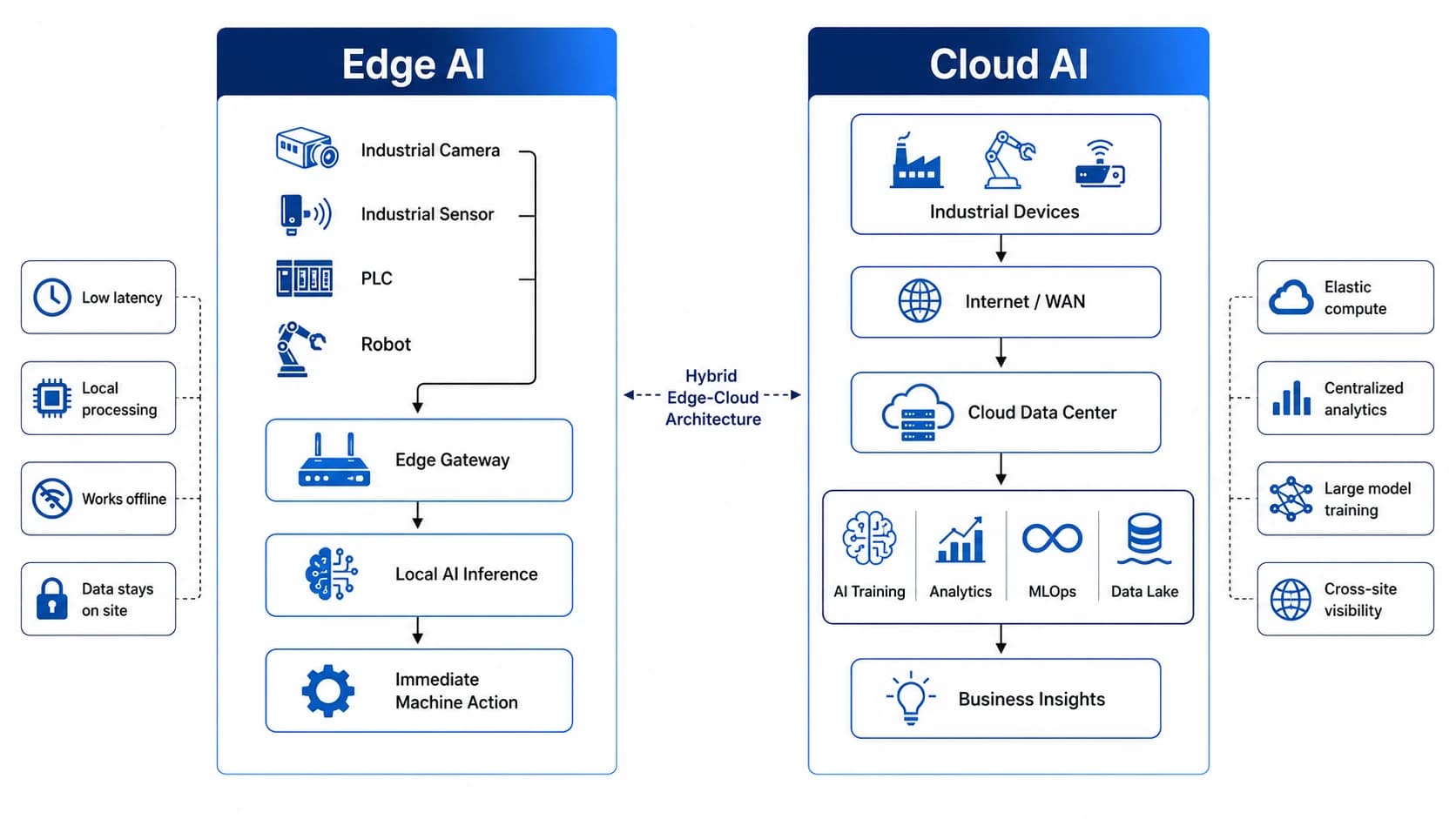
The primary difference in edge AI vs cloud AI is where AI models execute. Edge AI performs inference on or near the data source, such as cameras, industrial sensors, gateways, on-premises edge servers, or programmable logic controllers (PLCs), while cloud AI relies on centralized data centers for large-scale processing, model training, and orchestration.
Rather than replacing one another, enterprises combine both in a hybrid edge-cloud architecture, using the edge for time-critical decisions and the cloud for model lifecycle management, centralized analytics, and continuous improvement.
How Edge AI Works in Industrial Environments
In industrial edge AI, data is processed locally using AI accelerators such as GPUs, NPUs, or TinyML-enabled microcontrollers. This enables real-time AI inference for predictive maintenance, machine vision, safety systems, and robotics without depending on constant cloud connectivity.
Local processing also reduces bandwidth usage and supports operations where low latency or data residency is essential.
How Cloud AI Works for Enterprise-Scale Workloads
Cloud AI remains the preferred environment for managing enterprise data lakes, training large foundation models, and operating MLOps pipelines across distributed assets.
Hyperscale cloud infrastructure provides the compute elasticity needed for complex analytics and continuous model retraining. This makes it well-suited for organization-wide optimization rather than low-latency industrial AI workloads.
Why Industrial Leaders Are Rethinking Cloud-First AI Strategies
For many industrial AI workloads, the real question is whether the cloud should be involved in every decision. Production environments often require responses in milliseconds, where even a brief network round-trip can affect equipment safety, product quality, or operational continuity.
For example, in an automated visual inspection system, if a defective part is identified after data has traveled to the cloud and back, the production line may have already processed additional faulty units. This is why real-time AI inference is moving closer to the equipment itself.
Bandwidth economics are another driver. High-resolution industrial cameras and sensors generate massive volumes of data, making continuous cloud streaming costly and operationally inefficient. Remote sites, including agricultural machinery, offshore platforms, logistics hubs, and facilities with unreliable connectivity, also cannot depend on uninterrupted cloud access.
The latency gap reinforces this shift. As highlighted in Dynamisch's article on edge digital twins, cloud-hosted systems typically operate with 80–300 ms of latency, while edge deployments can respond in under 10 ms, enabling closed-loop control for time-critical industrial processes.
When Edge AI Is the Right Choice
Edge AI is the better choice when decisions cannot wait for a cloud round-trip. In practice, investing in industrial edge AI is justified when a workload meets at least two of these conditions: it requires sub-100 ms real-time AI inference, data must remain on-premises for compliance or security, network connectivity is expensive or unreliable, or sensors generate continuous high-volume data that is impractical to transmit.
These characteristics are common in anomaly detection, predictive maintenance, autonomous robotics, and machine vision on production lines.
Dynamisch's analysis of embedded IoT systems shows why. Local processing can achieve response times of less than 1 ms, compared with 80–160 ms for cloud processing. It can also reduce bandwidth consumption by up to 90% by transmitting only relevant insights instead of raw sensor data.
When Cloud AI Still Wins
Cloud AI still remains the strongest option when workloads prioritize scale over response time. It is well-suited for aggregating data across multiple factories, training large foundation models, running enterprise-wide analytics, and supporting MLOps pipelines that continuously retrain and deploy models.
If an application does not require real-time AI inference, centralized cloud infrastructure provides virtually unlimited computing capacity without the need to deploy AI hardware at every site.
The recent market statistics reflect this trade-off. The hardware component accounted for 51.8% of the global edge AI market in 2025, highlighting the infrastructure investment required for distributed industrial edge AI deployments.
For organizations that do not have strict latency, connectivity, or data residency requirements, cloud AI often offers the most cost-effective approach to scaling enterprise AI.
Business Impact - Cost, Risk, and Competitive Advantage
The edge AI vs cloud AI decision is ultimately a business decision rather than just a technology one. Your right decision affects the resilience, operating costs, regulatory compliance, and the ability to build products that competitors cannot easily replicate.
A practical example is the real-time appliance health monitoring IoT platform built by Dynamisch, which combined edge gateways with cloud services for analytics, telemetry ingestion, and visualization.
By processing operational data close to connected assets and using the cloud for centralized analysis, the solution achieved 65% faster issue identification, 27% lower mean time to resolution (MTTR), and approximately USD 300,000 in annual operational savings.
This illustrates how a hybrid edge-cloud architecture can improve both operational performance and total cost of ownership.
Beyond individual deployments, edge AI delivers measurable business value by enabling faster operational decisions, reducing network dependence, and limiting the amount of raw data that must be transmitted. According to NIST, edge AI helps address privacy, communication, and resource constraints while enabling AI systems to operate across distributed environments.
The cost of delaying adoption is also increasing. Organizations that rely only on centralized cloud processing may face higher cloud egress costs and stricter data sovereignty requirements.
At the same time, manufacturers are offering more latency-sensitive capabilities such as predictive maintenance, autonomous quality inspection, and adaptive process control, creating additional competitive pressure. In many industries, competitive advantage now depends as much on where AI runs as on the intelligence of the model itself.
The Hybrid Edge-Cloud Architecture Enterprises Are Standardizing On
For most industrial organizations, the choice between edge AI and cloud AI doesn't exist anymore. They are now thinking about how to combine both effectively. A hybrid edge-cloud architecture places real-time AI inference close to machines and utilizes the cloud for centralized model training and long-term analytics.
This approach is gaining momentum as organizations ask for operational resilience, lower latency, and greater control over where data is processed, particularly for distributed industrial environments.

Reference Architecture Pattern
A common IIoT AI deployment follows a layered architecture:
Industrial sensors and cameras → Edge gateway or AI-enabled device (GPU/NPU) → Local inference and decision-making → Secure cloud synchronization → Centralized data lake, MLOps pipeline, model retraining, and fleet-wide analytics
This approach reduces network traffic and enables continuously improved AI models to be deployed across thousands of assets. Dynamisch's real-time appliance health monitoring IoT platform follows a similar architecture, using edge gateways for telemetry collection and Azure cloud services for monitoring, analytics, and lifecycle management.
Role of MLOps in Managing Distributed Models at Scale
Without MLOps, managing hundreds or thousands of edge devices quickly becomes operationally complex. Modern MLOps pipelines automate model versioning, deployment, monitoring, and performance tracking across distributed infrastructure.
Operational data collected from edge devices is fed back into centralized training environments to enable continuous model refinement before updated models are securely redeployed to the edge. This closed feedback loop allows enterprises to scale industrial edge AI without sacrificing consistency, governance, or security.
How Edge AI and Cloud AI Play Out Across Industries
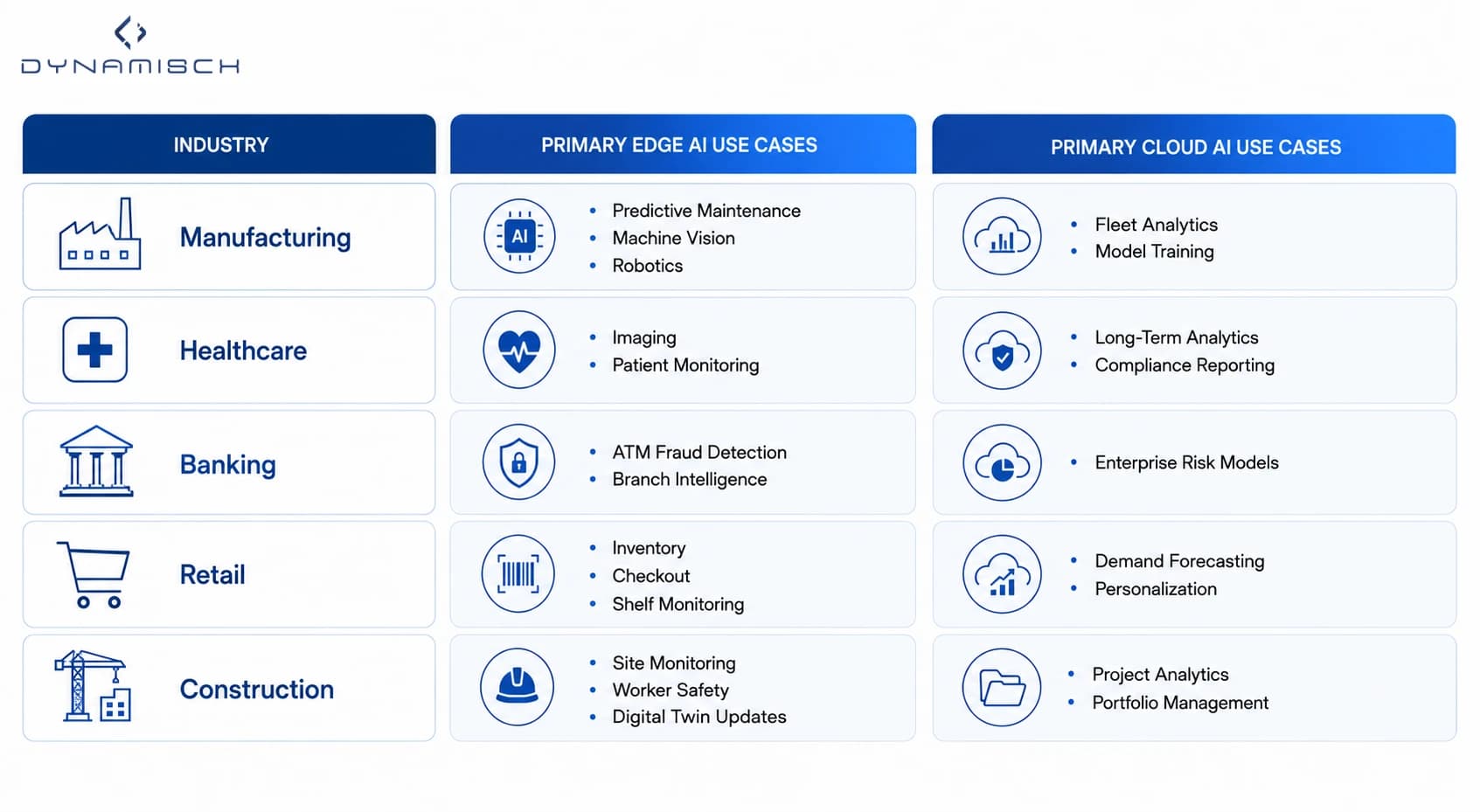
Different industries choose between edge AI and cloud AI as per use cases discussed below.
Manufacturing & Automotive
Manufacturing industry gains the greatest value from industrial edge AI where milliseconds affect quality and safety. Real-time AI inference powers predictive maintenance, defect detection, robotics coordination, and worker protection, while the cloud supports fleet-wide optimization.
Dynamisch's smart worker safety monitoring IoT platform demonstrates this approach by combining edge data collection, wearable sensors, AI analytics, and digital twin visualization to improve workplace safety.
Healthcare & Life Sciences
Hospitals and medical technology providers often process sensitive clinical data at the edge to support data governance and reduce latency, while cloud platforms enable long-term analytics and reporting.
Dynamisch's IoT radiation monitoring & safety management platform follows this model, using gateway-based data acquisition with centralized cloud analytics for radiation safety management.
Banking & Finance
Banks are now using edge AI more for fraud detection at payment terminals, ATMs, and branch systems. This enables immediate transaction screening. Cloud AI complements these deployments by aggregating enterprise-wide risk data, training fraud models, and identifying evolving attack patterns across financial networks.
Retail & Consumer
Retailers deploy AI at the edge for inventory tracking, shelf monitoring, loss prevention, and checkout automation. Cloud platforms manage customer analytics, demand forecasting, and personalization across multiple locations.
Construction & Architecture
Edge AI is well-suited for construction sites that frequently operate with intermittent connectivity for worker safety, equipment monitoring, digital twin, and computer vision synchronization. Cloud services update digital models, consolidate project data, and provide centralized oversight across distributed job sites.
The Operational and Security Challenges Slowing Edge AI Adoption
While there's a strong demand for industrial edge AI, successful deployment requires more than moving AI models closer to machines.
-
Operational Integration Challenges: Legacy operational technology (OT) remains one of the biggest integration hurdles. Many factories still rely on proprietary protocols and decades-old control systems that don't support modern AI workloads. This makes IIoT AI deployment a gradual modernization effort.
-
Security Concerns: Security is another big challenge. Every industrial PC, edge gateway, camera, and connected sensor expands the attack surface, requiring organizations to adopt a Zero Trust architecture with strong network segmentation, device identity, encrypted communications, and continuous verification across distributed environments.
-
Compliance Considerations: Compliance also affects architectural decisions. Regulations governing data residency and sovereignty require sensitive personal or operational data to remain within specific facilities or jurisdictions. This makes localized processing more attractive than unrestricted cloud transmission.
-
Scalability Limitations: Operational scale introduces additional complexity. Deploying, monitoring, patching, and updating AI models across hundreds or thousands of edge devices demands mature MLOps practices and engineers with expertise spanning embedded systems, AI, and industrial automation.
-
Cost Pressures: Cost remains another practical challenge. Unlike cloud platforms that follow a pay-as-you-go model, edge deployments require upfront investment in AI-capable hardware. Hardware represented 51.8% of the global edge AI market in 2025, reflecting the capital intensity of distributed infrastructure.
-
AI Adoption Barriers: Edge devices continue to face constraints in memory, compute capacity, and local training capabilities. This makes them dependent on cloud environments for large-scale model development and continuous improvement.
A 3-Step Checklist for Choosing Between Edge AI and Cloud AI
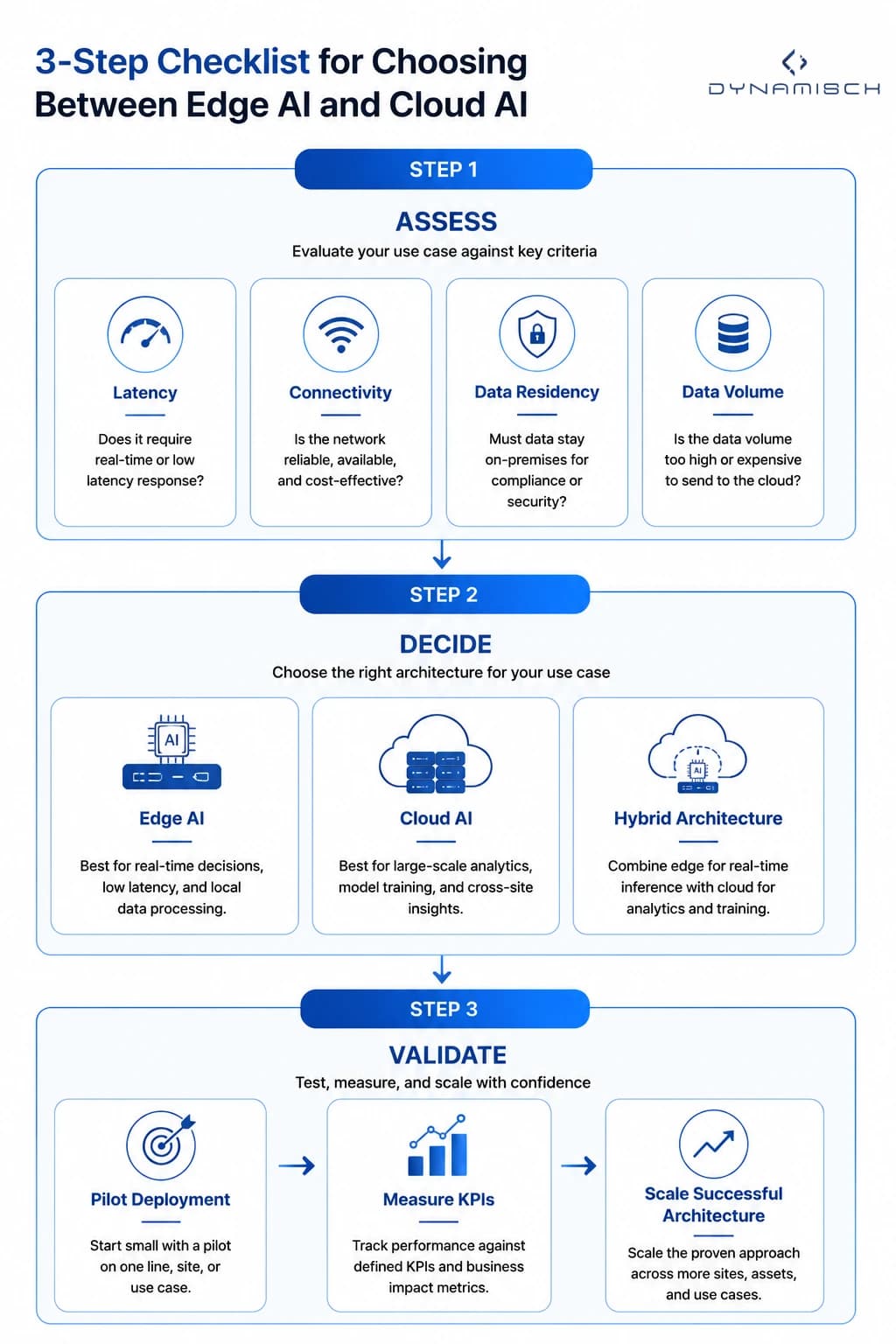
There is no universal winner in the edge AI vs cloud AI debate. The right architecture depends on the specific requirements of each workload rather than a single enterprise-wide strategy.
Step 1: Assess
Evaluate every AI use case against four criteria:
-
Latency: Does the application require real-time AI inference?
-
Data residency: Must data remain on premises for security or regulatory reasons?
-
Connectivity: Can the workload tolerate unreliable or intermittent network access?
-
Data volume: Is continuously transmitting raw video or sensor data practical and cost-effective?
Step 2: Decide
Select the architecture that best fits each use case. Choose edge AI for low-latency industrial operations, cloud AI for centralized analytics and large-scale model training, or a hybrid edge-cloud architecture when both local decision-making and enterprise-wide intelligence are required.
Step 3: Validate
Start with a pilot on a single facility, production line, or process. Measure business outcomes like downtime, latency, operational costs, and model accuracy, before expanding the solution across additional assets. This phased approach reduces implementation risk and ensures the chosen architecture delivers measurable value.
What's Next for Edge AI and Cloud AI Beyond 2026
The next phase of the edge AI and cloud AI evolution will be defined by making distributed AI more autonomous, faster, and easier to operate.
Custom AI Silicon Lowering Edge Costs
Purpose-built AI processors from semiconductor vendors and hyperscale cloud providers are making on-device inference more cost-effective and power-efficient. These specialized accelerators reduce dependence on centralized GPU infrastructure, enabling more AI workloads to execute directly on industrial equipment and edge gateways.
Agentic AI Moving to the Edge
Agentic AI is expanding beyond cloud orchestration. In March 2026, at the NVIDIA GTC 2026 event, Nutanix introduced a full-stack platform to help enterprises deploy and manage agentic AI at scale across hybrid environments. This reflects growing demand for autonomous AI systems that can operate closer to data sources while remaining centrally governed.
5G/6G Maturity Enabling Denser Deployments
As private 5G networks mature and 6G research advances, industrial sites will be able to support larger numbers of connected edge devices with lower latency and more reliable communication, enabling highly sophisticated IIoT AI deployment scenarios.
Tighter Data Sovereignty Regulation
Organizations are placing more emphasis on processing sensitive operational data within local facilities or national borders. This trend is expected to accelerate the adoption of hybrid edge-cloud architecture designs that balance regulatory compliance with centralized AI management.
Market Forecast
The long-term outlook remains strong. The global edge AI market is projected to grow at a 21.7% CAGR from 2026 to 2033, reaching approximately USD 118.7 billion, underscoring sustained enterprise investment in industrial edge AI and real-time AI inference capabilities.
Conclusion
Choosing between edge AI and cloud AI is not a decision about replacing one architecture with the other. It is about selecting the right execution environment for each workload based on data sensitivity, latency requirements, scalability, connectivity constraints, and total cost of ownership.
For most industrial organizations, a hybrid edge-cloud architecture delivers the best balance between real-time AI inference at the edge and centralized intelligence in the cloud.
The pace of adoption is accelerating. The global edge computing market is projected to grow from USD 658.1 billion in 2026 to USD 1.87 trillion by 2031, reflecting increasing investment in industrial automation, distributed AI, and data sovereignty-driven architectures.
As custom AI silicon, agentic AI, and advanced wireless connectivity continue to mature, the barrier to deploying industrial edge AI will continue to fall.
The next step for you is to evaluate your own AI use cases using the three-step checklist outlined in this guide. If you're planning an Industry 4.0 or AI modernization initiative, a structured architecture assessment can help determine where edge, cloud, or a hybrid approach will deliver the greatest operational and business value.
Frequently Asked Questions

Amit Kavatkar
Director of Engineering
Amit is an accomplished engineering leader with deep expertise in scalable software architectures and agile development practices. He has led end-to-end product engineering across mobile and SaaS platforms, delivering high-performance, user-centric solutions.With strong command over full-stack development, Amit combines strategic vision with hands-on technical depth. His work spans multiple domains including Retail, Hi-Tech, Industrial IoT, and Healthcare.