
For years, AI governance had a narrow job: review what a model said before a person acted on it.
Agents change that. They call APIs, update records, and move money, often with no one reviewing each step. AI agent risks now come from actions. So, agentic AI governance has to define what an agent may do, not only whether its output is accurate.
Surveys suggest many enterprises are behind. Gravitee's State of AI Agent Security 2026 report found that only 14.4% said every agent went live with full security or IT approval.
A Cloud Security Alliance survey of IT and security professionals found that 82% had discovered unknown agents, and 65% reported at least one agent-related incident in the past year.
The pattern is still clear: agentic AI risk management and autonomous AI controls tend to follow deployment.
What has to be true before an agent moves beyond a pilot?
Key Takeaways
- Agentic AI governance defines what an agent may access, call, and change at runtime, not just whether its answer looks right.
- Governance and risk management are two halves of one problem: NIST treats clear roles and communication as the foundation for mapping, measuring, and managing AI risk.
- The unit of risk is an action instead of an output when an agent can invoke tools, move data, or trigger a transaction.
- Control intensity should follow autonomy, with higher-risk actions needing more human approval and tighter monitoring.
- Ownership has to exist at portfolio, agent, and incident level so accountability stays clear when something breaks.
- The baseline controls are inventory, least privilege, runtime guardrails, AI agent audit trails, incident response, and pre-deployment validation.
- Three gates should be cleared before scaling: pilot to production, single-team to multi-team, and multi-team to enterprise-wide.
What Is Agentic AI Governance?
Agentic AI governance is the structured management of delegated authority for autonomous AI agents. It includes what AI agents can access, which tools they can call, what actions they may take, and who answers for the outcome.
How Governance and Risk Management Fit Together
Governance sets the rules and ownership. Risk management identifies and measures what can go wrong. Controls connect the two.
The NIST AI Risk Management Framework shows the split. Govern runs across the whole organization, while Map, Measure, and Manage apply each system.
UC Berkeley's agentic AI profile is organized around the same four functions. In practice, agentic AI risk management asks what an agent could do wrong, such as exceeding its permissions. Autonomous AI controls, including an AI agent audit trail, make the answers enforceable.
How It Differs from Traditional AI Governance
Traditional governance manages output risk: is the answer accurate, fair, and explainable? Agentic AI governance manages action risk. It's a change of moving from validating the answer to controlling the actions.
| Traditional AI governance | Agentic AI governance | |
|---|---|---|
| Focus | Accuracy, fairness, explainability | Actions, tool use, access |
| Main question | Is the output correct? | Is the action authorized? |
| Timing | Validation before deployment | Continuous control at runtime |
| Evidence of control | Test results, model documentation | Action logs, an AI agent audit trail |
The result is that governance moves from review to runtime.
Why Does Governance Have to Come Before Scaling?
Because the informal controls that keep a pilot safe rarely survive growth. A pilot has one agent, one team, a narrow toolset, and a person watching. Scale adds more agents, more credentials, more integrations, and less direct supervision.
The numbers show how fast that happens. In Gravitee's April 2026 survey of technology leaders, agent estates had roughly doubled in four months. According to the survey, nearly 38% of organizations ran more than 100 agents. Monitoring coverage averaged about 52% of deployed agents, up from about 47% in December.
Ownership is the weaker link. Only 7.2% of respondents said a named individual held formal accountability for agent behavior. Everyone else described responsibility as unclear, shared but undefined, or undiscussed. Autonomous AI controls that worked informally at pilot stage fail this way: each team assumes another one owns them.
Timing also affects cost. Adding agentic AI governance after agents are wired into production means tracing credentials, integrations, and data flows that nobody mapped at the time. Defining scope, ownership, and access limits first is usually less work.
For deployment steps, see our agentic AI implementation guide.
What Are the Main Risks of Agentic AI?
Agentic AI risk is the potential for harm when an autonomous system acts on delegated authority. The unit of risk is an action, not an output. AI agent risks fall into three groups, and agentic AI risk management starts by separating them.
Risks From What an Agent Can Do
Permissions are the first exposure. A Cloud Security Alliance survey of IT and security professionals, fielded in late 2025 and commissioned by Zenity, found that 53% of organizations had agents exceed their intended permissions. Another 47% reported an agent-related security incident in the past year.
Unauthorized tool calls follow the same path, since broad access lets an agent invoke tools nobody planned for. Irreversibility then decides how much oversight an action needs. A sent payment or deleted record is harder to recover than a draft.
Risks From What an Agent Can See
Agents handle sensitive data in motion. Customer records and documents pass between tools, memory, and external APIs within a single task. Each handoff is a place where data can leak or persist.
In Gravitee's April 2026 survey, open-text incident reports included agents caching personal data longer than allowed and third-party AI services logging private inputs. Reconstructing what an agent accessed depends on an AI agent audit trail. Retention and cross-border handling also carry legal consequences, covered in the regulations section below.
Risks From How Agents Multiply
Risk grows as the number of AI agents increases. UC Berkeley's Center for Long-Term Cybersecurity notes that other agents can reuse one agent's incorrect output, allowing errors to spread. Ownership slips as well.
In the same CSA survey, 54% of organizations reported having between 1 and 100 unsanctioned agents. Only 15% said that 76% to 100% of their agents had clearly defined owners.
As agents connect to more systems and services, their effective access can gradually expand without anyone noticing. Strong agent identities help contain this risk.
Many of the attack techniques behind these risks, including prompt injection, are cataloged in OWASP's Top 10 for Agentic Applications. All three groups grow with autonomy. The more an agent can do alone, the more autonomous AI controls matter, which is where the next section starts.
How Should Governance Scale with Agent Autonomy?
Controls should scale with autonomy. The more tasks an agent performs without human approval, the more safeguards it needs.
UC Berkeley's agentic AI profile treats agency as a spectrum and calls for risk controls proportionate to it. Others have formalized that spectrum, including a five-level model from Feng, McDonald, and Zhang and a six-level taxonomy from the Cloud Security Alliance published in January 2026.
The Four Autonomy Tiers
Without tiers, every agent gets the same review, which slows low-risk work and under-protects high-risk work.
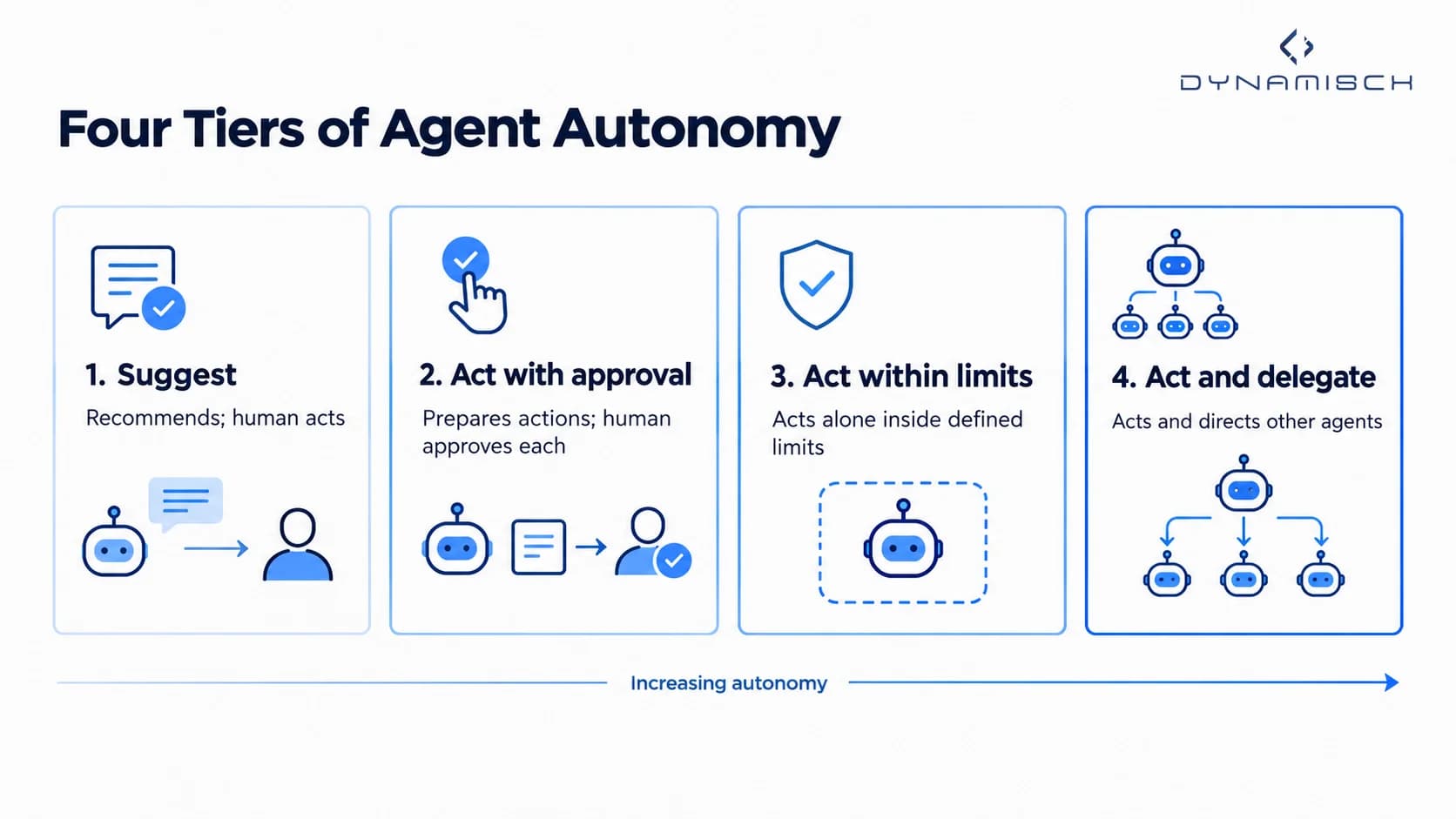
For enterprise use, we condense the idea into four tiers. The controls below are Dynamisch's recommended baseline for an AI agent governance framework, not a published standard. Each tier adds to the one before it.
| Tier | Agent behavior | Minimum controls |
|---|---|---|
| 1. Suggest | Recommends, human acts | Scope document, logging |
| 2. Act with approval | Prepares actions, human approves each | Tier 1 plus approval gates, least privilege |
| 3. Act within limits | Acts alone inside defined limits | Tier 2 plus runtime guardrails, kill switch, AI agent audit trail, sampled review |
| 4. Act and delegate | Acts and directs other agents | Tier 3 plus agent identity per instance, inter-agent monitoring, portfolio review |
A customer-facing agent that handles conversations and scheduling, like the one in our agentic AI customer engagement case study, would sit at Tier 3 if it acts alone within defined limits. Moving an agent up a tier should trigger a control review before the new permissions go live, not after.
How to Place an Agent in a Tier
Judge three factors separately. The most demanding one usually sets the tier.
Reversibility
Can the action be undone, and at what cost? Some actions, like rescheduling a meeting, are easy to reverse. Others, like releasing a payment, are much harder to undo.
Data Sensitivity
What regulated or confidential data does the agent touch? Personal, health, or financial records can raise the tier even when every action is reversible.
Reach
How many systems, users, or other agents does it affect? An agent that directs other agents belongs in Tier 4, whatever its own scope.
Who Owns Agentic AI Risk Inside the Enterprise?
Every agent needs a named owner, and so do the portfolio and each incident. Where accountability is shared, agent failures tend to go unclaimed.
The data points the same way. In a Cloud Security Alliance survey of 445 IT and security professionals, 34% reported ownership visibility for only 26% to 50% of their agents. The frameworks are clear on the fix.
The NIST AI Risk Management Framework calls for documented roles and lines of communication that are clear across the organization (Govern 2.1). Under the EU AI Act, deployers of high-risk systems must assign oversight to people with the competence, training, and authority to act (Article 26).
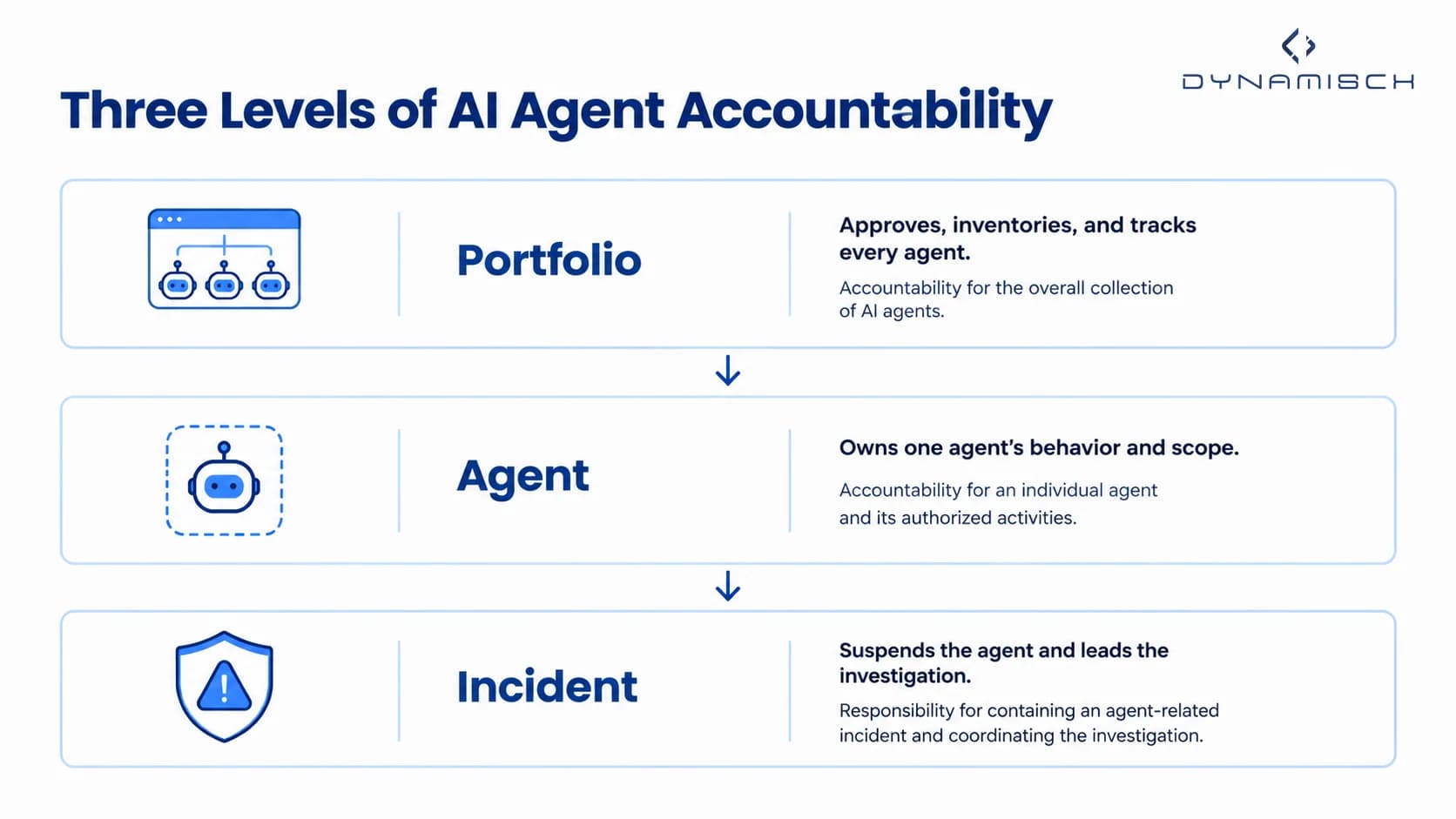
An AI agent governance framework works best with three levels of ownership:
- Portfolio: who approves, inventories, and tracks every agent.
- Agent: who answers for one agent's behavior and scope.
- Incident: who can suspend an agent and lead the investigation.
Roles map onto those levels fairly cleanly:
- CIO or head of AI: the portfolio and the inventory.
- CISO: identity, access, and runtime controls.
- Chief risk or compliance lead: risk appetite and regulatory mapping.
- Business owner: day-to-day agent behavior.
- Engineering lead: the build, the AI agent audit trail, and the kill switch.
A small review forum with decision rights, meeting on a set cadence, tends to move faster than a broad committee.
Ownership defined after an incident is defined under pressure, and usually in a hurry.
Which Controls Should Be in Place Before Scaling?
Six controls form the minimum before an agent scales. Each answers a specific failure, and each maps to published frameworks.
Agent Inventory and Identity
An inventory records every agent with its owner, purpose, and tier. Each agent should carry its own credentials, not a shared key, so every action traces to one identity.
The NIST AI RMF lists AI system inventory as a governance outcome (Govern 1.6). Without a complete inventory, no other control has a complete scope. Our zero trust guide covers identity.
Least-Privilege Access and Tool Allowlists
Scope access to the task and allow only named tools. An agent's real reach is the set of tools it can call, not the permissions it was designed with. In Gravitee's survey, 30.5% of organizations had a defined scope of permitted access in place before agents went live.
Runtime Guardrails
These are policy checks that run outside the model's own reasoning, before tool calls and external actions. Crafted input can override a model's instructions, but an independent check does not depend on the model agreeing. NIST expects deployed systems to be monitored in production (Measure 2.4).
Agent Audit Trail
An agent audit trail records each action, tool call, and decision path as governance evidence, not only debugging data. The EU AI Act requires high-risk systems to allow automatic event logging (Article 12), and ISO/IEC 42001 includes a control for recording event logs.
Kill Switch, Rollback and Incident Response
Teams should be able to suspend an agent, reverse its actions, and investigate. Only 34.1% of Gravitee's respondents had a documented process to pause or revoke access before launch.
NIST (Manage 2.4) calls for mechanisms to deactivate systems that behave inconsistently with intended use. Rollback is the harder half, since it depends on actions being reversible. Irreversible actions belong behind approval gates.
Pre-Deployment Validation
Test both normal workflows and failure scenarios, such as adversarial inputs, tool errors, and out-of-scope requests. NIST recommends collecting evidence that systems can fail safely (Measure 2.6). Repeat these tests whenever the model, tools, or permissions change.
Control Crosswalk
The table below maps each control to its closest published reference. EU AI Act articles apply to high-risk systems. Berkeley levers come from the Agentic AI Risk-Management Standards Profile.
| Control | NIST AI RMF | Berkeley lever | ISO/IEC 42001 | EU AI Act |
|---|---|---|---|---|
| Inventory and identity | Govern 1.6 | Transparency and documentation | A.4.2 | No direct article |
| Least privilege and allowlists | Map 3.3 | Defense-in-depth and containment | Not specific | Art. 15 |
| Runtime guardrails | Measure 2.4 | Continuous monitoring and post-deployment oversight | A.6.2.6 | Art. 14, 15 |
| Agent audit trail | Manage 4.3 | Transparency and documentation | A.6.2.8 | Art. 12 |
| Kill switch and incident response | Manage 2.4 | Human control and accountability | Not specific | Art. 14 |
| Pre-deployment validation | Measure 2.5 to 2.7 | System-level risk assessment | A.6.2.4 | Art. 9, 15 |
One set of controls can then produce evidence for several frameworks, which matters when the same agent falls under more than one regime.
Which Regulations and Standards Apply to Agentic AI?
The EU AI Act focuses on use cases and risk levels rather than whether a system is agentic. India's data protection law regulates personal data processing, however it is done. Both reach agents through what the agent does.
EU AI Act
Key Dates
The Digital Omnibus on AI, Regulation (EU) 2026/1744, was published on 24 July 2026 and entered into force on 27 July 2026. It moved the high-risk dates. The Act applies to organizations that place AI systems on the EU market or use them in the EU.
| Date | What applies |
|---|---|
| 2 August 2026 | Article 50 transparency duties, including chatbot disclosure |
| 2 December 2026 | Article 50(2) machine-readable marking, for generative systems already on the market |
| 2 December 2027 | High-risk obligations for stand-alone Annex III systems |
| 2 August 2028 | High-risk obligations for AI embedded in Annex I regulated products |
What It Means for Agents
Classification follows the use case. An agent used for hiring or credit decisions falls within Annex III. An agent routing internal tickets is unlikely to. A conversational agent that interacts with people also triggers Article 50 disclosure.
India: DPDP Act and Rules
MeitY notified the DPDP Rules, 2025 on 13 November 2025. Consent manager provisions apply from 13 November 2026. Most remaining duties, including notice, consent, security safeguards, and breach intimation, apply from 13 May 2027.
A proposal to shorten that window had not been notified as of a September 2026 summary. An agent that handles personal data falls under these duties, so its access scope and audit trail double as compliance evidence.
Voluntary and Certifiable Standards
The NIST AI RMF is voluntary, and NIST says a revision is in progress. ISO/IEC 42001 is a certifiable management system standard. Certification applies to an organization's AI management system rather than individual agents. Berkeley's agentic AI profile complements NIST's guidance by focusing on agent-specific risks.
The dates differ, but the evidence overlaps. An inventory, defined owners, and an agent audit trail support the EU AI Act, DPDP duties, and NIST or ISO alignment alike.
How Do Governance Requirements Differ by Industry?
Agentic AI governance rests on the same core controls in every sector. What changes is the evidence regulators expect and what an agent may do unsupervised.
Healthcare and Life Sciences
The HIPAA Security Rule requires mechanisms that record and examine activity in systems containing electronic protected health information (45 CFR 164.312(b)), so agents touching those systems need an AI agent audit trail. Clinical research adds FDA 21 CFR Part 11, which calls for secure, time-stamped audit trails.
Banking and Financial Services
US bank supervisors replaced SR 11-7 with SR 26-2 and OCC Bulletin 2026-13 on 17 April 2026. The new guidance places generative and agentic AI outside its scope, and the agencies said they plan a request for information on AI. Until that produces guidance, institutions must show agent oversight through their own validation, monitoring, and audit evidence.
Engineering, Construction and Manufacturing
Work here is document-heavy and often safety-linked. Our agentic CMS case study describes role-based access control, audit trails, document version control, and compliance monitoring around agents that handle technical documentation.
AI that serves as a safety component of a regulated product, such as machinery, falls under the EU AI Act's Annex I route, with obligations from 2 August 2028.
What Readiness Gates Should Enterprises Clear Before Scaling?
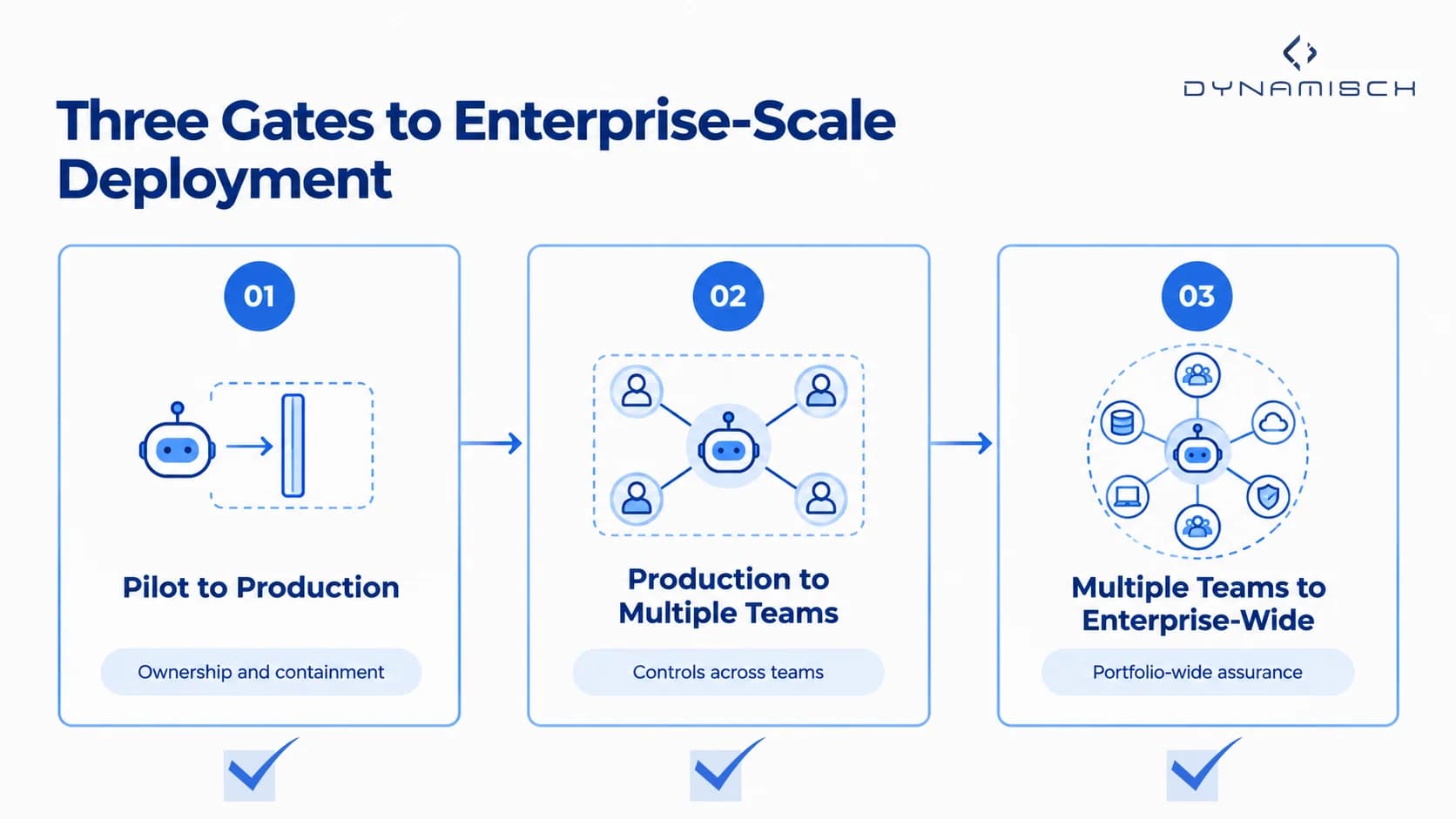
Enterprises should clear three gates: pilot to production, production to multiple teams, and multiple teams to enterprise-wide. Each gate is cleared with evidence rather than intent.
This is Dynamisch's recommended AI agent governance framework. It builds on the autonomy tiers and controls above and puts a checkpoint at each scaling decision, because the risks change at each step.
| Gate | Scaling decision | Pass criteria | Evidence to show |
|---|---|---|---|
| 1 | Pilot to production | Named owner, scope document, tier assigned, least privilege in place, AI agent audit trail on, kill switch tested | Owner sign-off, scope document, access review, suspension drill log |
| 2 | Production to multiple teams | Agent inventory complete, runtime guardrails independent of the model, incident runbook rehearsed, review cadence running | Inventory export, guardrail policy and logs, rehearsal record, review minutes |
| 3 | Multiple teams to enterprise-wide | Portfolio-level monitoring, control crosswalk evidence, regulatory mapping by market, scheduled revalidation | Portfolio dashboard, completed crosswalk, regulatory map, revalidation calendar |
Gate 1 tests ownership and containment. Gate 2 tests whether controls hold across teams. Gate 3 tests whether the organization can prove compliance across agents and markets, using the dates by market above. Moving an agent up an autonomy tier should reopen the relevant gate.
Teams skip gates for predictable reasons. In Gravitee's April 2026 survey, 81% of respondents felt pressure to deploy agents quickly even when security or governance was not fully in place. Only 19.7% said all their agents were fully secured and governed before going live.
Other reasons are quieter: no one owns the gate, or the evidence lives in people's heads. The cost arrives later. Controls skipped at Gate 1 get retrofitted under production load, and the proof needed at Gate 3 has to be reconstructed after the fact.
The decision rule is simple. A gate is cleared by evidence, not by a policy document.
Building Governed Agentic AI With Dynamisch
Governance holds up best when it is built into delivery rather than added after launch. Dynamisch's forward deployed engineers work inside the client's production environment, so access controls, security review, and monitoring are part of the engagement from the start.
On the build side, our AI infrastructure and agentic AI services cover agents designed to operate within defined limits, with traceability, access management, and audit trails. Our responsible AI and data security services add governance framework design, regulatory mapping, and review of systems already in production.
If your pilots are approaching production, contact our team to review which gates apply.
Frequently Asked Questions

Amit Kavatkar
Director of Engineering
Amit is an accomplished engineering leader with deep expertise in scalable software architectures and agile development practices. He has led end-to-end product engineering across mobile and SaaS platforms, delivering high-performance, user-centric solutions.With strong command over full-stack development, Amit combines strategic vision with hands-on technical depth. His work spans multiple domains including Retail, Hi-Tech, Industrial IoT, and Healthcare.