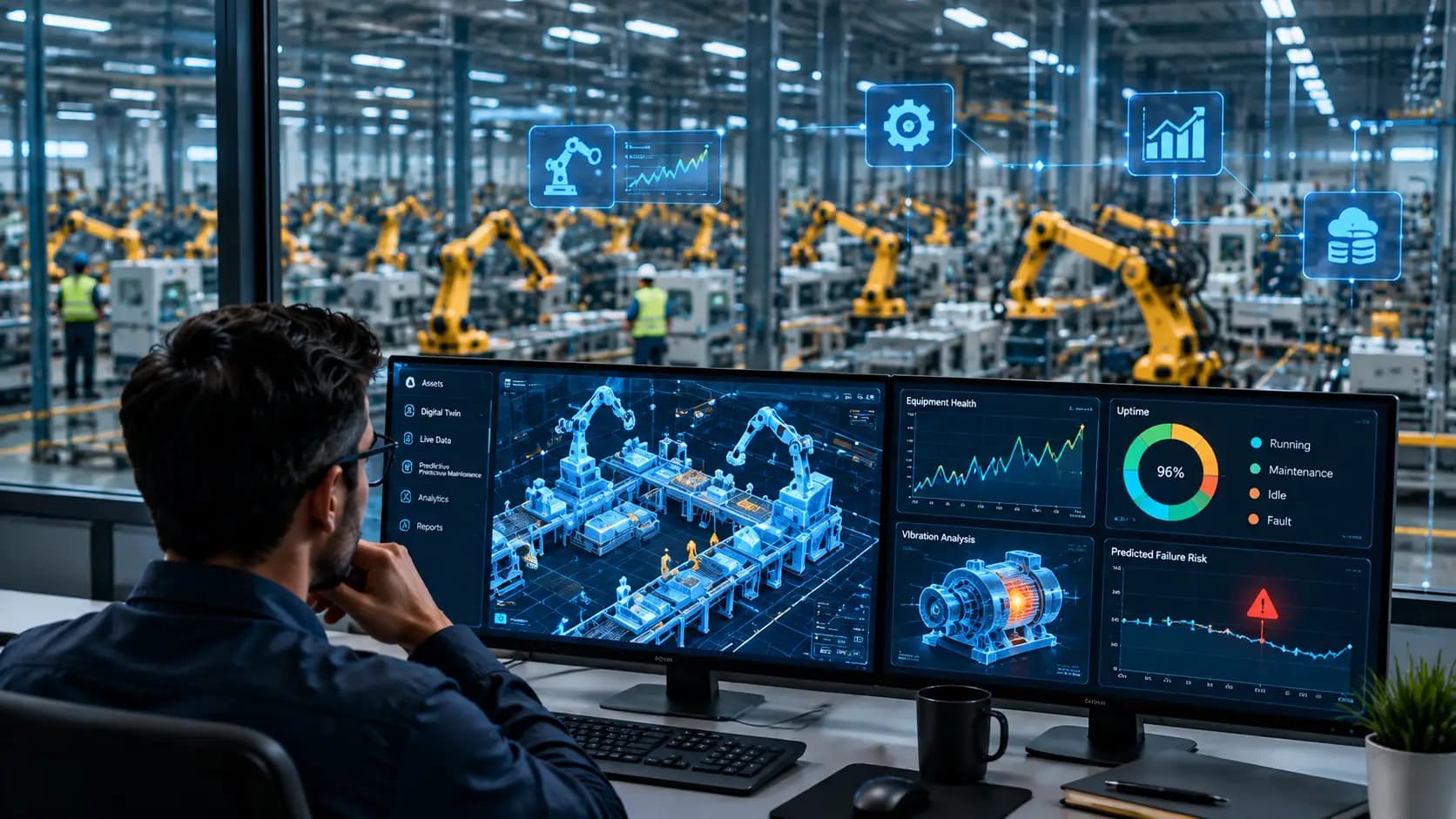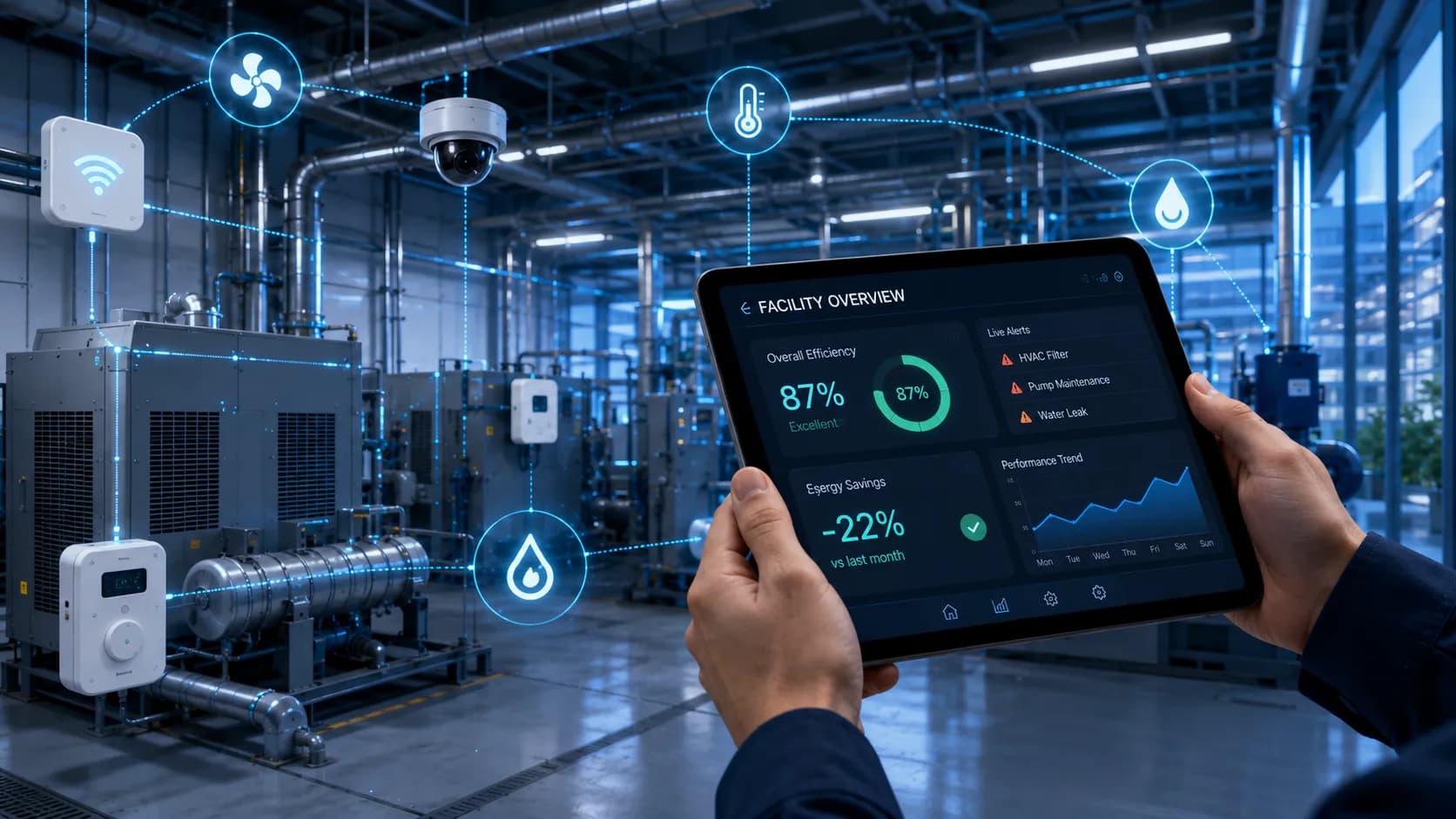
A digital twin can fail, and surprisingly, it is because the data behind it is disconnected. If you don’t record engineering changes into production records or don’t maintain service history separately from the product configuration, the twin can quickly become an incomplete representation of the asset.
NIST describes digital twins as digital representations of real-world entities, while the Digital Twin Consortium defines a digital thread as the interconnected information system linking data across lifecycle stages.
That distinction matters as enterprises expand digital engineering beyond isolated simulations. Mordor Intelligence estimates the digital thread market will grow from $16.87 billion in 2026 to $29.26 billion by 2031, with applications spanning automotive, healthcare, aerospace and defense, industrial machinery, and other sectors.
The practical question, then, is not simply digital twin vs digital thread. It is how the two fit together, and how to build the data continuity that allows a twin to remain useful throughout the product lifecycle.
Key Takeaways
-
Digital thread and digital twin are different layers. A digital thread connects dependable information across product lifecycle stages, while a digital twin is a synchronized digital representation of a real-world entity or process.
-
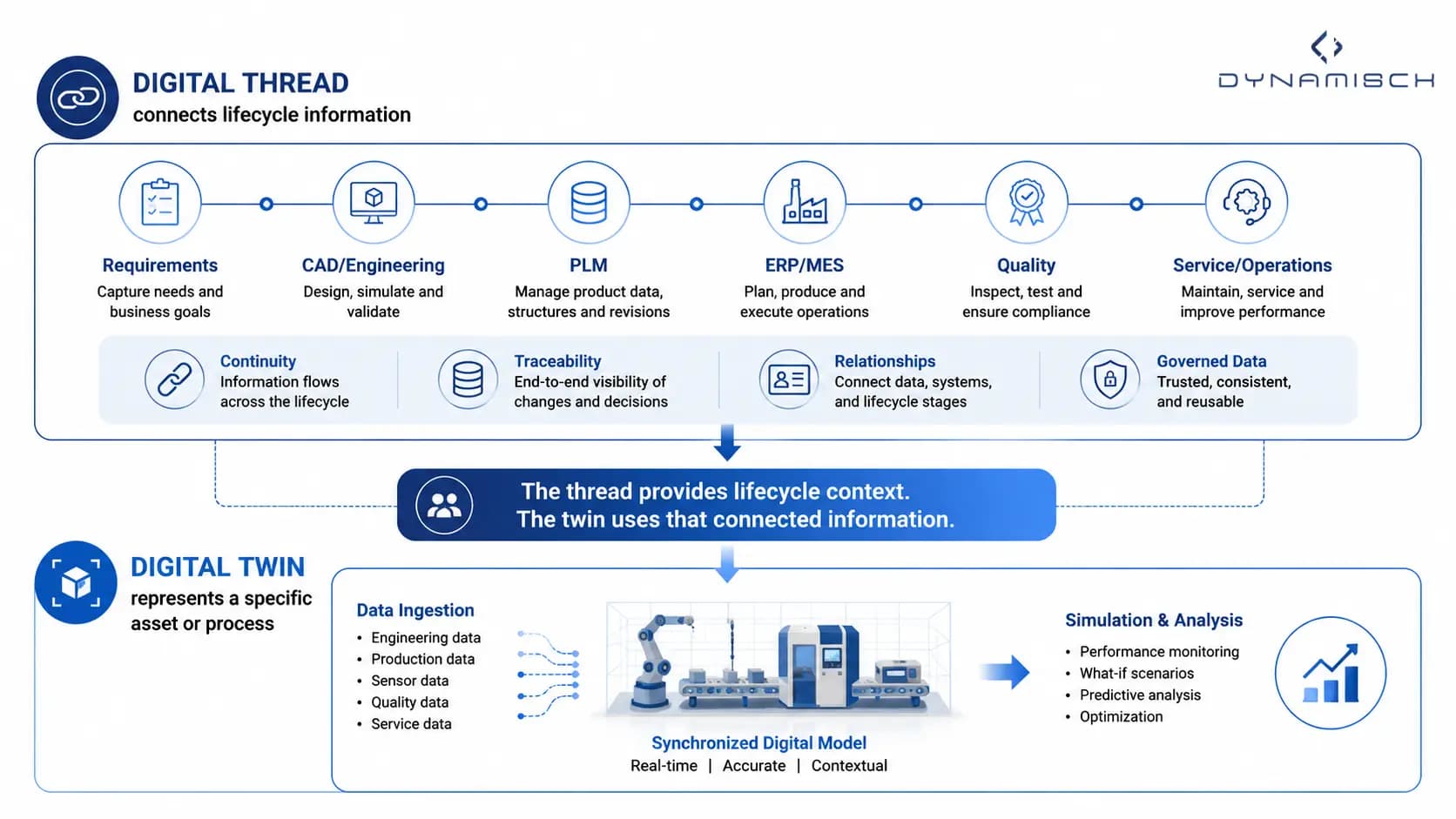
The thread provides context; the twin provides representation. The thread connects engineering, operational, configuration, and lifecycle information. The twin uses integrated data to represent an asset or process and support simulation, analysis, and decision-making.
-
They work best together. A well-structured PLM digital thread can provide the traceability and data continuity that keeps digital twin systems connected to relevant lifecycle information.
-
The practical distinction matters. When planning digital continuity in manufacturing or engineering-to-production traceability, treat the thread as the connective information architecture and the twin as a use-case-driven digital representation.
Two Words, Two Jobs: Getting the Definitions Right
The simplest way to understand digital twin and digital thread is to treat them as different layers of the same digital engineering environment. The thread connects information across the lifecycle; the twin uses integrated data to represent a specific real-world entity or process.
What is a Digital Thread?
A digital thread is a dependable and interconnected information system that links data across structures, time, behaviors, space, and lifecycle stages. In practice, it can connect information held across manufacturing, engineering, quality, operations, and other enterprise systems, provided those systems can exchange data reliably.
Its purpose is continuity and traceability. Digital thread preserves the relationships between information as a product or process moves through its lifecycle.
What is a Digital Twin?
A digital twin is an integrated, data-driven virtual representation of a real-world entity or process, synchronized at a defined frequency and level of fidelity. Depending on its use case, a twin can combine historical and current data with models or simulations to monitor conditions, represent behavior, or evaluate potential future states.
Our whitepaper explains how this technology is helping industrial operations. Explore the whitepaper Digital Twin in Industrial Systems.
Here's a quick table showing difference between Digital Twin and Digital Thread:
| Factors | Digital Thread | Digital Twin |
|---|---|---|
| What it is | Connected information across the lifecycle | Synchronized digital representation of an entity or process |
| Primary job | Preserve context, relationships, and traceability | Represent, monitor, analyze, or simulate |
| Typical question | “What information is connected, and how did it change?” | “What is happening, and what could happen next?” |
| Depends on | Interoperability, governance, identifiers, and lifecycle connections | Integrated data, models, and synchronization appropriate to the use case |
This differentiation is really important for PLM digital thread and digital continuity manufacturing initiatives. A thread provides the connective foundation; a twin is a specific application of that connected information.
Digital Twin Consortium explicitly describes the digital thread as essential to digital twins because it connects and integrates information across the product lifecycle.
Why the Two Get Blurred Together and What It Costs You
Businesses often blur the distinction between digital twins and digital threads. The confusion is quite understandable. Both concepts sit at the intersection of engineering data, simulation, models, and operational systems. But they solve different problems.
The distinction becomes harder to see when vendors present the twin as the visible centerpiece. Platforms such as NVIDIA Omniverse can assemble physically accurate digital twins from engineering and operational data, making the model itself highly tangible. The less visible work is establishing the identifiers, data connections, interoperability, and governance that keep those inputs trustworthy over time.
Consider a manufacturing twin built to simulate a production facility. If engineering information, operational inputs, and configuration data are not connected reliably, the twin can become disconnected from the asset it represents. Digital thread is essential to connect and integrate information across the lifecycle.
That failure has practical consequences. When lifecycle information remains scattered, engineering-to-production traceability becomes harder. This results in teams losing the context needed to understand which version is current, why a configuration changed, or how an engineering decision affects downstream operations.
NIST's digital-thread work similarly focuses on connecting heterogeneous artifacts across requirements, CAD/CAM, PLM, machines, simulation, and sensor data. The result is a more difficult foundation for dependable decisions.
How the Thread and the Twin Actually Work Together
Think of the digital thread as the lifecycle context that feeds purpose-built digital twins. A digital thread connects and maintains access to product lifecycle information, while digital twins use integrated data to represent specific entities or processes.
NIST research on manufacturing digital twins describes how a digital thread can provide access to design, manufacturing, inspection, and use data, while multiple twins can be integrated to address broader manufacturing objectives.
We've seen this play out directly in our own delivery work. For a UK-based organization operating across high-risk industrial sites, we built a safety monitoring platform where wearable devices captured real-time data on worker location, helmet usage, altitude, and PPE compliance, feeding it into a live digital twin dashboard built on NVIDIA Omniverse.
The dashboard only mattered because the data behind it stayed current. A static visualization of the site would have told the safety team nothing useful. It was the continuous flow of sensor data into the twin that let them catch incidents such as falls or SOS alerts faster and move from reactive reporting to proactive monitoring.
This creates a practical pattern:
CAD/PLM → ERP/MES → governed digital thread → operational and sensor data → twin and simulation layer → engineering, operations, and service decisions
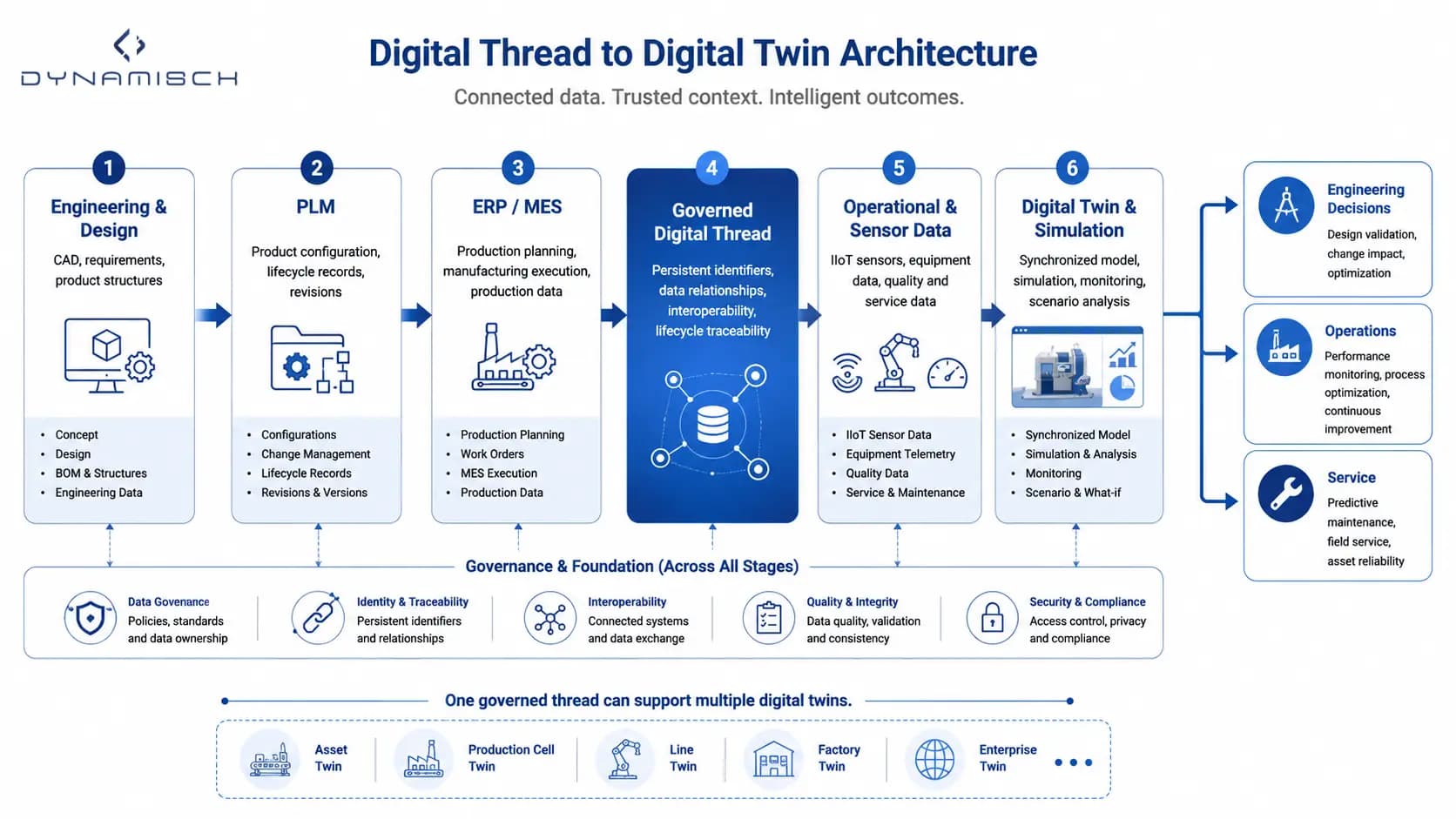
Simulation is the bridge between lifecycle information and decisions about future states. A digital twin can combine current and historical data with simulation models to represent the past and present and simulate possible futures.
This simulation layer is where platforms such as NVIDIA Omniverse come into play. Rather than replacing the enterprise digital thread, Omniverse complements it by providing the 3D integration and physics-based simulation environment that digital twins use to model and test real-world behavior.
That distinction becomes clearer when evaluating the NVIDIA Omniverse digital twin ecosystem. The architecture, therefore, is not thread or twin. The thread provides continuity and traceability; individual twins turn that connected information into models that teams can analyze, simulate, and act upon.
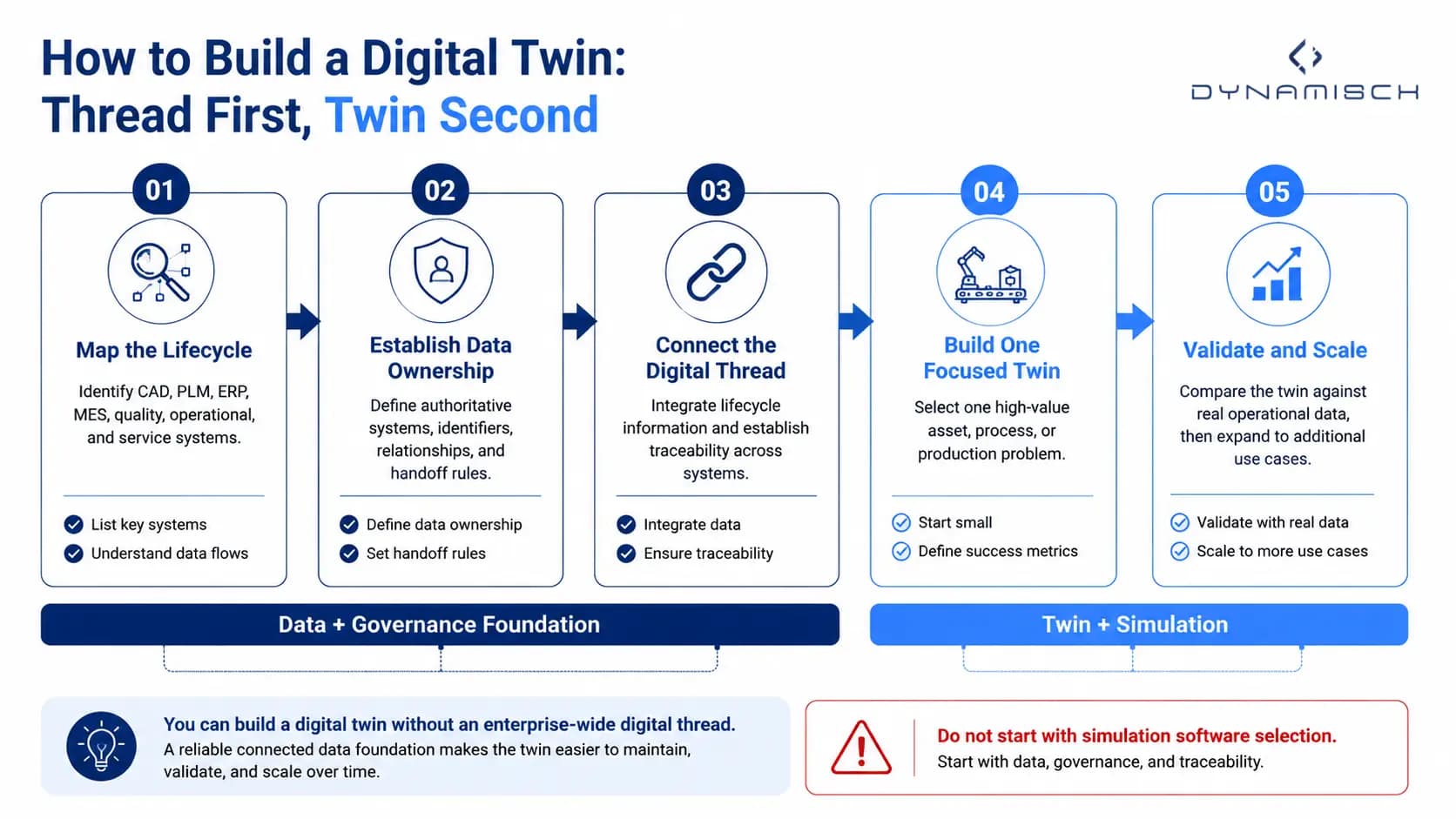
Sequencing It Right - Thread First, Twin Second
If the goal is a durable digital twin, start with the digital thread, not the twin software. The first priority is connecting lifecycle information and establishing traceability across the systems that create and consume it. Persistent identifiers are the key requirement for tracking product information across manufacturing, design, inspection, and other lifecycle activities.
That makes the early work less about simulation and more about data architecture and governance. Define how product and asset identities are maintained, which systems are authoritative, and how information moves between CAD, PLM, ERP, MES, quality, and operational environments.
Once that foundation is credible, choose a narrowly defined twin use case. Start with one process, asset, or production problem where better prediction, monitoring, or simulation has a measurable business purpose. Then validate the twin against relevant operational data before expanding its scope.
This sequence also makes scaling easier. The lifecycle data can improve twin interoperability and reuse with validation and testing as part of implementation.
The common mistake is reversing those priorities: selecting a twin platform first and treating data integration as an implementation detail. A sophisticated model cannot compensate for fragmented lifecycle information.
Where This Shows Up in Practice
The value of a digital thread and digital twin becomes clearest where products have complex lifecycles, costly physical changes, or strict traceability requirements.
Manufacturing & Industrial Machinery
In manufacturing, digital threads connect production, design, inspection, and product-support information. NIST has developed standards and methods specifically to improve traceability across these lifecycle stages. Digital twins can then represent equipment or workcells for monitoring, testing, and operational analysis.
Aerospace & Defense
Aerospace is a strong example of why lifecycle continuity matters. Recent NASA-linked work on aircraft data architecture identifies authoritative and connected data as a means of improving traceability and supporting digital-thread continuity across aircraft design.
Healthcare & Life Sciences
In the Healthcare and Life Science industry, traceability has a regulatory dimension, particularly for medical devices. The FDA's UDI system links device identity from manufacturing through distribution and patient use, while its total-product-lifecycle approach connects premarket and postmarket information.
In the EU, EUDAMED's UDI/Device module became mandatory on May 28, 2026, reinforcing the role of structured lifecycle data in device traceability.
What's Changing Between Now and Near Future
The shift from isolated digital twins to connected digital engineering is already underway. The near-term challenge is making the underlying data trustworthy enough to support increasingly sophisticated simulation and AI.
-
Data fragmentation remains the core blocker. PLM, ERP, CAD, MES, quality, and operational systems often contain related information without sharing a consistent data model. NIST continues to identify interoperability and integration of heterogeneous manufacturing systems as central challenges for digital-thread implementation.
-
Security and deployment models are becoming more flexible. Digital-thread architectures span on-premises, cloud, and hybrid environments. The right model depends on an organization's data, integration, security, and operational requirements rather than a universal cloud-first approach.
-
The simulation layer is advancing quickly. NVIDIA's Omniverse platform supports industrial digital twins using physics simulation, OpenUSD, and AI technologies. Foxconn, for example, is using digital twins for factory planning and simulation before physical deployment.
-
Traceability is becoming a stronger driver. Regulatory and quality requirements make reliable lifecycle information really important in sectors such as medical devices and aerospace. The FDA's UDI system, for example, establishes standardized device identification across distribution and use.
-
The market is expanding, but adoption still requires discipline. Mordor Intelligence estimates the digital thread market will grow from $16.87 billion in 2026 to $29.26 billion by 2031. For enterprises, the more important question is whether that investment produces connected, governed information that digital twins and AI systems can actually use.
Conclusion
The digital twin vs digital thread question is ultimately less about choosing between two technologies and more about understanding their relationship. The twin is the visible representation, but the thread provides the connected lifecycle information that can make that representation trustworthy, traceable, and useful. The Digital Twin Consortium explicitly identifies the digital thread as essential to connecting and integrating information across a digital twin's lifecycle.
If you're evaluating a digital twin initiative, the question worth asking first isn't which simulation platform to buy. It's whether your ERP, PLM, and MES data can actually support one. That's usually a shorter conversation than people expect.
Dynamisch can help you assess that foundation and scope a digital twin initiative around the integration, data, and engineering requirements that matter. Contact us for a free consultation.
Frequently Asked Questions

Sanket Prabhu
Vice President of Engineering
As Vice President of Engineering at Dynamisch, Sanket Prabhu stands at the intersection of Generative AI, Spatial Computing, and enterprise-scale innovation. With over 15 years of experience driving innovation across AI, XR, IoT, Digital Twins, and Gaming, he transforms emerging technologies into high-growth business engines. His leadership reflects both technical depth and strategic precision.