
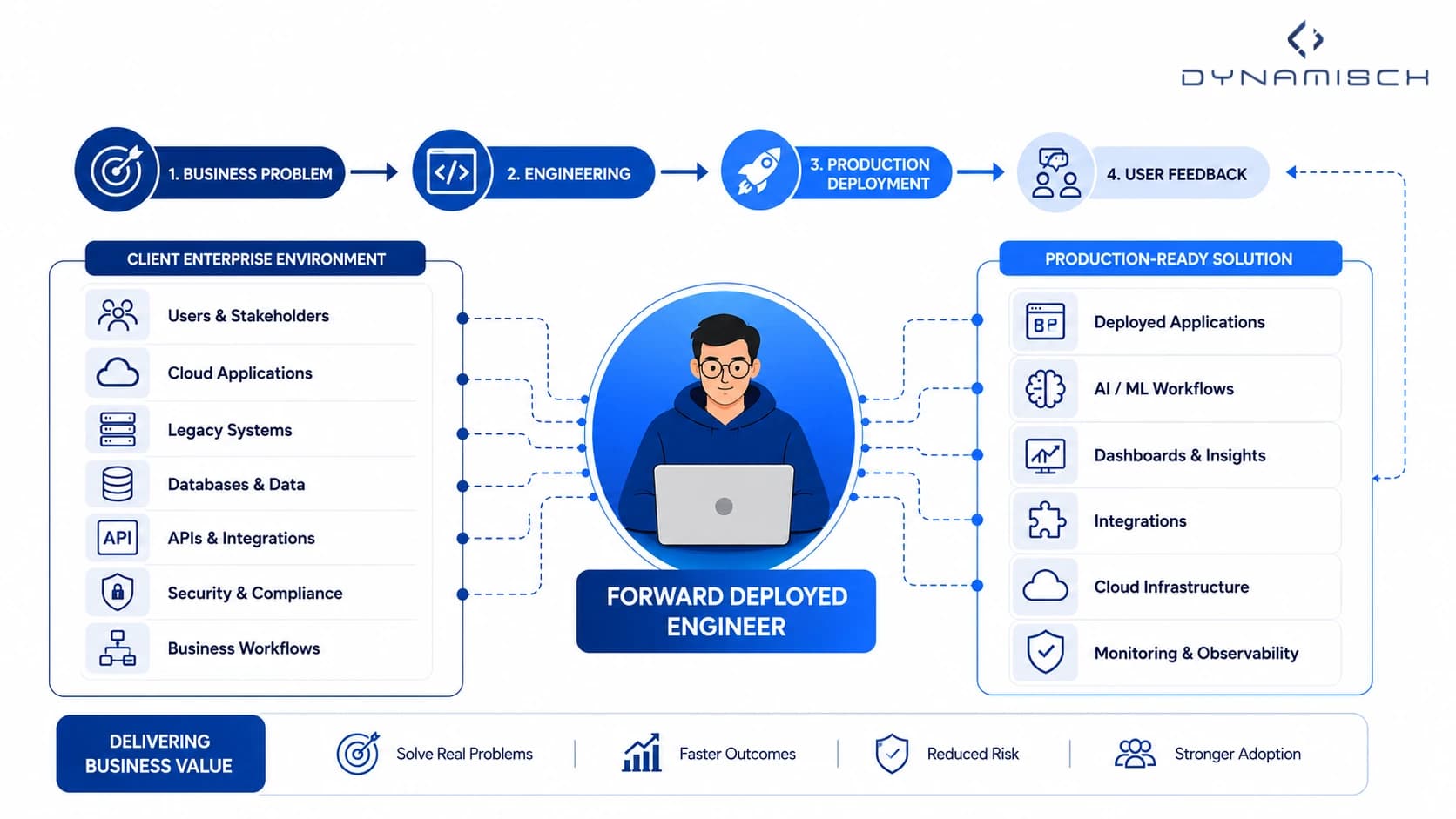
A Forward Deployed Engineer (FDE) is a software engineer who works directly inside a client’s environment to build, integrate, and deploy production solutions around that client’s real systems and constraints.
The model is gaining attention as enterprise technology buyers look beyond pilots and prototypes toward solutions that can operate reliably in production.
Unlike a traditional software engineer focused on a product roadmap, an FDE combines hands-on engineering with deep customer context and end-to-end delivery responsibility.
For enterprises, that makes forward deployed engineering particularly relevant when legacy systems, complex integrations, data, security, or operational requirements stand between a promising technology and measurable business value.
Key Takeaways
-
A Forward Deployed Engineer works inside a client's own environment to build, integrate, and deploy production solutions, rather than delivering a prototype from a distance.
-
The term FDE originated at Palantir in the early 2010s and has since become standard vocabulary across AI labs, fintech companies, and enterprise software vendors.
-
Forward deployed engineer hiring has grown sharply in 2026, driven by enterprises hitting the same wall: AI pilots that work in a demo but fail to reach production.
-
Many enterprise AI initiatives stall or fail not because the underlying model underperforms, but because of legacy systems, security review, and authentication requirements that surface only in a real environment.
-
An FDE differs from a solutions architect, a consultant, and a standard software engineer by staying accountable for a working system in production, not just a design, recommendation, or delivered prototype.
-
At Dynamisch, Forward Deployed Engineering is a staffed practice built around agentic AI implementation, complex API and Model Context Protocol (MCP) tooling, legacy code modernization, and large-scale data migration work.
-
Enterprises evaluating an FDE partner should confirm whether the team works inside real client environments, how success is measured, and whether accountability continues after deployment.
What Does a Forward Deployed Engineer Do?
A Forward Deployed Engineer (FDE) works directly with a client to understand a business problem, build a technical solution, and take it into the client’s production environment.
Although the term "forward deployed" originally meant engineers working on-site with customers, in modern FDE engagements, they often work remotely or in a hybrid model. The important part is that they stay closely involved with the client's projects and work as part of the team.
Rather than stopping at a prototype, the FDE works against real data, integrations, infrastructure, user feedback, and security requirements, often owning the solution from initial discovery through deployment.
The role combines software engineering with close client collaboration. An FDE may build a custom application or AI workflow, design an architecture, integrate data sources and APIs, iterate with users, and troubleshoot deployment constraints until the solution works in practice.
By working directly with end users and technical teams throughout implementation, Forward Deployed Engineers create short feedback loops that help them make improvements and fix problems as new needs or challenges come up during real use.
Importantly, a Forward Deployed Engineer is first and foremost a software engineer. The role is distinguished not by advisory responsibilities but by writing production-grade code, remaining accountable for delivering working systems, and solving customer-specific technical problems.
Core Responsibilities of a Forward Deployed Engineer
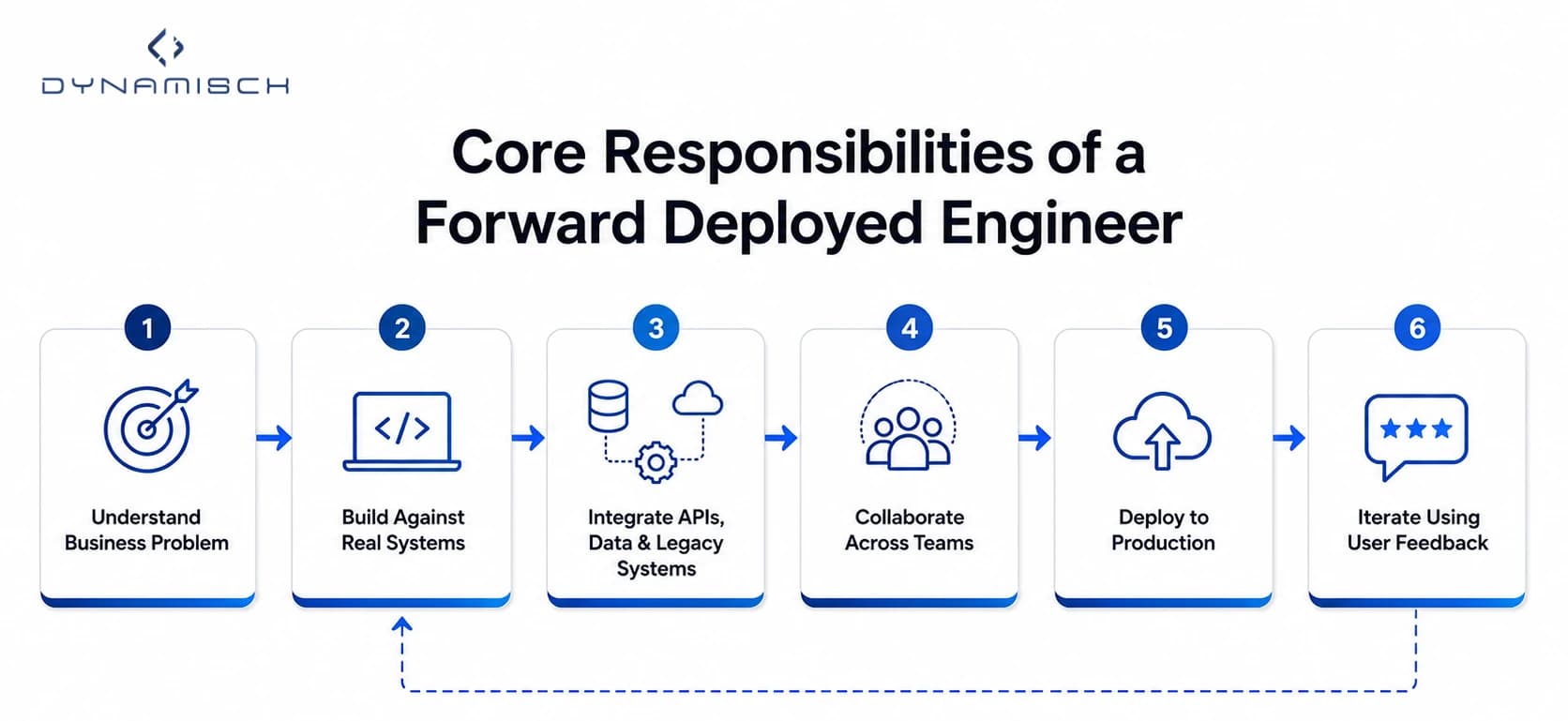
The exact scope of work of FDEs varies by engagement, but the role typically includes:
-
Understand the business problem before deciding what to build.
-
Build against real systems, data, infrastructure, and enterprise constraints.
-
Validate production behavior through testing and direct user feedback.
-
Handle integrations involving APIs, legacy systems, authentication, networking, and security.
-
Own delivery through deployment, with responsibility for the solution’s real-world use rather than simply handing over code.
Because production deployments span multiple stakeholders, Forward Deployed Engineers also work closely with engineering, infrastructure, security, product, and operations teams to resolve technical dependencies that extend beyond writing code alone.
Where Did the Term "Forward Deployed Engineer" Come From?
The term traces back to Palantir Technologies in the early 2010s. Palantir defined a Forward Deployed Software Engineer, or "Delta," as a software engineer who embeds directly with customers to configure Palantir's existing software platforms to solve their toughest problems, unlike a traditional engineer building one capability for many customers.
"Forward deployed" was borrowed from military vocabulary, meaning operating at the point of action rather than from a rear base. The model existed because many of Palantir's earliest government customers operated in highly complex and sensitive environments where requirements evolved through close collaboration rather than conventional product discovery.
How the Role Has Evolved Into a Broader B2B Category
The title has since become industry vocabulary. Indeed's postings data showed forward deployed engineer listings up roughly over 700% year over year by April 2026, with Anthropic, Palantir, Stripe, OpenAI, and Google Cloud among the named hirers.
A small number of large employers account for most active postings, while a long tail of over a hundred smaller companies each hire only a few FDEs. A Palantir-specific title is now standard enterprise practice.
Why Are Enterprises Hiring Forward Deployed Engineers in 2026?
Businesses aren't hiring forward deployed engineers because the model is trendy. They're hiring them because the traditional deployment playbook keeps breaking down at the exact moment when it matters most, and two forces explain why.
The Integration Wall Problem
The AI initiatives of many businesses fail at the point of contact with the real business: data residency rules, legacy systems, internal security review, and authentication layers. They don't fail because the model is weak.
A widely cited MIT study, drawing on 52 executive interviews, surveys of 153 leaders, and analysis of 300 public AI deployments, found that 95% of generative AI pilots delivered no measurable P&L impact, while only a small fraction reached production with measurable value.
MIT researchers pointed to a "learning gap" as the core issue. It's the difficulty of getting flexible, generic tools to adapt to a specific organization's workflows and systems.
Forward deployed engineering is designed to help close that gap, which is why enterprise buyers researching what a forward deployed engineer is tend to arrive at the term through a failed pilot, not a job posting.
The Shift From Product-Led to Services-Led Growth
In response, AI-forward companies are now rethinking how they go to market. Instead of optimizing purely for low-touch, self-serve software delivery, they're placing engineers directly inside customer environments to absorb integration complexity themselves.
This is a deliberate strategic bet: a company that can consistently solve the last mile of deployment builds a position that competitors selling only software cannot easily copy.
It's also the clearest distinction in the FDE vs. consultant debate: the FDE stays accountable for a working system, not a recommendation.
Forward Deployed Engineer vs Traditional Roles: What's the Difference?
The forward deployed engineer role gets confused with three adjacent jobs, and the confusion usually costs buyers time during vendor evaluation. Here's where each one actually diverges.
FDE vs Solutions Architect
Solutions Architects primarily focus on system design and technical guidance. While many also prototype or support implementation, FDEs typically remain responsible for writing production code and driving the solution through deployment.
An architect can be right about the design and still watch it stall in execution, because nobody owns the gap between the diagram and the running system. The FDE owns that gap.
FDE vs Traditional IT Consultant
Traditional consulting engagements often conclude after delivering recommendations or a defined implementation scope. Forward deployed engineers stay embedded through deployment and into early adoption. They adjust the system as real usage exposes edge cases that the discovery phase never surfaced.
FDE vs Software Engineer
A standard software engineer builds for their own company's product, optimizing for scale across many customers. An FDE builds inside a specific client's environment, against that client's constraints, data, and legacy systems; one deployment at a time.
| Role | Primary Focus | Where They Work |
|---|---|---|
| Solutions Architect | System Design | Design phase, often removed from execution |
| Traditional Consultant | Defined deliverable | Engagement ends at handoff |
| Software Engineer | Product development | Own company's codebase |
| Forward Deployed Engineer | End-to-end delivery into production | Embedded in the client's production environment |
What Does an FDE Look Like at Dynamisch?
At Dynamisch, Forward Deployed Engineering is not a rebranded service line. It is a distinct delivery model applied to some of the most technically demanding work we do: agentic AI implementation, complex API and MCP tooling development, legacy code modernization, and large-scale data migrations such as Teradata to Databricks and SAS to PySpark.
They are the kind of engagements where an engineer has to understand a client's existing systems well enough to work inside them safely, which is exactly the skill set the forward deployed engineer role was built around.
The practice is led by Pritish Zade, Vice President of Technology, and Arpit Singh, Senior Technical Lead, who also run a structured internal training function for the team. That detail matters more than it might seem. A company that has to reassign generalist engineers to FDE work project by project is offering something different from a company that trains and staffs a dedicated team for it.
How a Dynamisch FDE Engagement Works
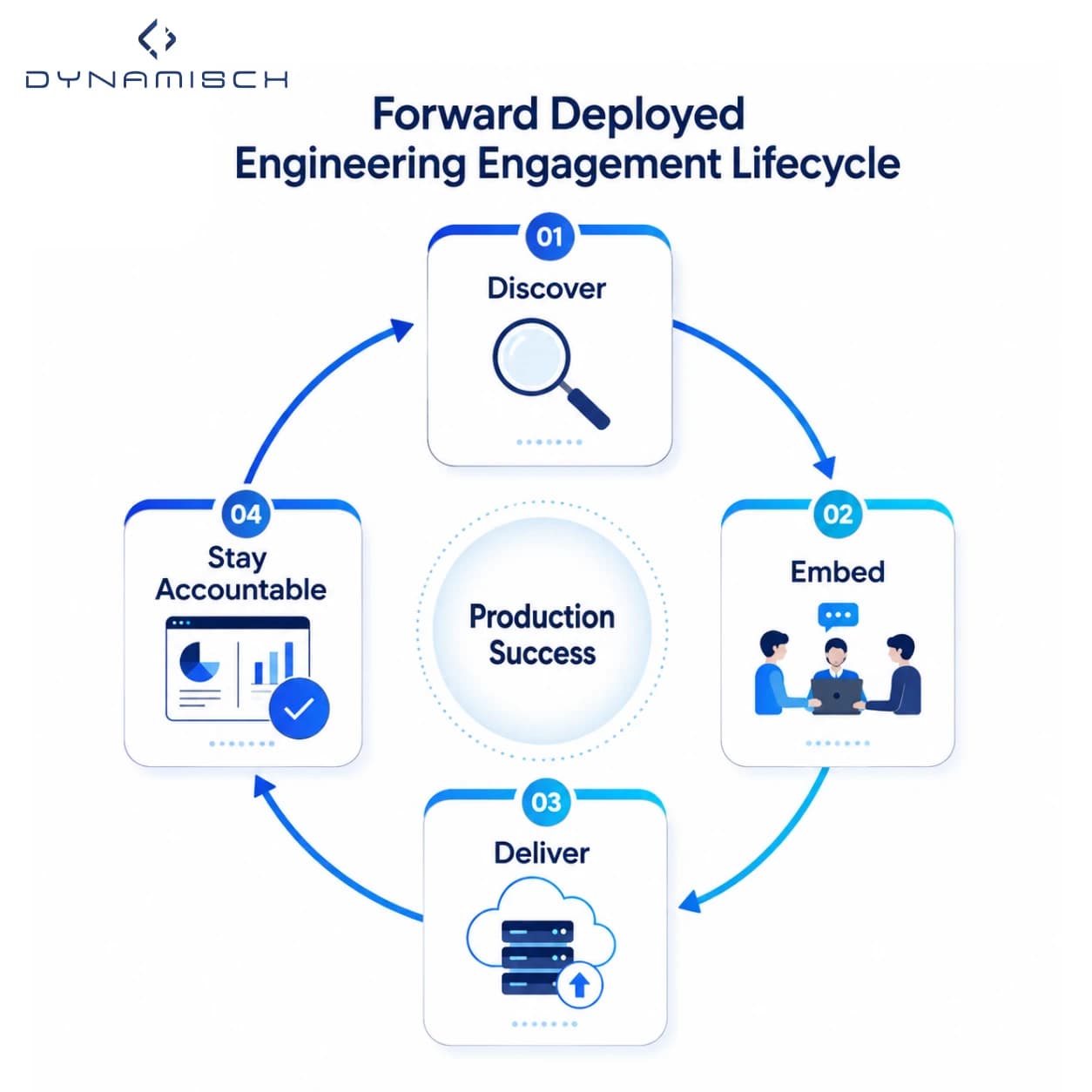
Every engagement follows the same four stages: Discover, Embed, Deliver, and Stay Accountable. In short, that means understanding a client's environment before writing code, working inside their systems, delivering incrementally into production, and staying involved after deployment to confirm the work is actually being used.
The full breakdown of how each stage works is covered on our Forward Deployed Engineering page.
What Are the Risks of Not Adopting the FDE Model?
The clearest risk is a pilot that never progresses to a production system. Gartner has projected that over 40% of agentic AI projects will be canceled by the end of 2027, citing rising costs, unclear value, and weak risk controls.
In many cases, this is not a technology problem. It is what happens when a working prototype meets a security review, a legacy system, or an authentication process nobody planned for.
That gap carries a real cost. Enterprises that keep funding proof-of-concept work without a path to production are paying twice: once to build the pilot, and again when it has to be rebuilt or abandoned because it was never designed to survive contact with the client's actual environment.
There is also a competitive dimension. Organizations that have already embedded engineers with their customers are shortening the distance between a working demo and a deployed system. Every quarter spent repeating the same integration failures on a new initiative is a quarter a competitor spends closing that gap instead.
The forward deployed engineer model exists specifically to prevent that pattern from repeating project after project.
How to Evaluate a Forward Deployed Engineering Partner
The term forward deployed engineering has become popular enough that it now covers everything from genuinely embedded technical work to relabeled staff augmentation. Before signing a contract, it is worth asking a few direct questions.
Questions to Ask Before You Commit
-
Does the team work inside your actual environment, or only in a sandbox?
A partner who can only demonstrate results in an isolated test environment has not proven they can handle your legacy databases, your security review process, or your authentication setup.
-
How is success measured, by delivery or by production adoption?
A delivered prototype and a system your team is actually using are different outcomes. Ask which one the contract defines as done.
-
What happens after deployment? Does the engagement include ongoing accountability?
Forward deployed engineering, when done properly, does not end the moment code is delivered. Ask what support looks like once the system is live.
-
Can they show specific technical proof, not just general AI capability claims?
Ask for concrete examples of systems that reached production, including the technical constraints involved, rather than general statements about AI expertise.
Final Thoughts
The forward deployed engineer role will likely keep growing as more enterprises discover that AI capability and AI adoption are not the same thing. The companies that treat deployment as seriously as they treat model selection will be the ones with something to show for their AI spend a year from now.
If your AI initiative is stuck between pilot and production, Dynamisch has the FDE team that closes that gap. Talk to our FDE team.
Frequently Asked Questions

Arpit Singh
Senior Technical Lead
Arpit Singh is a Senior Tech Lead with over 10 years of experience, skilled in translating complex client requirements into actionable strategies. He empowers the technical team to deliver exceptional solutions through effective communication and mentorship. Arpit also leads execution on the ground for Dynamisch's Forward Deployed Engineering team, training engineers to work directly inside client environments and deliver production-ready systems, not just prototypes.