
Zero Trust Architecture is a cybersecurity framework built on the principle of “never trust, always verify.” It assumes no user, device, app, or system merits default trust.
This applies whether it is inside or outside the corporate network. Instead of using traditional perimeter defenses, the Zero Trust security model checks every access request.
It authenticates, authorizes, and validates each request before granting access to enterprise resources.
Defined by NIST SP 800-207, Zero Trust Architecture (ZTA) operates across seven core pillars: identity, devices, networks, applications, data, infrastructure, and visibility.
In this article, we’ll explore Zero Trust Architecture. We’ll explain how the “never trust, always verify” model works in practice and cover its seven core pillars.
We’ll review real-world ways to implement it. We’ll also highlight common mistakes organizations should avoid during adoption.
Key Takeaways
- Zero Trust Architecture replaces the outdated assumption that you can trust everything inside a corporate network perimeter by default.
- The Zero Trust security model follows “never trust, always verify.” Every user, device, application, and workload needs ongoing identity, device, and context checks before getting access.
- Gartner predicts that by the end of 2026, 10% of large enterprises will have a mature and measurable Zero Trust program. In 2023, fewer than 1% had one.
- Zero Trust is quickly becoming a compliance expectation in the USA, UK, and EU. NIST SP 800-207, federal Zero Trust mandates, and NCSC guidance drive this. NIS2 and DORA also support this.
- Zero Trust implementation is a phased architectural transformation involving identity, access controls, visibility, microsegmentation, and continuous monitoring, not a single product purchase.
Why Perimeter Security No Longer Works
Traditional cybersecurity was built around the “castle-and-moat” model. The idea was simple: keep threats outside the corporate network with firewalls and perimeter defenses. Trust everything inside the network boundary.
That approach worked when employees, applications, and data mostly lived inside a centralized office network. But modern enterprises now operate across cloud platforms, remote devices, SaaS applications, APIs, and AI-driven systems. The network perimeter has effectively disappeared.
The Death of the Network Perimeter
According to recent industry reports, more than 90% of organizations will adopt hybrid or multi-cloud infrastructure by 2027. At the same time, remote and distributed workforces will continue to grow across all sectors.
This shift has fundamentally weakened traditional firewall-based security models. Employees access enterprise applications from many locations outside the corporate perimeter. These include home networks, personal devices, airports, customer sites, and cloud environments.
In this environment, attackers no longer need to “break into” a network. They often gain access through exposed credentials, third-party integrations, or compromised cloud identities. Once inside, traditional perimeter security provides little resistance to lateral movement across systems.
Identity Is the New Perimeter
As network boundaries disappeared, identity became the primary control point in enterprise security.
Today, compromised credentials remain one of the leading causes of data breaches. Attackers often use phishing, credential stuffing, and session hijacking to steal user identities. They then use those identities to access sensitive systems.
The Zero Trust security model addresses this by continuously verifying every user, device, and session before granting access. Zero Trust does not automatically trust users after login. It continuously checks user identity, device health, location, behavior, and access risk in real time.
The Insider Threat Problem
Traditional security models assumed that anyone already inside the corporate network could be trusted. In modern enterprise environments, that assumption has become one of the biggest security risks.
Insider threats are not limited to malicious employees. They also include compromised accounts, negligent users, third-party contractors, and overprivileged access across cloud systems.
A single compromised account with broad permissions can give attackers access to multiple applications. They can steal sensitive data or disrupt critical operations without immediate alerts.
Zero Trust Architecture reduces this risk by removing implicit trust entirely. With Zero Trust in place, users inside the network must still verify their access before using enterprise resources.
What Is Zero Trust Architecture?
Zero Trust Architecture is a cybersecurity framework that removes implicit trust from enterprise environments. It follows the principle of explicit verification. Zero Trust does not automatically trust users or systems inside a network. It verifies every access request before granting access.
NIST SP 800-207 defines the Zero Trust security model for modern cloud, hybrid, and distributed environments. It protects users, devices, and applications that operate beyond traditional network boundaries.
Never Trust, Always Verify
The core principle of Zero Trust is “never trust, always verify.”
Zero Trust requires users, devices, applications, and workloads to prove who they are before accessing enterprise resources. This applies no matter where the request comes from. Verification is continuous and considers factors such as identity, device health, location, behavior, and access risk.
This approach helps reduce phishing, credential theft, session hijacking, and unauthorized lateral movement.
Least Privilege Access
Zero Trust follows the principle of least privilege. Users and systems receive only the access they need to complete a task.
Organizations increasingly use role-based permissions, time-limited access, and just-in-time privileges instead of permanent standing access. Zero Trust limits the damage attackers can cause when they compromise an account or device.
Assume Breach
Zero Trust takes a different approach than traditional security models by assuming that breaches can and will happen.
Instead of focusing only on perimeter defense, organizations continuously monitor activity, segment systems, and restrict lateral movement to contain potential threats quickly.
For example, microsegmentation isolates workloads and limits attacker movement across environments. Real-time analytics and behavioral monitoring also help security teams detect suspicious activity early.
This “assume breach” mindset improves cyber resilience and reduces the impact of security incidents.
A video from The CISO Perspective breaks down ZTA in a simple way:
The Seven Pillars of Zero Trust Architecture
Zero Trust Architecture uses seven core pillars. These pillars work together to secure users, devices, applications, and data across modern enterprise environments.
Zero Trust strengthens defense in depth by applying multiple security controls across identities, devices, networks, applications, and data. It does not rely on a single perimeter defense.
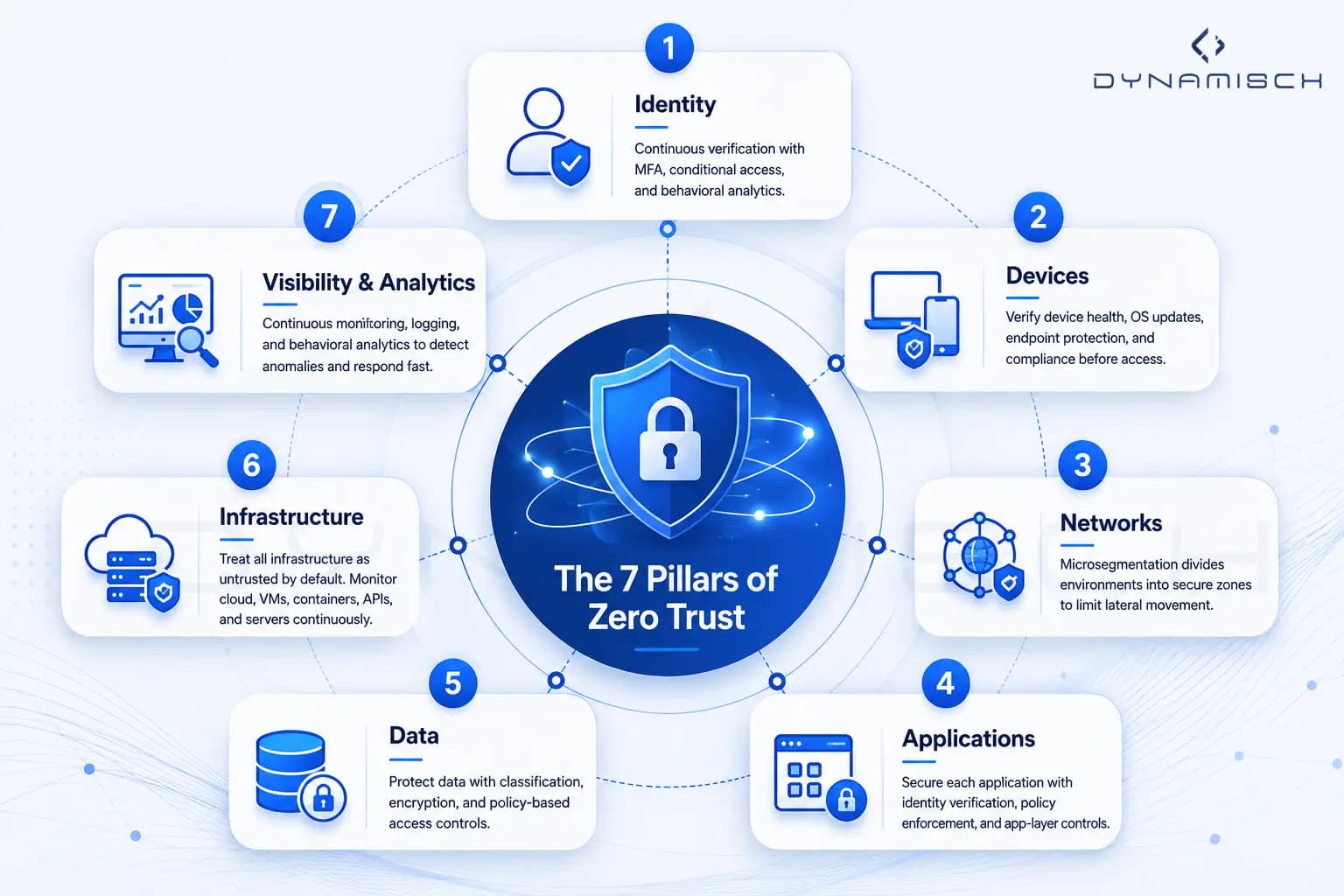
Identity
Identity is the foundation of the Zero Trust security model. Controls such as multi-factor authentication (MFA), conditional access policies, and behavioral analytics must continuously verify every user before the system grants access.
Devices
Every device requesting access must meet defined health, security, and compliance standards. Zero Trust checks device health, operating system updates, endpoint protection status, and risk signals. Only then does it allow access to enterprise resources.
Networks
Zero Trust networks use microsegmentation to divide environments into smaller security zones. This limits lateral movement and helps contain attackers even if a breach occurs inside the network.
Applications
Zero Trust secures each application individually instead of trusting users based on network location. It grants access per session through identity verification, policy enforcement, and application-level controls.
Data
Zero Trust protects data through classification, encryption, and policy-based access controls. Users and applications can only access the specific data required for their role or task.
Infrastructure
All infrastructure components are treated as untrusted by default. This includes cloud workloads, virtual machines, containers, APIs, and servers. Continuous monitoring and policy enforcement help secure modern hybrid and multi-cloud environments.
Visibility and Analytics
Continuous monitoring, logging, and behavioral analytics provide real-time visibility across the entire environment. This helps security teams to quickly detect anomalies, investigate suspicious activity, and respond to threats before they escalate.
Zero Trust vs Traditional Perimeter Security: Key Differences
Traditional perimeter security was designed for centralized, on-premise environments where users and systems operated inside a clearly defined corporate network. Zero Trust Architecture supports modern cloud, hybrid, and distributed environments where users, devices, and applications operate far beyond a traditional perimeter.
Here are the key differences between Zero Trust and Traditional Perimeter Security:
| Factor | Traditional Perimeter Security | Zero Trust Architecture |
|---|---|---|
| Trust model | Implicit trust inside the network | No implicit trust anywhere |
| Access control | Network-based access | Identity and context-based access |
| Verification | Usually performed once at login | Continuous verification throughout sessions |
| Lateral movement | Often unrestricted internally | Contained through microsegmentation |
| Remote work | Relies heavily on VPN tunnels | Native support through Zero Trust Network Access (ZTNA) |
| Cloud compatibility | Designed mainly for on-premise environments | Built for hybrid and multi-cloud infrastructure |
| Breach assumption | Focused on keeping attackers out | Assumes breach and limits impact |
| Security visibility | Limited east-west traffic visibility | Continuous monitoring and analytics |
| Compliance alignment | Increasingly difficult to align with modern regulations | Maps closely to NIST, NCSC, ISO 27001, NIS2, and DORA guidance |
As enterprise environments become more distributed, organizations are increasingly shifting from perimeter-centric security to Zero Trust models.
How Zero Trust Architecture Works in Practice
At its core, Zero Trust Architecture operates as a continuous verification loop. It evaluates every access request in real time before users, devices, or applications can interact with enterprise resources.
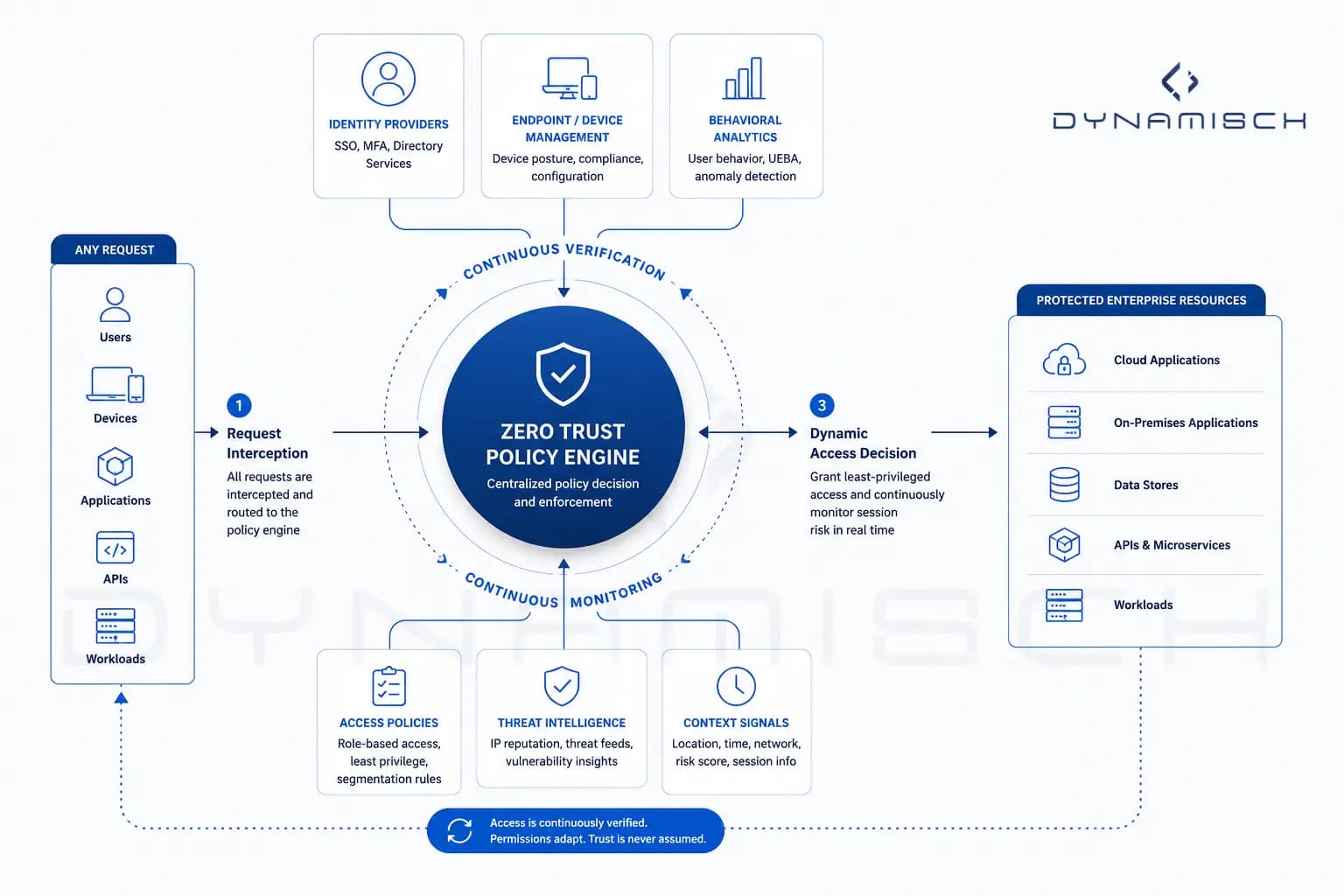
Step 1: Request Interception
Every access request is intercepted by a centralized policy engine before access is granted. This approach applies to users, devices, APIs, workloads, and applications, whether requests come from inside or outside the network.
Instead of trusting traffic by default, the policy engine evaluates each request against predefined security policies.
Step 2: Identity and Context Verification
The policy engine continuously checks multiple signals, such as user identity, multi-factor authentication status, device health, location, access time, and user behavior.
For example, Zero Trust may approve a login request from a managed corporate device during normal working hours. However, it may require extra verification or deny the same request from an unknown device or unusual location.
Step 3: Dynamic Access Decision
Once verification is complete, access is granted with the minimum permissions required for that specific session. Zero Trust continuously monitors permissions and adjusts or revokes access when risk conditions change.
This dynamic approach limits overprivileged access and helps prevent attackers from moving laterally across systems after a compromise.
Zero Trust Architecture Components and Technologies
Zero Trust Architecture is not a single product. It combines multiple security technologies that work together to continuously verify identities, secure access, and monitor activity across enterprise environments.
Identity and Access Management (IAM)
Identity and Access Management forms the foundation of the Zero Trust security model. IAM platforms help organizations verify users through single sign-on (SSO), multi-factor authentication (MFA), conditional access policies, and privileged access management controls.
These systems ensure users only receive access to the applications and resources required for their role.
Zero Trust Network Access (ZTNA)
Zero Trust Network Access replaces traditional VPN-based access models. Instead of exposing the entire network, ZTNA grants users access only to specific applications or services after identity and security verification.
ZTNA evaluates each request independently, helping organizations secure remote workforces, cloud applications, and hybrid environments more effectively.
Microsegmentation
It divides networks and workloads into smaller isolated zones. If attackers gain access to one segment, they cannot automatically move laterally across the environment. This approach helps organizations secure cloud and hybrid infrastructures where teams deploy applications and workloads across distributed environments.
Security Information and Event Management (SIEM) and SOAR
SIEM and SOAR platforms provide continuous monitoring, centralized logging, threat detection, and automated incident response capabilities. These systems help SecOps teams quickly detect suspicious activity. They use real-time analytics and automated workflows to enforce Zero Trust policies.
Cloud Access Security Broker (CASB)
Cloud Access Security Brokers help organizations monitor and control access to cloud applications and SaaS platforms. CASB solutions enforce security policies across cloud environments, improve visibility into user activity, and help protect sensitive data stored in third-party applications.
Zero Trust Compliance Requirements in the USA and UK
Zero Trust Architecture is no longer viewed as only a cybersecurity best practice. Regulators and agencies in the USA, UK, and EU expect organizations to use security models. These models must verify access often and follow Zero Trust principles.
United States: NIST SP 800-207 and Federal Zero Trust Strategy
In the USA, NIST SP 800-207 provides the foundational framework for Zero Trust Architecture. Federal adoption increased after the 2021 Executive Order on Improving the Nation’s Cybersecurity. The Office of Management and Budget (OMB) later introduced its Zero Trust Strategy memorandum.
CISA later introduced its Zero Trust Maturity Model, outlining requirements across identity, devices, networks, applications, and data. Federal agencies had to meet key Zero Trust goals by the end of 2024. This made Zero Trust a required strategic direction for the US public sector.
United Kingdom: NCSC Zero Trust Guidance and Cyber Essentials
The UK’s National Cyber Security Centre (NCSC) has increasingly encouraged organizations to move beyond perimeter-only security approaches. Its guidance aligns closely with Zero Trust concepts such as strong identity verification, device security, segmentation, least privilege access, and continuous monitoring.
Cyber Essentials Plus also supports several Zero Trust controls through secure configuration, access management, malware protection, and vulnerability management requirements. Regulations like the UK GDPR and the PSTI Act also support Zero Trust principles. They focus on identity verification, secure access, and device security.
European Union: NIS2 Directive and DORA
The European Union’s NIS2 Directive and DORA are increasing Zero Trust adoption in critical sectors. This is especially true for financial services and essential infrastructure.
Both frameworks support Zero Trust principles through different controls. This includes strict access management, incident reporting, network segmentation, continuous monitoring, and third-party risk management.
What This Means for Organizations Operating Across Jurisdictions
For organizations operating across multiple markets, maintaining separate security programs for different regulatory environments is increasingly inefficient.
Many frameworks share common requirements, including strong identity controls, least privilege access, segmentation, and fast incident response. As a result, enterprises are adopting Zero Trust Architecture as one model. This helps simplify compliance across the USA, UK, and EU.
Zero Trust for AI-Powered and Agentic Environments
AI-powered systems, autonomous agents, and hyperconnected cloud environments are rapidly expanding the enterprise attack surface. In 2026, implicit trust is becoming increasingly risky as machine identities, automated workflows, and AI-driven applications interact across distributed environments at massive scale.
Zero Trust Architecture is evolving beyond human identity security to secure AI-native ecosystems as well.
Securing AI Agents and Non-Human Identities
AI agents, service accounts, APIs, and automated pipelines now represent a growing percentage of enterprise identities. Unlike human users, these non-human identities often operate continuously.
Unlike traditional IAM systems, Zero Trust extends continuous verification, least privilege access, and behavioral monitoring to machine identities as well. This helps organizations reduce the risk of credential abuse, API compromise, and unauthorized automation activity.
Protecting AI Training Data with Zero Trust Data Controls
AI training datasets have become high-value targets for attackers. Compromised or manipulated data can lead to biased models, inaccurate outputs, or AI poisoning attacks.
Zero Trust data controls help protect AI systems. They use data classification, encryption, granular access policies, and continuous monitoring of data pipelines. They restrict access to sensitive training data based on identity, role, and context.
Some organizations also apply immutable storage and version-controlled data pipelines to protect AI training datasets from tampering, accidental modification, or ransomware attacks. It improves traceability, recovery, and data integrity across AI and cloud-native environments.
Using AI to Enforce Zero Trust Policies
AI is also strengthening Zero Trust enforcement itself.
Behavioral analytics, anomaly detection, and AI-driven threat intelligence allow policy engines to evaluate risk more accurately in real time. AI-powered systems can detect unusual login behavior or suspicious device activity. They can also trigger adaptive security responses automatically instead of relying only on static rules.
This improves threat detection speed while reducing false positives and operational overhead for security teams.
How to Implement Zero Trust Architecture: A Phased Approach
Zero Trust implementation is not a one-time deployment. Many organizations adopt Zero Trust Architecture gradually by prioritizing critical systems, high-risk assets, and identity controls first.
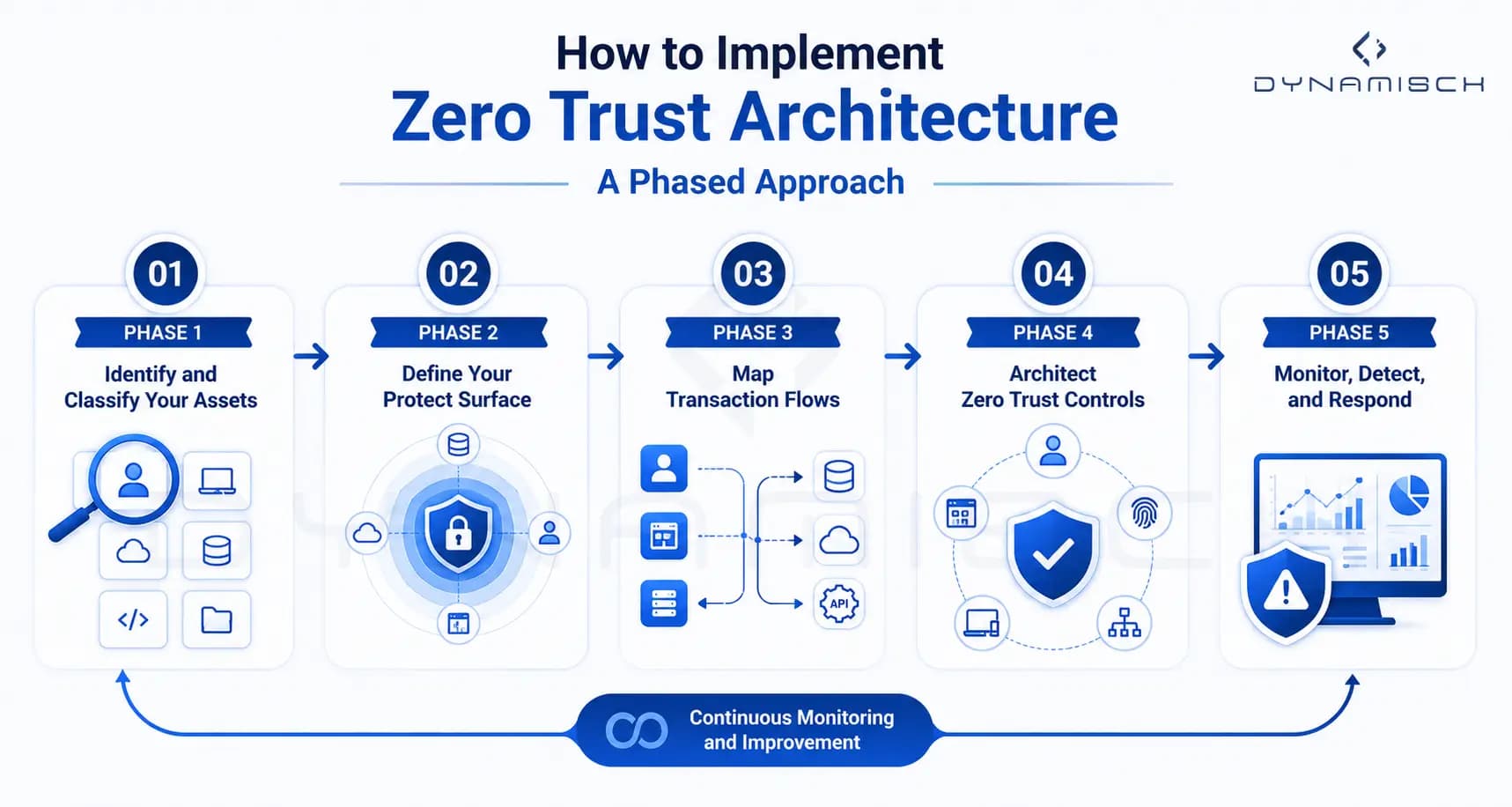
Phase 1: Identify and Classify Your Assets
You cannot protect what you cannot see. Start by creating a full inventory of users, devices, apps, cloud workloads, APIs, and sensitive data flows. This visibility helps you understand where critical assets exist and which systems present the highest risk.
Phase 2: Define Your Protect Surface
Unlike traditional perimeter security, Zero Trust focuses on protecting the smallest possible attack surface around critical assets. This “protect surface” may include customer data, financial systems, AI models, healthcare records, and production workloads. These assets require stronger access controls and monitoring.
Phase 3: Map Transaction Flows
Before implementing policies, you must understand how users, applications, and systems interact with protected resources. Mapping transaction flows helps identify unnecessary access paths, shadow IT activity, and excessive permissions that attackers may exploit.
Phase 4: Architect Zero Trust Controls
After identifying critical flows, implement Zero Trust controls such as identity verification, MFA, microsegmentation, device health checks, and least-privilege access. Most organizations begin with high-risk systems and expand controls incrementally across the environment.
Phase 5: Monitor, Detect, and Respond
Zero Trust is an ongoing operational model. Continuous monitoring, log analysis, behavioral analytics, and policy updates help organizations detect threats early, respond faster, and adjust security controls as environments change.
Common Mistakes When Implementing Zero Trust
Even well-funded Zero Trust initiatives can fail if organizations approach implementation incorrectly. Some of the most common mistakes include:
- Treating Zero Trust as a product purchase: Zero Trust Architecture is not a single product or tool. It is a long-term security strategy that requires ongoing implementation and improvement. Successful implementation requires coordinated identity, network, device, application, and monitoring controls.
- Starting with network controls before identity management: Identity is the foundation of Zero Trust. Organizations that prioritize segmentation or network tooling before strengthening IAM, MFA, and access governance often create operational complexity.
- Protecting new systems and leaving legacy environments trusted: Many organizations secure cloud applications, but continue granting implicit trust to older on-premise systems. Attackers often exploit these legacy environments as easier entry points.
- Ignoring non-human identities: Service accounts, APIs, AI agents, automation tools, and machine identities are rapidly increasing across enterprise environments. Unmanaged API keys and overprivileged service accounts can become major attack points.
- Skipping asset discovery and transaction mapping: Zero Trust policies are only effective when organizations fully understand their users, applications, data flows, and system dependencies. Incomplete visibility often leads to overly permissive access policies.
Zero Trust Architecture by Industry
Zero Trust Architecture requirements vary across industries depending on regulatory obligations, operational risks, and infrastructure complexity.
Healthcare
Healthcare organizations use Zero Trust to protect electronic health records (EHR), secure connected medical devices, and reduce ransomware risks. Strong identity verification, device security, and least-privilege access also help support HIPAA compliance and protect sensitive patient data.
Banking and Financial Services
Financial institutions use Zero Trust to prevent fraud and protect privileged access to banking systems. Using Zero Trust, they meet regulatory requirements such as DORA and PCI DSS. With continuous verification and behavioral analytics, they identify suspicious account activity before attackers can move across critical financial infrastructure.
Manufacturing
Modern manufacturing environments increasingly rely on connected industrial IoT devices, smart factories, and converged IT/OT systems. Zero Trust helps manufacturers secure production systems, control device identities, and limit lateral movement between operational technology and enterprise networks.
SaaS and Hi-Tech
SaaS and technology companies use Zero Trust to secure multi-tenant environments. They use it to protect CI/CD pipelines and manage developer access across cloud-native systems. They use granular identity controls and continuous monitoring to reduce the risk of unauthorized access and supply chain attacks.
Final Thoughts
Zero Trust Architecture is no longer optional for modern enterprises operating across cloud, AI-driven, and distributed environments. As cyber threats grow, more sophisticated and regulatory expectations continue to evolve across the USA, UK, and EU.
The “never trust, always verify” model helps organizations reduce lateral movement, strengthen identity security, protect sensitive data, and improve resilience against modern attacks. But successful Zero Trust adoption requires a long-term architectural approach built around continuous verification, least-privilege access, and adaptive policy enforcement.
Organizations that start building Zero Trust maturity today will be ready to secure hybrid systems and AI-driven environments. This approach improves confidence, compliance readiness, and operational resilience.
Frequently Asked Questions

Arvind Thevar
DevSecOps Architect
Arvind is a skilled DevOps and Site Reliability Engineer proficient in Kubernetes, AWS, Docker, and Terraform. He has a proven track record in automating infrastructure, migrating monolithic applications to containerized environments, and establishing robust CI/CD pipelines. He ensures regulatory compliance and security in high-risk environments. He works across AWS, GCP, and Azure to support secure operations.