
The distinction between Forward Deployed Engineering (FDE) and traditional consulting is simple to state and easy to underestimate: a Forward Deployed Engineer builds and delivers production code and is judged on whether the system works, while traditional strategy and advisory consulting engagements typically culminate in recommendations, roadmaps, or implementation plans.
Nearly every other operational difference between FDE and traditional consulting, where the work happens, how fast value shows up, how success gets measured, follows from this one fact.
For enterprise buyers comparing FDE and consultant models before a procurement decision, understanding this root distinction matters more than comparing rates, seniority, or resumes. This article breaks down exactly how it plays out in practice.
Many consulting firms offer implementation services as well. This comparison focuses specifically on advisory-led consulting engagements, where recommendations are the primary deliverable, versus Forward Deployed Engineering engagements, where implementation is the primary deliverable.
Key Takeaways:
-
The core difference between FDE and consulting is accountability: a Forward Deployed Engineer is accountable for a working system, a traditional consultant is accountable for the quality of a recommendation.
-
Consultants typically work from their own environment and hand off a deliverable, while FDEs work inside the client's live environment, committing code to the client's own repository.
-
Roughly 30 to 50 percent of consulting recommendations are never fully operationalized, often because the engagement ends before implementation meets real organizational friction.
-
Enterprise consulting engagements commonly run 12 to 24 weeks of analysis before implementation starts, while FDE work compresses discovery, prototyping, and validation into a concurrent process, often producing a working prototype within weeks.
-
Traditional consulting fits situations needing a strategy, audit, or second opinion before committing engineering resources. Forward Deployed Engineering fits situations needing working software inside existing infrastructure and constraints.
-
Research from MIT Project NANDA and Deloitte both point to the same root cause of AI pilot failure: integration with real systems, not model performance, which is the specific gap FDE is structured to close.
-
Companies can use both models on the same initiative, typically consulting for early strategy and FDE once a working system needs to be built and deployed.
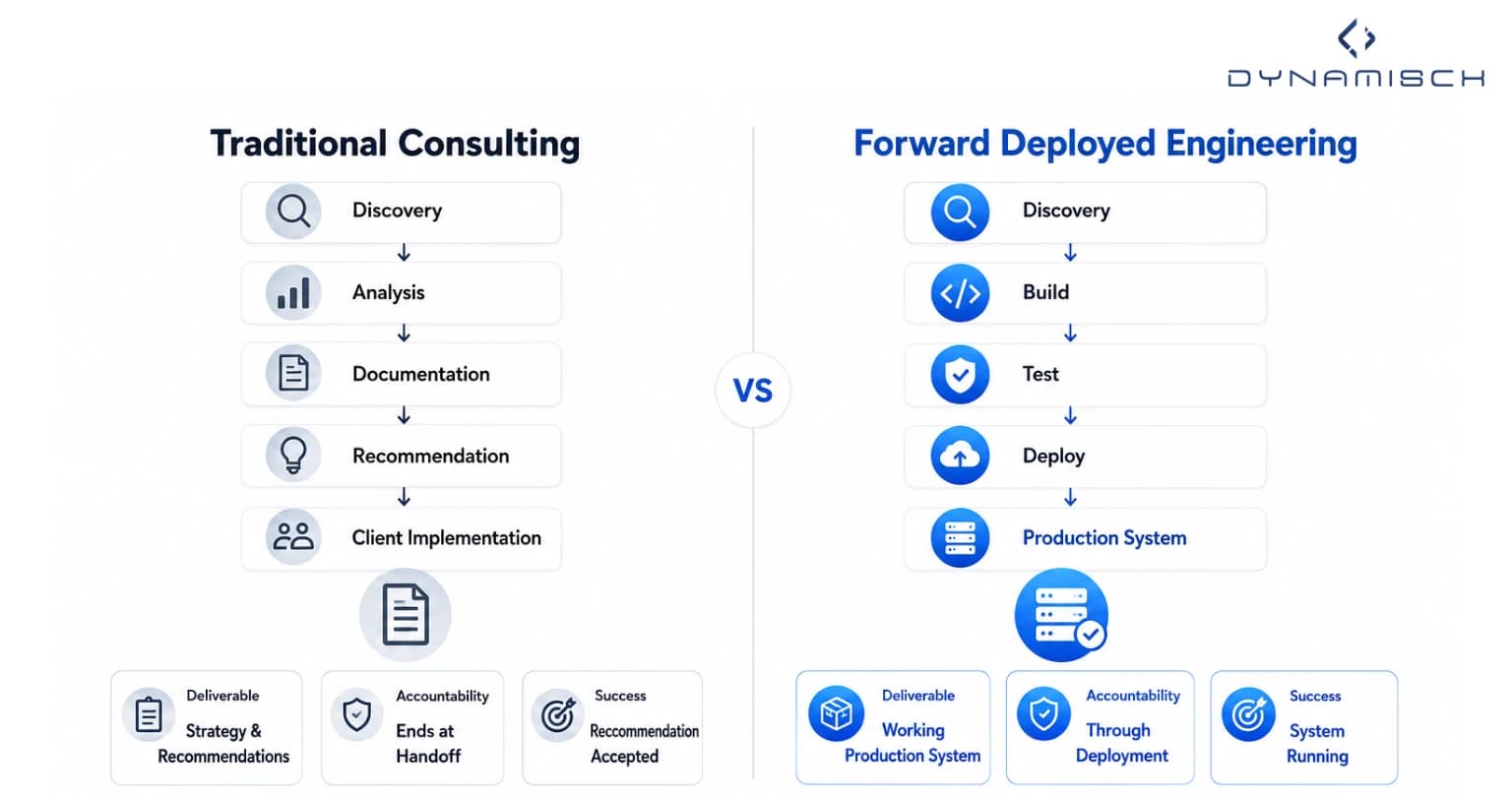
What Is the Core Difference Between FDE and Consulting?
The core difference between an FDE and a consultant is accountability: a forward deployed engineer is accountable for a working system, whereas a traditional consultant is typically accountable for the quality of the delivered analysis and recommendations. That single fact shapes everything downstream.
It determines whether the engagement ends at a handoff or continues through deployment, where the work physically happens, and what happens when the original plan meets a system it was not designed for.
A consultant who discovers a gap between the spec and reality can note it in a follow-up report. An FDE working inside the client's environment has to solve it because the code still has to run.
Why This Distinction Matters More Than the Job Title
Both roles can be senior, expensive, and sharp, so seniority is not what separates them. What separates a forward deployed engineer from an implementation consultant is what each is structured to produce: a document the client has to act on, or a system that already works.
Where the Work Actually Happens
A traditional consultant typically does the discovery and analysis work in their own environment, conducts interviews and workshops, produces requirements documents, and then builds the deliverable off-site before handing it over.
While consultants may also spend significant time on-site or embedded with client teams, they are not always responsible for delivering production software themselves.
A Forward Deployed Engineer works from inside the client's environment instead. That means committing code to the client's own repository, joining the client's daily standups, and building directly against the client's real systems and data rather than sitting in a home office managing a ticket queue.
In modern engagements, the FDEs even work in hybrid or remote mode but are dedicatedly connected to the client's environment. This is not a minor scheduling difference. It changes what the engineer can see, and when.
Why Presence Changes What Gets Discovered, and When
In many cases, the deployment failures don't come from bad requirements documents. Instead, they come from constraints nobody wrote down: a data field that's messier in production than in the sample set, a legacy system that behaves differently than documented, an approval step nobody mentioned.
A consultant working from a specification usually finds these gaps at integration, the most expensive and disruptive point to find them. An FDE working inside the environment tends to find them earlier, before the build has committed to a direction that later has to be undone.
How Success Is Measured Differently
Success in traditional consulting is typically measured by the quality of the analysis and whether the client accepts the recommendation, not by what happens after. It's the distinction that matters more than it sounds.
Industry data suggests roughly 30 to 50 percent of consulting recommendations are never fully operationalized, often because the engagement ends before implementation runs into real organizational friction. By the time a recommendation is tested against production reality, it's frequently no longer the consultant's problem to solve.
Forward Deployed Engineering is measured differently. Success means the system is actually running and being used, because the FDE stays through deployment rather than exiting at handoff.
For procurement teams comparing FDE vs consultant models, this is the accountability question worth asking directly: Is this person or team responsible for the recommendation or for the outcome?
How Delivery Speed and Structure Compare
Delivery speed is one of the clearest differences between FDE and traditional consulting, and it comes down to sequencing rather than effort.
Traditional consulting typically runs in phases: weeks or months of discovery and analysis, a recommendation, then a separate implementation phase, often with a different team altogether.
Enterprise consulting engagements commonly stretch to 12 to 24 weeks of analysis before implementation even begins, pushing first production value out to six months or longer.
Forward Deployed Engineering compresses that sequence instead of just speeding it up. Discovery, prototyping, and validation against real systems happen concurrently, so a working prototype often exists within weeks and a production-ready capability follows shortly after.
The engineer isn't waiting for sign-off between phases; they're building against live feedback as they go.
For enterprise buyers, this timeline difference is often the most concrete signal separating forward deployed engineering and consulting during evaluation, since it shows up directly in contract structure and milestone definitions.
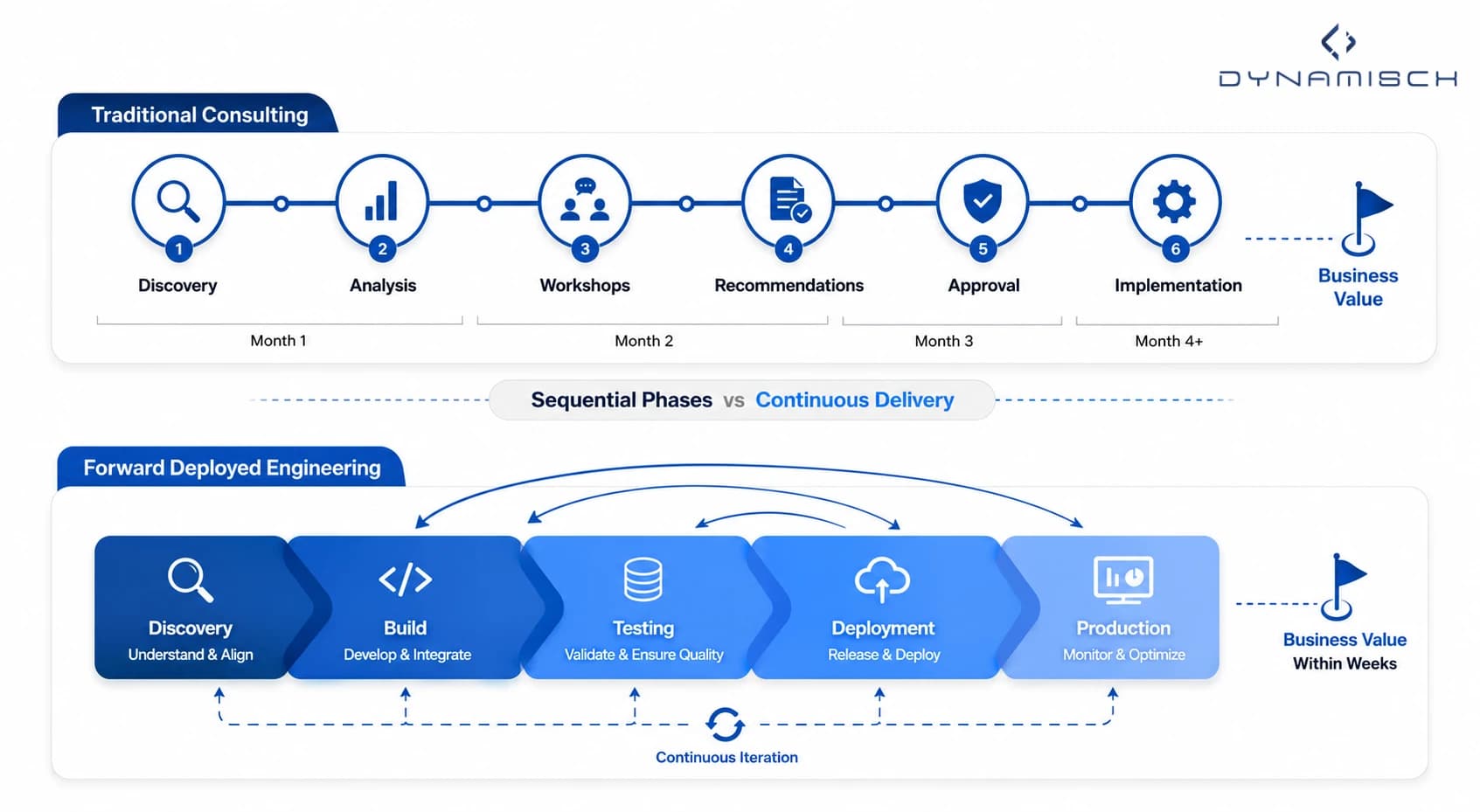
FDE vs Traditional Consulting: Side-by-Side Comparison
The table below summarizes how FDE vs traditional consulting compare across the factors that matter most in a procurement decision: where the work happens, what gets delivered, what each model is actually built for, and how success is measured.
| Factor | Traditional Consulting | Forward Deployed Engineering |
|---|---|---|
| Primary deliverable | Recommendation, report, or roadmap | Working system in production |
| Where the work happens | Consultant's own environment, client visited periodically | Inside the client's live environment |
| Success measured by | Quality and acceptance of the recommendation | Whether the system is deployed and adopted |
| Timeline to value | Often months, phased sequentially | Weeks, discovery and build run concurrently |
| Accountability after delivery | Often ends at handoff | Continues through deployment and adoption |
| Best suited for | Strategy, audits, second opinions before committing resources | Working software that has to function inside your stack |
When to Choose Each Model
The right choice between FDE and a consultant depends on what you actually need at the end of the engagement: a decision or a deployed system.
When Traditional Consulting Is the Right Fit
Traditional consulting makes sense when you need an audit, a strategy, or an independent second opinion before committing engineering resources.
If no production system is being built yet and the goal is to assess options, align stakeholders, or validate a direction, a recommendation is the right deliverable. You're paying for judgment and analysis, not the final code.
When Forward Deployed Engineering Is the Right Fit
Forward Deployed Engineering is the right fit when the need is working software that has to function inside your existing legacy systems, infrastructure, and security constraints.
If the initiative depends on something actually running, a recommendation alone won't move it forward. This is where forward deployed engineering vs consulting stops being a philosophical distinction and becomes a practical one: someone has to own getting the system live.
What This Means for Enterprise AI Initiatives Specifically
Enterprise AI initiatives are especially exposed to this distinction because of where AI pilots actually fail. Research from MIT's Project NANDA and separate Deloitte survey data both point to the same root cause: pilots stall because the organization can't get the system integrated with real legacy systems, production data, and existing workflows, and not because the model underperforms.
That is precisely the gap a traditional consultant's recommendation cannot close on its own, and precisely the gap Forward Deployed Engineering is structured to work inside of.
This makes the choice between FDE and consultant a materially different bet for AI projects specifically. A strategy document describing how an agentic AI system should integrate with your ERP or legacy data pipeline is not the same as an engineer building and testing that integration against your actual systems.
For enterprise AI and agentic AI deployment, that difference often determines whether an initiative reaches production at all.
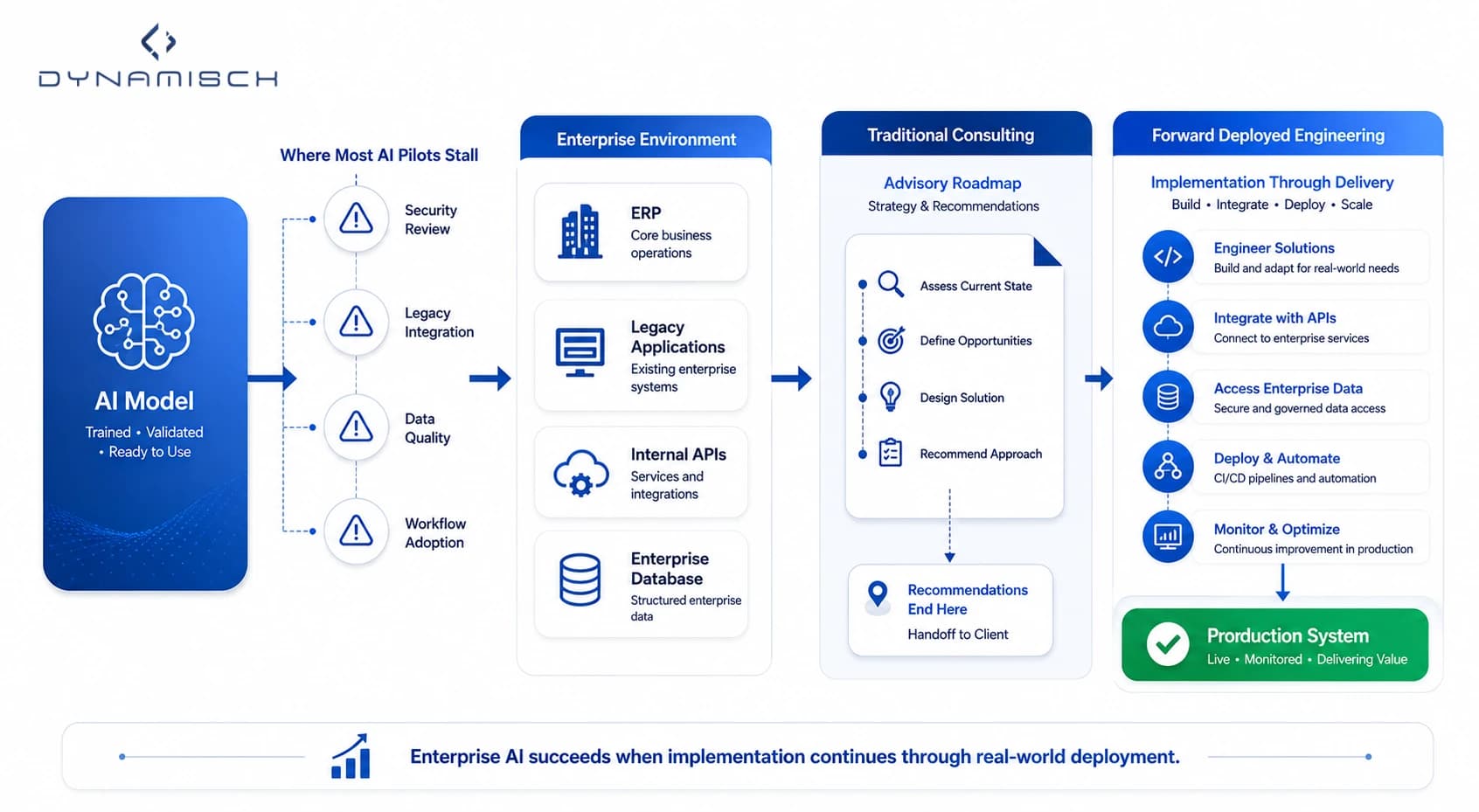
How Dynamisch Applies the FDE Model
Dynamisch runs Forward Deployed Engineering as a staffed, ongoing practice, not a one-off project team assembled for a single engagement.
The practice applies to complex API and Model Context Protocol (MCP) tooling integration, agentic AI implementation, legacy code modernization, and large-scale data migration, the kinds of work where a recommendation alone rarely moves the needle, and someone has to own getting the system running inside your existing stack.
For enterprise buyers comparing forward deployed engineer and implementation consultant options, the practical question is who stays accountable once the build starts touching your real systems.
Dynamisch's FDE engineers work inside that environment for the duration of the deployment, not just through initial scoping.
Explore the full details on Dynamisch's FDE capability here.
Conclusion
The FDE vs consultant decision is not just a staffing preference. It shapes whether an initiative gets a document or a working system, and how long that takes.
Choosing the wrong model for the job costs money, and moreover, it costs months you don't get back, months your competitors may be spending building instead of deciding. This choice deserves the same scrutiny you'd apply to any other vendor decision that determines whether an initiative actually reaches production.
If you're evaluating engagement models for an AI or software initiative, talk to our FDE team about whether this model fits your situation.
Frequently Asked Questions

Arpit Singh
Senior Technical Lead
Arpit Singh is a Senior Tech Lead with over 10 years of experience, skilled in translating complex client requirements into actionable strategies. He empowers the technical team to deliver exceptional solutions through effective communication and mentorship. Arpit also leads execution on the ground for Dynamisch's Forward Deployed Engineering team, training engineers to work directly inside client environments and deliver production-ready systems, not just prototypes.