
When managing Salesforce at the enterprise level, did you ever find the release process as simple as moving changes from a sandbox into production? It's rare. Large organizations often have to tackle thousands of metadata components, complex approval chains, and strict compliance requirements.
These complexities result in a somewhat familiar problem. The deployments work in one ecosystem but fail in another. This creates operational risks, delays, and frustration across the team.
That challenge is now becoming more acute as Salesforce is moving beyond CRM customization into a platform for data-driven automation, multi-cloud applications, and AI agents. This is all through its capabilities such as Data Cloud and Agentforce. This increased platform complexity makes manual change management difficult to sustain.
According to Gearset's 2025 State of Salesforce DevOps report, only 13% of Salesforce teams don't have plans to pursue DevOps practices, while the vast majority are actively implementing.
For enterprise leaders, slow and error-prone releases affect more than developer productivity. They can increase compliance exposure and make it harder to retain skilled Salesforce talent.
In this guide, we’ll see what Copado is, how it works, its core capabilities, and how enterprises can evaluate whether it fits their Salesforce modernization strategy.
Key Takeaways
- Copado is a Salesforce-native DevOps and release management platform that combines CI/CD, automated testing, governance controls, and AI-driven operational intelligence.
- Founded in 2013, Copado has evolved from a deployment automation tool into an enterprise DevOps platform serving more than 1,750+ customers across regulated and complex Salesforce environments.
- Core capabilities of Copado include Git-based CI/CD pipelines, robotic test automation, Org Intelligence™ for metadata and dependency visibility, and Agentia™ for AI-assisted delivery operations.
- The primary business value of using Copado is reducing deployment risk, improving release consistency, and accelerating delivery across multi-org Salesforce ecosystems.
- Copado is best suited for mid-market and enterprise organizations with frequent releases, multiple Salesforce environments, or stringent compliance requirements.
- A major 2026 trend is the rise of AgentOps, where platforms such as Copado extend beyond DevOps automation to govern autonomous AI agents operating throughout the software delivery lifecycle.
What Is Copado?
Copado is a Salesforce-native DevOps, release management, and testing platform designed to help organizations plan, build, test, deploy, and govern changes across Salesforce environments and other enterprise SaaS platforms.
Copado is not like other generic CI/CD tools. It's built particularly for the complexities of Salesforce org structures, configuration, and metadata. It allows developers, administrators, and release managers to work within a platform that understands how Salesforce applications are actually developed and deployed.
Founded in Madrid in 2013 by Salesforce release engineers Federico Larsen and Philipp Rackwitz, Copado was started as a deployment automation solution and eventually grew into a broader enterprise DevOps platform. Headquartered in Chicago, the company has raised more than $270 million from investors including Insight Partners, Salesforce Ventures, and IBM Ventures.
Today, Copado itself is an end-to-end Salesforce DevOps tool that combines CI/CD, automated testing, AI-powered operational intelligence, compliance controls, and release orchestration. The platform serves more than 1,750+ global brands across industries including financial services, healthcare, manufacturing, and logistics.
What Does Copado Actually Do?
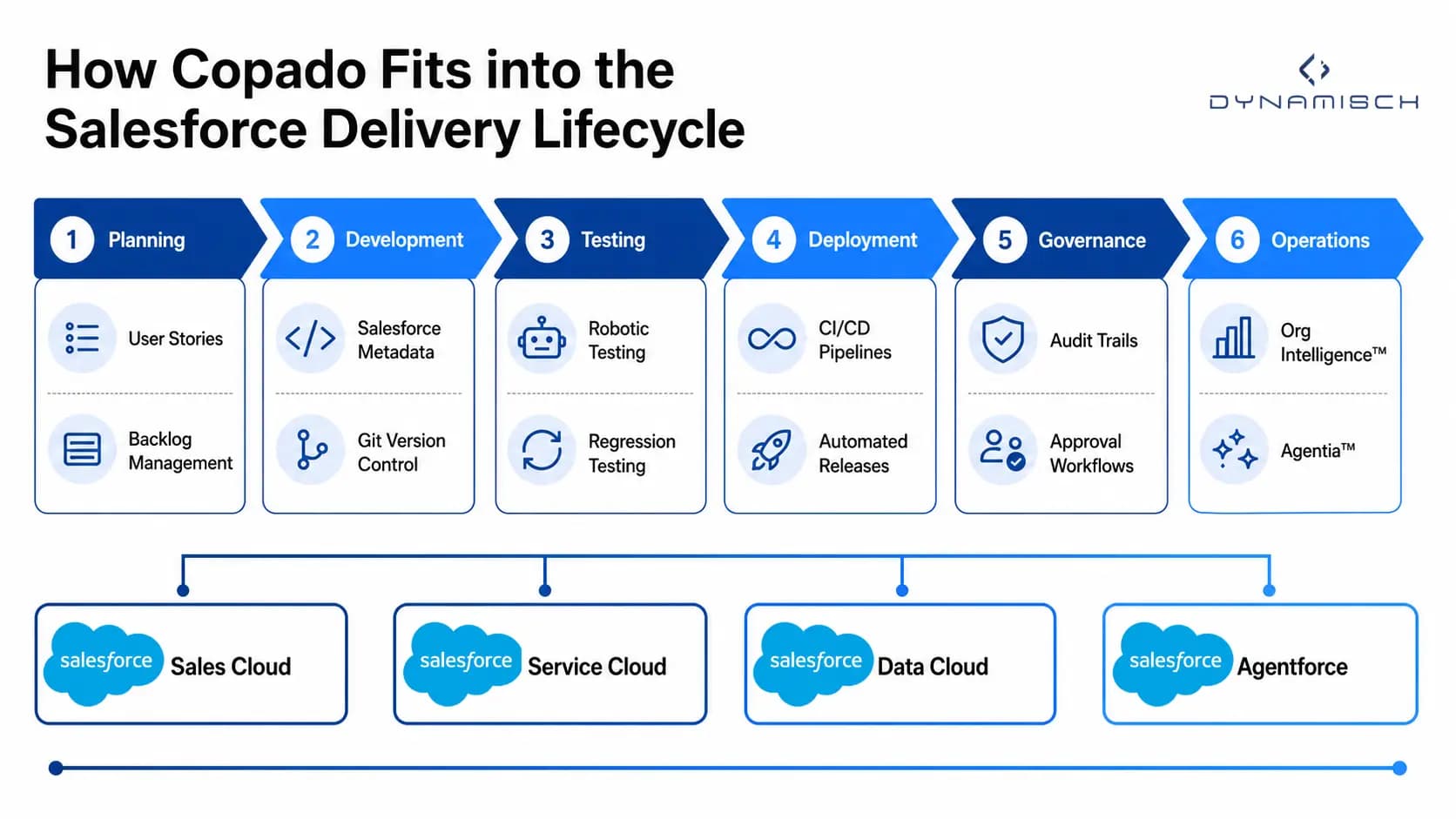
Copado DevOps platform helps enterprises manage the entire Salesforce delivery lifecycle, from planning, development, testing, to deployment and operational governance. It is built to overcome challenges that traditional software delivery tools struggle with in the Salesforce ecosystem.
CI/CD for Salesforce
Copado CI/CD brings Git-based version control, branching strategies, automated deployments, and release pipelines to Salesforce. Now, teams don't need to rely on manual change sets. They can promote changes through controlled environments using repeatable workflows. This improves consistency and reduces deployment risk.
Robotic / Automated Testing
Copado includes low-code automated testing capabilities and exploratory testing tools. This helps in validating Salesforce changes before production releases. By automating regression testing and test execution, organizations can shorten QA cycles while reducing the chance of errors in critical business processes.
Org Intelligence™
Launched in 2025, Org Intelligence™ is the platform that provides visibility into Salesforce metadata, automations, architecture, and dependencies. The purpose of this platform is to help teams understand how components are connected, what deployment risks are there, and what potential downstream impacts there are before changes are released.
Agentia™ and the Shift to AgentOps
In April 2026, Copado introduced Agentia™, a platform that integrates context-aware AI agents into the software development process. These agents operate within the governed workflows and can help with almost everything in the Salesforce lifecycle including planning, code generation, testing, release coordination, and even issue diagnosis.
When Dynamisch Founder & CEO Parag Tribhuwankar attended CopadoCon 2026 in Bengaluru, he watched Agentia go live on the main stage. It featured five specialist agents, each connected to a different stage of the release lifecycle and working inside the actual pipeline.
His takeaway echoed a pattern we see repeatedly with enterprise Salesforce teams: most leaders already know that Copado is the right platform. The bigger challenge and the reason many implementations slow down is configuring it correctly and making it work effectively across a real, multi-org environment.
Copado describes this emerging model as "AgentOps", the discipline of managing and governing autonomous AI agents.
Compliance & Governance
It's required to follow proper governance and compliance for businesses working in regulated industries. Copado takes care of this challenge as well. It provides audit trails, deployment controls, policy-based governance, and approval workflows. These capabilities help organizations maintain traceability across releases.
Why Enterprises Adopt Copado: The Business Case
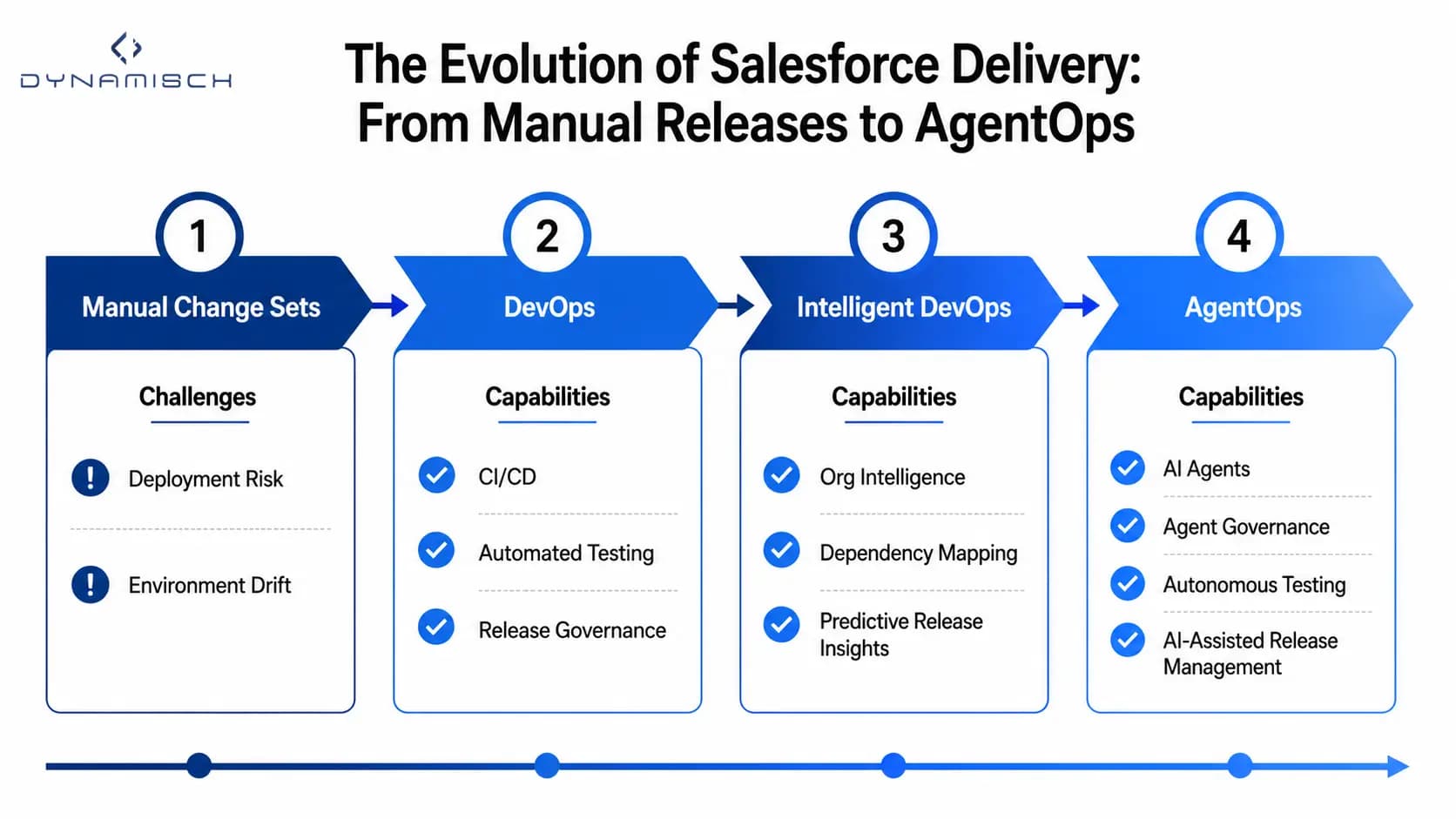
Enterprises typically adopt Copado because Salesforce delivery becomes very difficult to manage once the teams, environments, and business-critical workflows grow. Manual deployments and inconsistent testing processes cause deployment failures, environment drift, and delayed releases.
The root challenge lies in Salesforce's architecture. Salesforce combines almost everything like code, integrations, metadata, and security configurations. It can create operational risk and reduce delivery predictability if you manage these dependencies using manual change sets.
This can largely impact your business. If the release cycles are slow, it can delay CRM improvements, regulatory updates, and new AI capabilities. In regulated industries like financial services, it may also create audit concerns, production disruptions, and data integrity issues.
A structured Salesforce DevOps tool such as Copado aims to address these challenges through standardized release processes, automated testing, deployment governance, and traceability across environments.
As discussed before, the broader market trend already supports this shift, with 87% of Salesforce teams either practicing DevOps or actively pursuing DevOps maturity. This suggests that more companies are considering Salesforce DevOps as a must-have instead of a nice-to-have.
For enterprise leaders, the strategic advantage is very clear: faster and safer releases make it easy to deliver new customer experiences, AI-driven business services, and advanced analytics while maintaining governance and control.
Who Should (and Shouldn't) Use Copado
Copado generally works best for large companies that manage several Salesforce systems and make regular updates. It is especially useful for businesses that must follow strict rules or have many Salesforce developers. In these environments, Copado's tools are worth using for managing structured releases, maintaining governance, and automating testing.
On the other hand, Copado may not be suitable for organizations having a single Salesforce org, limited customization, and fewer deployment needs. User reviews about Copado DevOps on different platforms, like G2, emphasize that it has an initial learning curve and configuration overhead, particularly for those who don't have dedicated DevOps ownership.
Copado is one option. But there are other tools as well like this for Salesforce DevOps, including Flosum, ACCELQ, Salesforce DevOps Center, and Gearset. Choosing the right one totally depends on the organization's budget, scaling requirements, delivery maturity, and compliance requirements.
How Copado Fits into a Modern Enterprise Tech Stack
Copado sits exactly within the application delivery layer of the enterprise technology stack. The layer that specifically focuses on Salesforce release management, deployment automation, and governance.
By integrating with Git repositories, IT service management tools, CI/CD pipelines, and other collaboration systems, Copado helps connect the Salesforce development to wider software delivery processes.
From an architectural perspective, Copado solves one part of enterprise transformation. Companies using Salesforce AI, analytics tools, AI agents, or Data Cloud also need supporting skills like data engineering, MLOps, cloud security, and integration architecture.
This distinction matters. Copado helps to govern how Salesforce changes move safely into production, while the surrounding technology ecosystem determines how applications, AI models, data, and business processes operate together.
For most large enterprises, successful Salesforce modernization requires both capabilities working in concert.
How Copado Is Used Across Industries
Copado has the same core capabilities for all users, but different industries choose it for different reasons.
Banking & Finance
Financial institutions often manage large Salesforce environments. They must follow strict internal policies and industry regulations. The approval workflows, release governance, and audit trails capabilities of Copado help support controlled change management and deployment traceability.
Healthcare & Life Sciences
Healthcare organizations that use Salesforce for patient engagement, clinical operations, or Health Cloud deployments most of the time require highly controlled release processes. Copado's automated testing and deployment governance help these organizations in reducing risk and maintaining auditable records of platform changes.
Retail & Consumer
Retail businesses regularly release Salesforce updates to support seasonal sales, customer service, loyalty programs, and other e-commerce operations. Copado's CI/CD automation helps them release these updates faster and reduces the risk of deployment-related problems during busy times.
Manufacturing & Automotive
Manufacturing companies often use Salesforce for many different tasks, including sales, customer service, partner management, and field service.
Capabilities of Copado, such as Org Intelligence™, can help in understanding metadata dependencies and assessing the potential impact of changes before deployment. This ultimately reduces risk across interconnected business processes.
Salesforce DevOps Challenges Enterprises Face in 2026
As Salesforce systems are becoming more AI-driven and interconnected, enterprise DevOps teams are facing a new set of challenges, both operational and governance-related.
-
Operational Complexity: Modern Salesforce systems span Service Cloud, Sales Cloud, Industry Clouds, Data Cloud, and Agentforce-powered workflows. As dependencies increase across applications, integrations, and automations, coordinating releases becomes very complex.
-
AI Agent Governance: Agentforce and other autonomous AI agents introduce a new operational challenge: how to test, monitor, audit, and even how to roll back AI-driven behavior. Gartner predicts that more than 40% of agentic AI projects will be cancelled by the end of 2027 due to unclear business value, escalating costs, or insufficient risk controls, highlighting the growing importance of AgentOps and AI governance frameworks.
-
Talent Shortages: Another challenge that businesses continue to face is a shortage of professionals who combine Salesforce architecture expertise with DevOps automation, compliance, and AI governance skills.
-
Compliance Pressure: Organizations largely operate under multiple security and industry-specific compliance requirements simultaneously. This increases the need for auditable release management and change controls.
-
Multiple disconnected tools vs. Consolidation: Many teams manage separate tools for deployments, testing, observability, and AI operations. The industry trend is toward more integrated platforms that reduce operational friction and improve end-to-end visibility.
How to Evaluate and Implement a Salesforce DevOps Platform Like Copado
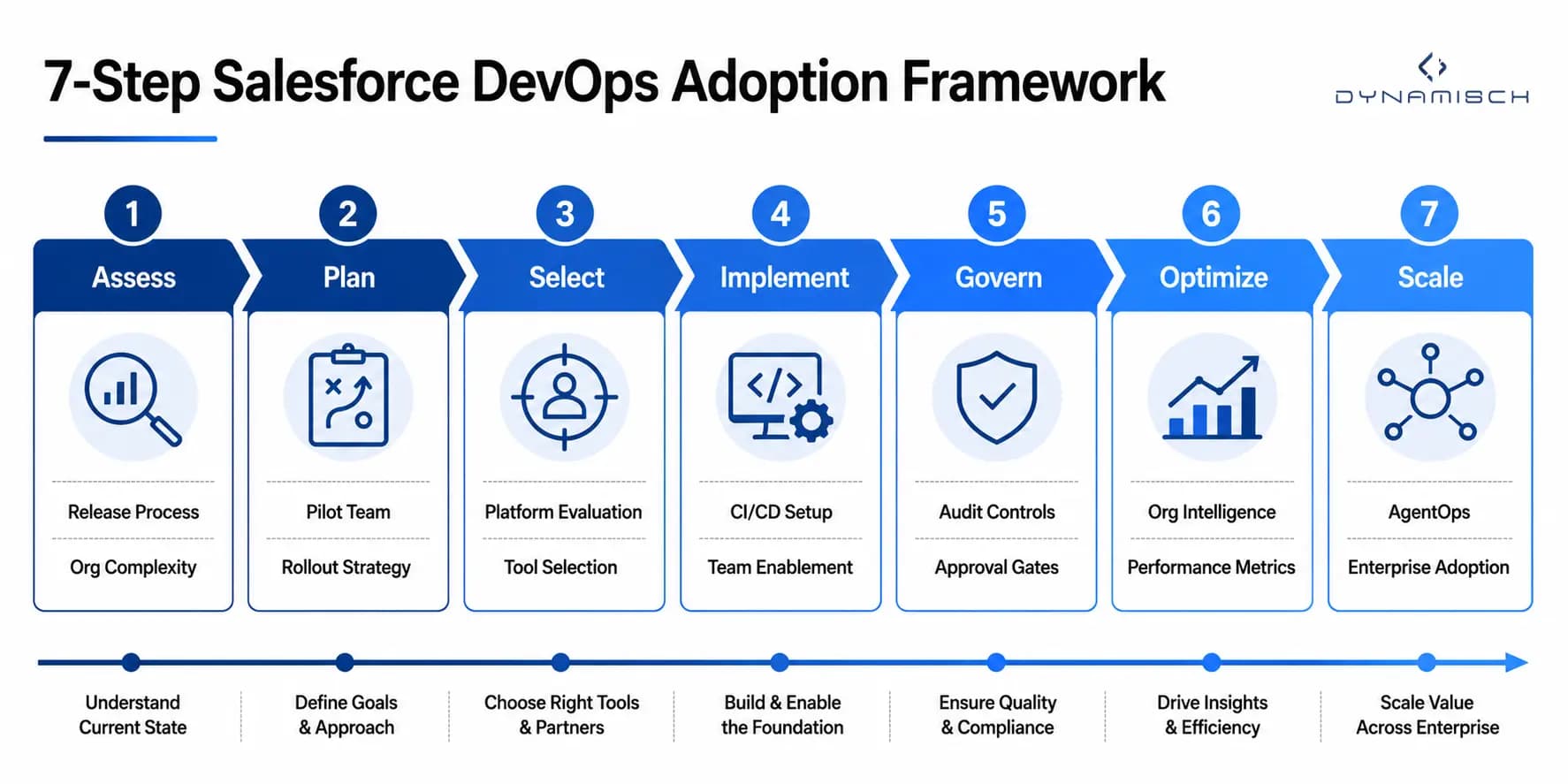
It's usually less about tooling to implement a Salesforce DevOps initiative successfully. It's actually more about the process maturity, governance, and adoption. Here are the seven steps to evaluate and implement Copado DevOps.
Step 1: Assess
Evaluate your current release process, change-failure rates, deployment frequency, Salesforce org complexity, and testing practices.
Step 2: Plan
Start with a phased rollout. Plan a pilot and start with a single business unit, Salesforce org, or product team before rolling it out across the company.
Step 3: Select
When evaluating Copado platform options, choose the edition that best fits your needs. Consider your team size, automation goals, compliance requirements, and future AI-agent adoption plan.
Step 4: Implement
In the implementation stage, it's better to assign clear DevOps ownership. It is because having a dedicated platform administration and clear governance helps to avoid the common challenges in configuration and adoption during the initial implementation.
Step 5: Govern
It's the crucial stage of Copado implementation. You must put governance measures in place from day one. Set up audit trails, compliance requirements, approval workflows, and release controls.
Step 6: Optimize
To identify roadblocks and reduce release risk over time, use testing insights, deployment metrics, and Org Intelligence™ dependency analysis.
Step 7: Scale
Once the implementations seem to be working properly, extend the DevOps practices towards AgentOps (Copado Agentia). This includes agent testing, governance, and lifecycle management.
The Future of Salesforce DevOps
Here are several key trends that are redefining the next phase of Salesforce DevOps and enterprise software delivery:
-
AgentOps Becomes a Core Discipline:
Autonomous AI agents are already being used in planning, testing, deployment, and other operations. In the near future, enterprises will need formal governance frameworks to audit, secure, and control the behavior of these AI agents throughout the delivery lifecycle.
-
Convergence of Low-Code and AI-Native Development:
Instead of relying only on traditional drag-and-drop configuration, Salesforce development is moving beyond and using AI agents that can generate automations, applications, and workflows from simple natural-language instructions.
-
Governance-by-Default:
Considering Gartner's prediction of 40% agentic AI projects to be cancelled by the end of 2027, the importance of robust operational governance is at rise. While governance is already a key consideration in Salesforce DevOps, it will become the default approach in the future. Organizations will continue to see it as a business requirement rather than just compliance.
-
Multi-Cloud DevOps Expansion:
Salesforce DevOps tools like Copado now support more than just Salesforce. That means organizations can now manage deployments, releases, and governance across multiple cloud applications.
-
Continued Growth in AI-Assisted Delivery:
Businesses will continue to invest more in AI-enabled DevOps, automation, and software delivery platforms as there's sustained demand for safer, more intelligent, and faster release management processes.
Final Thoughts: Is Copado Right for Your Salesforce Strategy?
What started as a Salesforce deployment tool has become a mature enterprise DevOps platform. Copado combines release automation, governance, testing, and, more recently, AI-agent management through Agentia and the emerging AgentOps model.
We have seen what Copado is and what it is capable of doing. The key question for enterprise leaders now is whether the current delivery processes can handle the large, complex Salesforce environments. The growing use of Data Cloud, Agentforce, and AI-powered workflows is making manual release management harder to maintain and govern.
When you start treating Salesforce DevOps as part of a broader digital engineering strategy that includes cloud architecture, MLOps, AI security, data governance, and enterprise integration, it gives more value.
If your organization is reviewing its Salesforce release maturity, now is a good time to determine whether it can scale and whether solutions like Copado, supported by experienced engineering partners such as Dynamisch, can help strengthen that foundation for future growth.
Frequently Asked Questions

Arvind Thevar
DevSecOps Architect
Arvind is a skilled DevOps and Site Reliability Engineer proficient in Kubernetes, AWS, Docker, and Terraform. He has a proven track record in automating infrastructure, migrating monolithic applications to containerized environments, and establishing robust CI/CD pipelines. He ensures regulatory compliance and security in high-risk environments. He works across AWS, GCP, and Azure to support secure operations.