Edge-deployed digital twins are changing how industrial organizations monitor and control physical systems in real time. Unlike cloud-hosted twins that introduce latency of 80 to 300 milliseconds, edge twins process data on-site and respond in under 10 milliseconds, making closed-loop control of high-speed equipment genuinely possible.
This article covers how edge twin architecture works, where it is delivering measurable results in 2026, and what organizations need to plan for before committing to a deployment.
What Is an Edge Digital Twin and Why Does Location Matter?
A digital twin is a live, data-fed virtual model of a physical object or system. It receives sensor readings, updates its internal state to match the real world, runs simulations, and sends back insights or control signals. The "live" part is what separates a digital twin from a static 3D model or a CAD drawing. A twin is dynamic. It changes when its physical counterpart changes.
For years, the standard architecture was straightforward: sensors on the machine, data streamed to the cloud, twin runs in a centralized compute environment, insights returned to the operator. This worked reasonably well for non-time-critical applications such as long-term maintenance planning or energy consumption analysis. The limitation was latency.
A round trip from a factory floor sensor to a cloud data center and back can take anywhere from 80 milliseconds to over 300 milliseconds depending on network conditions. For tasks like predictive analytics reviewed by a human once a day, that is completely acceptable. For tasks like closed-loop control of a high-speed CNC machine or fault detection in a power grid relay, it is not.
Why This Matters
A 100ms delay in a system running at 10,000 RPM means the digital twin is always reacting to what happened, not what is happening. At the edge, that gap closes to under 10ms, making proactive control possible for the first time.
Edge computing solves the latency problem by placing processing power physically close to the data source. When the digital twin runs on an edge server mounted in the same facility as the asset, data does not need to travel far. The simulation updates in near-real-time, and responses reach the control system fast enough to matter.
Edge Digital Twin Adoption: Key Statistics for 2026
These figures reflect where the industry stands as of 2026, combining market data and deployment results from published industrial case studies.
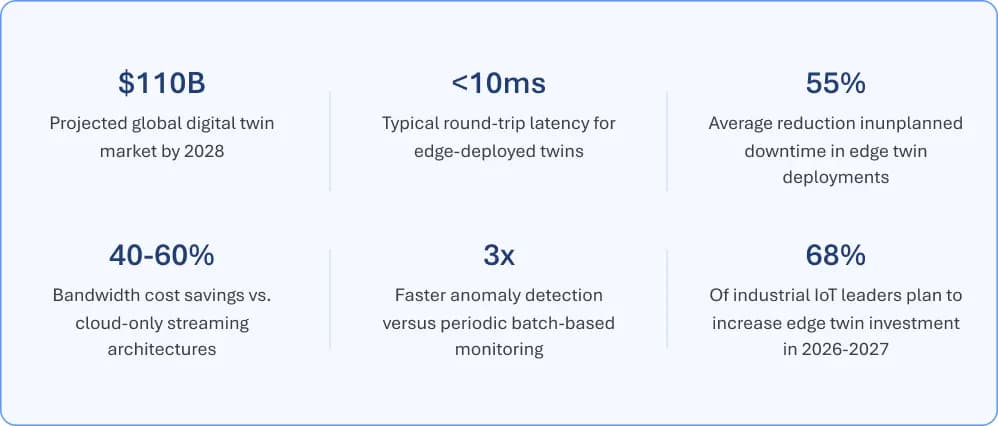
Those numbers reflect a maturation of the technology from proof-of-concept to production deployment. The 55 percent downtime reduction figure is particularly significant for asset-intensive industries, where a single unplanned failure can cost manufacturers between $50,000 and $500,000 per hour depending on the production line.
How Edge Digital Twin Technology Works: The Full Technical Stack
Building a digital twin that runs at the edge requires several technology layers working together. Understanding each one helps explain both what makes this possible in 2026 and what makes it different from earlier attempts.
Sensor and Data Acquisition Layer
Physical sensors on the asset collect measurements: temperature, vibration frequency, pressure, flow rate, current draw, rotational speed. Modern industrial sensors communicate via OPC-UA, MQTT, or Modbus protocols at sampling rates ranging from 10 Hz for thermal data to 10,000 Hz for vibration signatures. The accuracy and frequency of this data determine how faithfully the twin mirrors reality.
Edge Compute Node
This is the hardware that makes edge twins possible. Edge nodes in 2026 typically run on ARM-based server-class hardware or ruggedized x86 systems, often with dedicated AI inference accelerators like NVIDIA Jetson Orin or Intel Movidius chips. These devices offer 20 to 100 TOPS (tera-operations per second) of AI compute in a form factor that withstands industrial environments. They run containerized workloads via Kubernetes-based orchestration platforms like K3s, which makes deploying and updating twin software operationally manageable.
Simulation Engine and Model Layer
The twin itself runs as a physics-based or data-driven model on the edge node. For mechanical systems, this often involves reduced-order models (ROMs) derived from full finite element simulations run once in the cloud and then compressed for real-time edge execution. A ROM that originally required 4 hours to compute in a full FEM environment can run continuously on edge hardware at 50 Hz update rates after compression. For rotating equipment, ML-based models trained on historical sensor data now achieve state estimation accuracy within 2 to 3 percent of ground truth.
Feedback and Control Interface
The twin's outputs connect back to the physical system through PLCs (programmable logic controllers) or SCADA systems, or they surface as alerts and recommendations through operator dashboards. In closed-loop configurations, the twin actively sends control adjustments. In open-loop setups, it informs human decision-making without direct actuation.
Industries Using Edge Digital Twins: Real-World Results
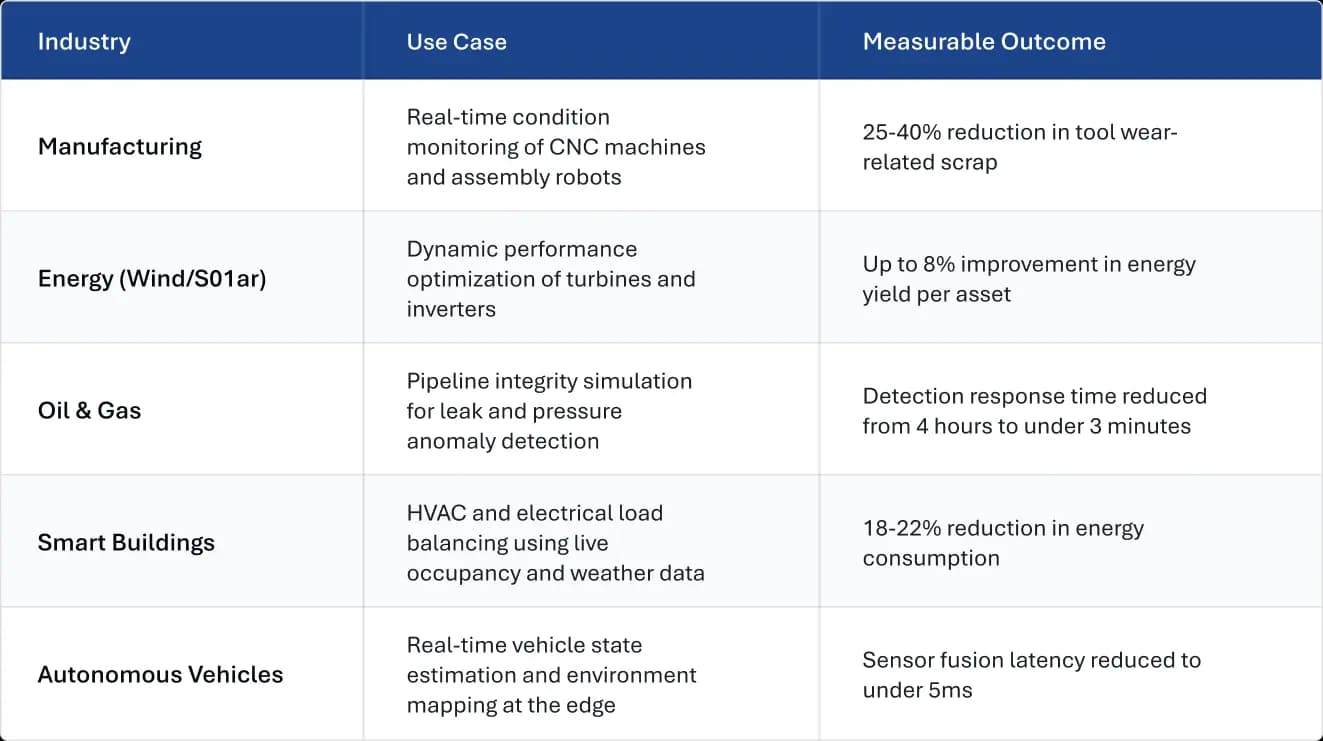
In each of these use cases, the critical factor is that the simulation needs to respond faster than a human can, and faster than a cloud round-trip allows. The edge is not just a cost play, it is a capability enabler.
Why Edge Digital Twin Deployment Is Practical in 2026
-
5G and private LTE networks have dramatically improved local wireless bandwidth, enabling 1 Gbps+ throughput between sensors and edge nodes inside industrial facilities without relying on fiber runs to every sensor point.
-
Lightweight containerization through K3s and similar platforms allows organizations to deploy, update, and manage twin software across fleets of edge nodes using the same DevOps practices used for cloud services.
-
Compressed simulation models derived from physics-based digital engineering tools (Ansys, COMSOL, Siemens Simcenter) can now be exported as deployable edge runtimes. This was a research capability 3 years ago and is now a vendor-supported workflow.
-
Edge AI inference chips have reached a performance-per-watt efficiency that makes running ML inference models continuously at high frequency economically viable for the operational budgets of mid-sized industrial operators.
-
OT/IT convergence standards like ISA-95 and OPC-UA have matured enough that connecting edge twin outputs to existing SCADA and ERP systems is an integration project, not a research project.
Challenges of Edge Digital Twin Deployment
Edge twin deployments are not without friction. Three areas require careful planning before committing to a rollout.
Model accuracy degradation over time.
A twin is only as accurate as the model it runs on. Physical assets change: parts wear, conditions shift, configurations get modified. Without a continuous retraining pipeline that feeds updated operational data back to refresh the model, twin accuracy drifts. Organizations deploying edge twins need to budget for model maintenance, not just initial deployment.
Cybersecurity exposure at the OT layer.
Every edge node connected to a control network is a potential attack surface. Industrial control systems historically operated in air-gapped environments. Connecting them to edge compute that links upward to cloud management planes introduces risk. Zero-trust network architecture at the OT layer is no longer optional in this configuration; it is a baseline requirement.
Skills gap at the operations level.
The team that maintains the edge infrastructure and the team that understands the physical process rarely have overlapping expertise. Bridging this in the organizational structure is frequently harder than solving the technical problems.
Future of Edge Digital Twins: What to Expect Through 2027
Three developments are worth tracking for organizations building or expanding their edge twin programs.
Federated twin networks will allow individual edge twins to share anonymized performance data with peer assets across an operator's fleet or even across operators within an industry consortium. A compressor twin at one facility could improve its predictive model by learning from the collective behaviour of 400 similar compressors running globally, without any single organization's raw data leaving its own environment.
Generative physics models are beginning to enter production. Rather than compressing an existing FEM simulation, next-generation tools use foundation models trained on large libraries of physical system data to generate simulation approximations from first principles. This reduces the engineering time needed to build a twin for a new asset class from months to days.
Embedded regulatory compliance monitoring is becoming a procurement requirement in sectors like energy, pharmaceuticals, and aerospace. Regulators in the EU and North America are beginning to recognize edge twin outputs as valid evidence for compliance reporting, which changes the economic calculation for deployment from "operational efficiency tool" to "compliance infrastructure."
Closing Thoughts
Digital twins have existed conceptually for two decades. What is different now is execution speed, deployment cost, and operational integration. The move from cloud-hosted to edge-hosted twins is not a hardware trend. It is a capability shift that changes what these systems can actually do inside a running physical operation.
Organizations that treat edge twin deployment as a long-horizon research initiative are increasingly behind peers who are already iterating on second-generation production deployments. The technology stack is stable. The economics work. The primary work left is organizational: aligning the teams, building the model maintenance pipeline, and securing the expanded OT attack surface.
Physical systems do not wait. Neither should the digital representations that help run them.
Building a digital twin strategy for your industrial or IoT environment? Our team helps organizations design and deploy edge-ready digital twin systems tailored to your operations. Talk to our engineers.
Frequently Asked Questions

Sanket Prabhu
Vice President of Engineering
As Vice President of Engineering at Dynamisch, Sanket Prabhu stands at the intersection of Generative AI, Spatial Computing, and enterprise-scale innovation. With over 15 years of experience driving innovation across AI, XR, IoT, Digital Twins, and Gaming, he transforms emerging technologies into high-growth business engines. His leadership reflects both technical depth and strategic precision.