AI in software testing is fundamentally changing how engineering teams approach quality assurance, and nowhere is that change more visible than across the Software Testing Life Cycle (STLC). Requirements were finalized, development cycles completed, and QA teams validated functionality toward the end of the release lifecycle. That model no longer scales.
This article explores how AI is transforming the STLC from a reactive QA process into an intelligent quality engineering system.
Key Takeaways
- Over 60% of enterprises have introduced AI-assisted testing into their delivery pipelines, yet most implementations remain limited to isolated automation. The real transformation happens when intelligence is embedded across every phase of the STLC.
- NLP-driven requirements analysis identifies ambiguity, missing validation conditions, and contradictory business logic upstream, before defects are ever introduced into the development cycle.
- AI-driven test planning systems like Launchable replace intuition-based regression scoping with measurable risk modeling built from code churn velocity, historical defect density, and service dependency graphs.
- Generative AI accelerates test case engineering significantly, but volume alone is not the same as coverage quality. AI expands the test quantity. QA engineers must still own coverage strategy, edge case governance, and validation architecture.
- Self-healing automation frameworks like Testim, Mabl, and Functionize reduce locator maintenance overhead, but they introduce model drift risks when AI-learned patterns of correct UI behavior diverge from actual product intent after major redesigns.
- AI-driven defect intelligence reduces triage noise at scale by correlating stack traces, runtime logs, deployment metadata, and historical defect patterns to classify and route issues automatically.
- Predictive release quality systems continuously model defect escape probability, coverage velocity, and service stability to turn release readiness from a meeting discussion into a measurable and real-time metric.
- The most common AI-QA failures are organizational. Poor training data, coverage inflation, and the removal of human review loops produce more risk than the problems they were meant to solve.
The focus is on real engineering workflows, measurable impact, and scalable AI integration across modern software delivery pipelines
QA Is No Longer a Final Gate
Modern engineering environments built around microservices, distributed systems, rapid CI/CD delivery, and cloud-native architectures demand continuous quality validation across the entire development pipeline.
As a result, the Software Testing Life Cycle (STLC) is evolving from a linear process into a continuously instrumented quality intelligence system powered by AI, observability platforms, predictive analytics, and autonomous automation frameworks.
The shift is already visible across enterprise engineering ecosystems.
Teams are integrating platforms like Functionize and Tricentis Tosca directly into CI/CD workflows to reduce regression maintenance, improve execution stability, and accelerate release confidence.
Meanwhile, engineering teams are combining LLMs, observability platforms, and historical delivery telemetry to improve requirement validation, risk prioritization, and defect intelligence across the entire software lifecycle.
According to the 2025 Capgemini World Quality Report, more than 60% of enterprises have introduced AI-assisted testing capabilities into their delivery pipelines. However, most implementations remain limited to isolated automation use cases.
The real transformation begins when intelligence is embedded across the entire STLC.
The AI-Augmented STLC: A New Architectural Model
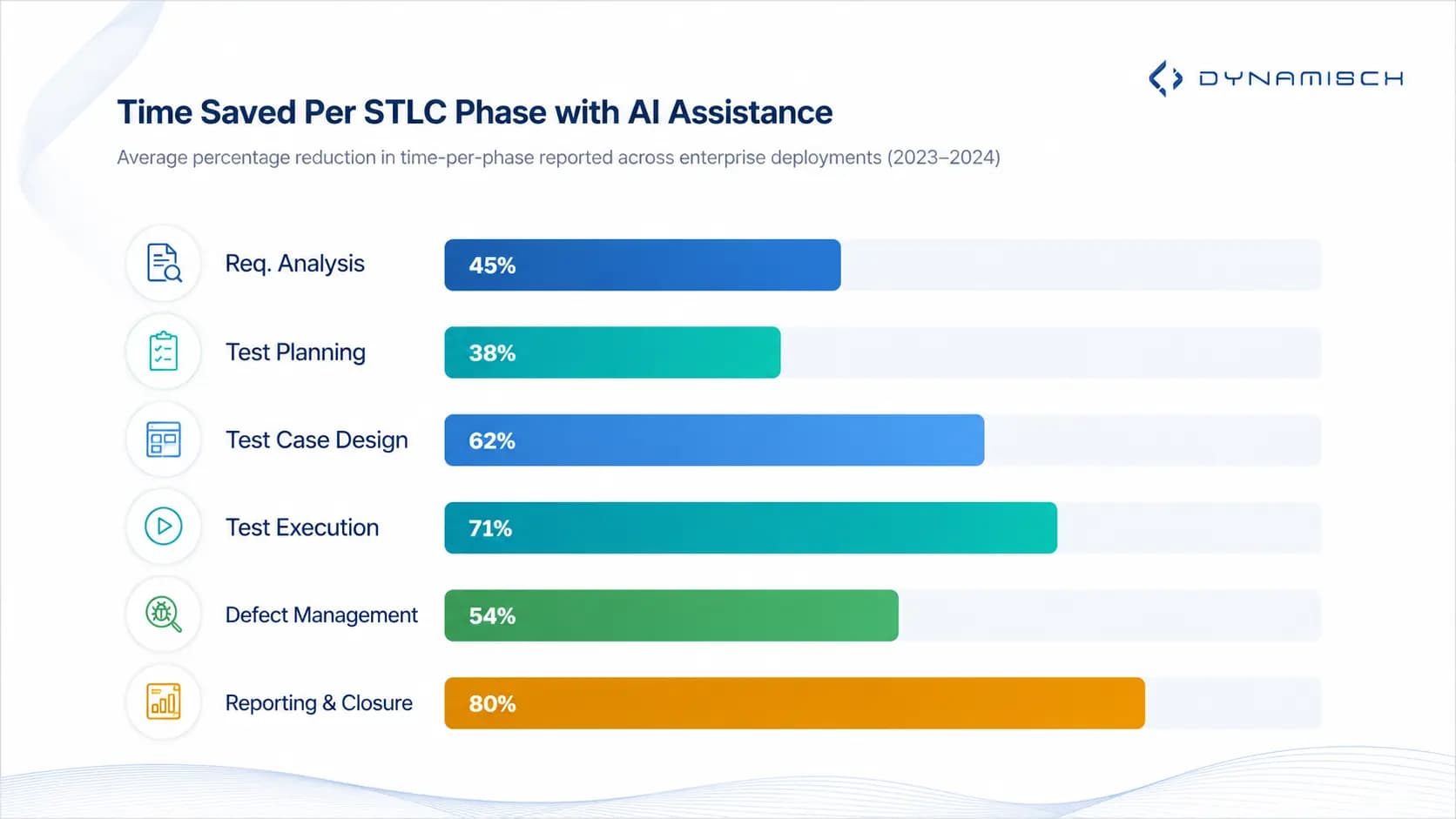
Traditional STLC models follow a sequential workflow.
Modern AI-native quality engineering introduces continuous intelligence loops between every layer of the pipeline.
Production telemetry feeds future regression prioritization. Runtime failure patterns reshape risk models. Observability data influences test generation. Historical defects continuously retrain release confidence systems.
Instead of static workflows, QA becomes a continuously adaptive intelligent engineering system.
Core Shifts in STLC Architecture
The integration of AI transforms the traditional STLC by redefining how quality engineering systems operate across modern software delivery pipelines.
Static vs. Living Architecture
Traditional frameworks often rely on static documentation and manually maintained testing assets. AI-augmented STLC introduces continuously evolving quality systems where platforms like Datadog and Dynatrace dynamically update dependencies, risk models, and testing priorities using runtime telemetry and production signals.
Linear vs. Agentic Workflows
Instead of sequential Plan → Develop → Test workflows, modern testing platforms like Mabl, Testim, and Functionize continuously analyze commits, predict regression risks, reprioritize execution, and adapt coverage automatically.
Manual Testing vs. Predictive Validation
AI shifts testing both left and right. LLM-driven systems generate test scenarios directly from requirements, while observability platforms analyze production logs and runtime anomalies to detect failures proactively and improve release confidence continuously.
From “Code Writer” to “AI Curator”
The role of QA engineers and architects is evolving from manual script development toward orchestration and governance. Tools like GitHub Copilot and Cursor assist with test generation and automation, allowing engineers to focus on quality strategy, risk analysis, and system reliability.
Stage 1: AI-Powered Requirements Analysis
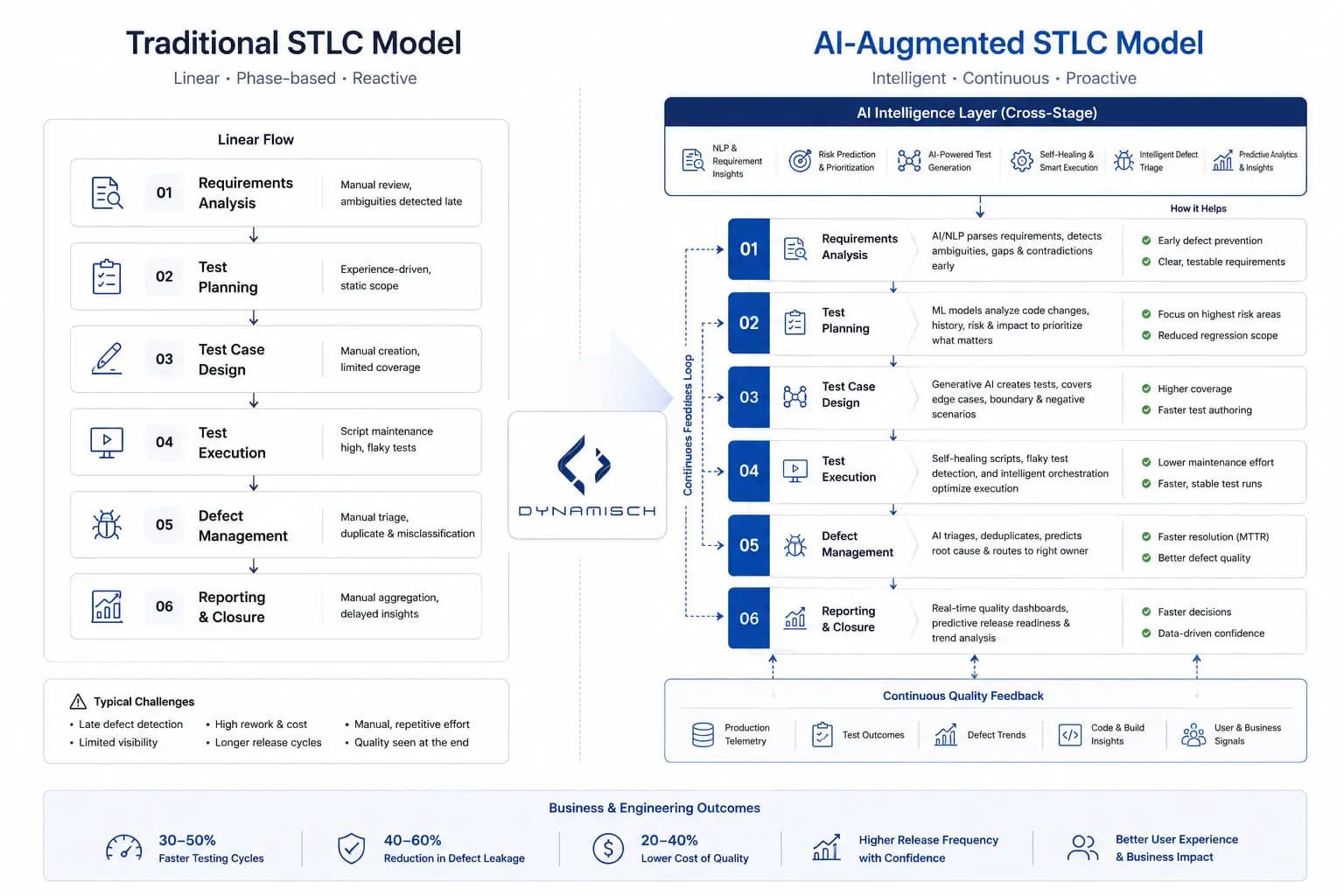
Requirement ambiguity remains one of the largest upstream contributors to downstream production defects.
Traditional QA processes rely heavily on manual interpretation of user stories, BRDs, acceptance criteria, and functional specifications. In complex enterprise delivery environments, inconsistencies between business intent and engineering implementation often remain undetected until integration testing or UAT.
AI-powered NLP systems are significantly changing this process.
Engineering teams are increasingly integrating LLMs through platforms like OpenAI, Claude Code, Cursor, custom semantic analysis engines, and enterprise copilots to analyze requirement artifacts automatically.
These systems can:
- Detect ambiguous acceptance criteria
- Identify contradictory business logic
- Flag missing validation conditions
- Infer testability gaps
- Generate traceability mappings
- Correlate historical defect patterns with new requirements
Some organizations are embedding NLP-driven validation directly into Jira workflows, backlog refinement processes, and sprint planning systems.
Stage 2: Intelligent Risk-Based Test Planning
Traditional test planning depends heavily on institutional knowledge.
Senior QA engineers prioritize regression scope based on prior experience, known failure areas, and release familiarity. That approach becomes unreliable at an enterprise scale, where applications consist of hundreds of services, APIs, dependencies, and distributed deployment streams.
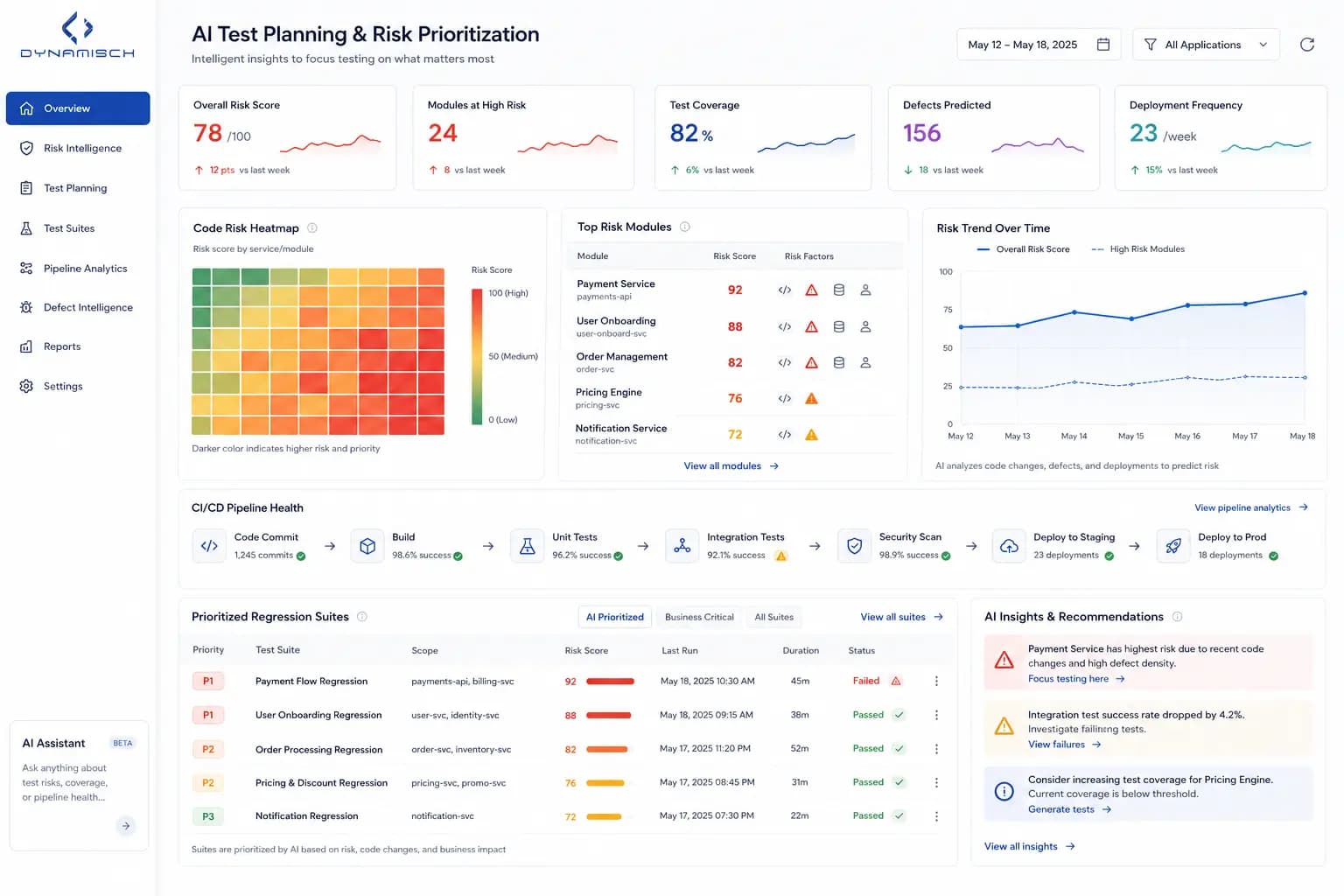
AI-driven planning systems replace intuition with measurable risk modeling.
Platforms like Launchable analyze:
- Historical defect density
- Code churn velocity
- Commit frequency
- Production incident trends
- Deployment instability
- Service dependency graphs
- Runtime telemetry
to dynamically prioritize test execution.
Instead of executing full regression suites uniformly, engineering teams focus validation effort on components statistically most likely to fail.
Stage 3: Generative AI Test Case Engineering
Test case development remains one of the most time-intensive layers of QA operations.
Generative AI systems are now accelerating test engineering workflows significantly.
Engineering teams are combining LLMs with tools like GitHub Copilot, Cursor, and custom OpenAI integrations to generate:
- Functional test scenarios
- Boundary-value validations
- API contract test flows
- Synthetic test datasets
- Negative test conditions
- Multi-step workflow validations
- Edge-case permutations
Modern implementations integrate directly with:
- Swagger/OpenAPI specifications
- GraphQL schemas
- Event-driven architectures
- Product analytics platforms
- CI/CD systems
This enables context-aware test generation rather than static scripted automation.
However, mature engineering governance remains essential.
AI-generated test volume can create a false sense of coverage completeness while still missing distributed system failures, asynchronous edge cases, concurrency issues, or domain-specific business logic anomalies.
The role of QA engineers increasingly shifts toward coverage architecture, validation strategy, and quality governance.
Stage 4: Autonomous Test Execution and Self-Healing Automation
Execution remains the most visible operational ROI layer for AI-driven QA.
Traditional automation frameworks suffer from chronic maintenance overhead caused by:
- UI locator instability
- Dynamic DOM changes
- Timing inconsistencies
- Flaky synchronization
- Environment drift
Modern platforms like Testim, Mabl, and Functionize address these problems using adaptive machine learning systems.
Self-Healing Automation
AI-powered self-healing engines dynamically recover failed selectors using:
- Visual similarity detection
- DOM relationship analysis
- Accessibility attribute matching
- Context-aware locator prediction
Instead of hardcoded XPath dependencies, test frameworks become behavior-aware.
Flaky Test Detection
Platforms analyze historical execution telemetry to identify unstable test patterns before they affect release confidence metrics.
Intelligent Parallelization
AI orchestration systems optimize execution pipelines using:
- Dependency graphs
- Historical runtime data
- Infrastructure availability
- Failure probability models
This improves regression throughput significantly across large-scale enterprise environments.
Stage 5: AI-Driven Defect Intelligence and Triage
Defect management systems generate enormous operational noise at scale.
Large enterprise delivery programs often struggle with:
- Duplicate defects
- Incorrect severity classification
- Delayed root-cause analysis
- Improper ownership routing
- High MTTR
AI classifiers are increasingly integrated into engineering workflows to automate defect intelligence operations.
Platforms enhanced with predictive analytics correlate:
- Stack traces
- Runtime logs
- Deployment metadata
- Service ownership maps
- Historical defect patterns
- Infrastructure anomalies
to classify and prioritize defects automatically.
This enables faster triaging, lower operational noise, and improved resolution efficiency.
Stage 6: Predictive Quality Intelligence and Release Confidence
Traditional QA reporting is retrospective. Modern AI-native quality systems are predictive.
Instead of static pass/fail dashboards, engineering leadership receives continuously updated release confidence models based on:
- Defect escape probability
- Coverage velocity
- Deployment frequency
- Runtime reliability metrics
- Failure trend analysis
- Service stability indicators
This transforms QA reporting into operational decision intelligence.
Release readiness becomes continuously measurable rather than manually evaluated during release meetings.
Where Most AI-QA Implementations Fail
Despite aggressive vendor positioning, AI adoption in QA introduces significant operational complexity.
The most common failure patterns are organizational rather than technological.
Despite rapid adoption, many AI-QA implementations fail due to weak engineering foundations rather than tooling limitations.
Training Data Quality and Model Bias
AI test tools trained on poor historical data, sparse defect logs, inconsistent test labels, and heterogeneous CI pipelines produce models that amplify existing bias. A self-healing tool that has never seen a React 18 concurrent-rendering pattern will make heuristic guesses that break in production. Data quality is not an AI problem; it's an organizational hygiene problem that AI makes visible.
Coverage Inflation and False Completeness
Generative AI can produce hundreds of test cases from a specification in minutes. This creates a dangerous illusion of coverage of completeness. Cases generated without domain-grounded review often test the happy path exhaustively while missing the adversarial, integration-level, and data-state edge cases that matter most. AI expands the volume of tests; humans must still own the quality of that coverage strategy.
Model Drift and the Limits of Self-Healing
Self-healing scripts reduce maintenance on locator changes. But they introduce new maintenance on model drift when the AI's learned patterns of "correct" UI behavior diverge from actual product intent after major redesigns. Teams that remove human review loops to fully automate maintenance often find themselves debugging AI decisions rather than debugging tests. Net labor may not always favor full automation.
Conclusion
AI is rapidly transforming the Software Testing Life Cycle (STLC) from a reactive QA process into a continuous intelligent quality engineering system powered by predictive analytics, automation, and real-time feedback loops.
However, successful adoption requires more than deploying testing tools. Organizations need scalable STLC architectures built around observability, adaptive automation, and continuous quality intelligence.
At Dynamisch, we help enterprises modernize QA operations by integrating platforms like Testim, Mabl, Applitools, and AI-driven workflows into CI/CD pipelines to improve release confidence, reduce maintenance overhead, and accelerate software delivery.
As systems become increasingly autonomous, quality engineering must evolve from manual validation into intelligent, continuously adaptive testing ecosystems.
Modernizing your QA operations with AI? Our team helps enterprises integrate AI-driven testing platforms into CI/CD pipelines, improve release confidence, and reduce automation maintenance overhead. Talk to our QA engineers.
Frequently Asked Questions

Sanket Kulkarni
Lead QA
With a decade of rich experience, Sanket is a dedicated QA Lead specializing in Manual Testing, Automation Testing with Selenium and Cypress, API Testing with Postman and Soap UI, and Mobile Testing.