
AI in drug discovery and clinical development is reshaping how the life sciences industry approaches timelines, R&D productivity, and the delivery of effective therapies to patients. Traditional drug development models remain expensive, time-intensive, and highly unpredictable, with many drug candidates failing across preclinical and clinical stages.
Developing a single therapy from discovery to commercialization can take more than a decade and require billions in investment. Delays in patient recruitment, fragmented clinical data, protocol amendments, and inefficient operational workflows continue to slow innovation across the industry.
AI is rapidly emerging as a transformative capability that can address many of these structural inefficiencies. Rather than functioning as an isolated innovation initiative, AI is becoming integrated into modern life sciences operating models across research, clinical development, and trial execution.
A recent peer-reviewed review article, From Lab to Clinic: How Artificial Intelligence (AI) Is Reshaping Drug Discovery Timelines and Industry Outcomes, published in Pharmaceuticals (2025), explored how AI is influencing the entire drug development lifecycle — from target identification and lead optimization to clinical trial execution and patient outcomes.
The findings highlight a clear industry shift: AI is no longer experimental. It is becoming a foundational capability for organizations looking to modernize clinical operations, improve decision-making, and scale innovation.
Key Takeaways
- AI is helping life sciences organizations reduce drug discovery timelines and improve R&D productivity.
- Clinical trials are becoming more efficient through AI-driven site selection, patient recruitment, predictive analytics, and risk monitoring.
- AI enables faster decision-making by improving the use of structured and unstructured clinical data.
- Precision medicine initiatives are becoming more scalable through AI-supported patient stratification and biomarker analysis.
- Better integration of multimodal data is improving clinical outcomes and operational efficiency.
- Long-term success depends on strong data governance, scalable infrastructure, and workflow integration — not just AI tools alone.
- Organizations operationalizing AI at an enterprise scale are gaining measurable advantages in speed, cost efficiency, and innovation capacity.
Why Traditional Drug Development Models Are Failing and What AI Changes
Despite advances in biotechnology and clinical research, conventional drug development still faces several persistent challenges:
- High candidate failure rates during discovery and development
- Long timelines for target validation and lead optimization
- Delayed patient recruitment and enrollment
- Fragmented data across sponsors, CROs, clinical sites, and laboratories
- Increasing trial costs due to protocol amendments and operational delays
- Heavy reliance on manual workflows for review, documentation, and reporting
Even small improvements in these areas can create substantial financial and operational impacts. AI's value lies in its ability to analyze large-scale biological, clinical, and operational datasets significantly faster than traditional approaches.
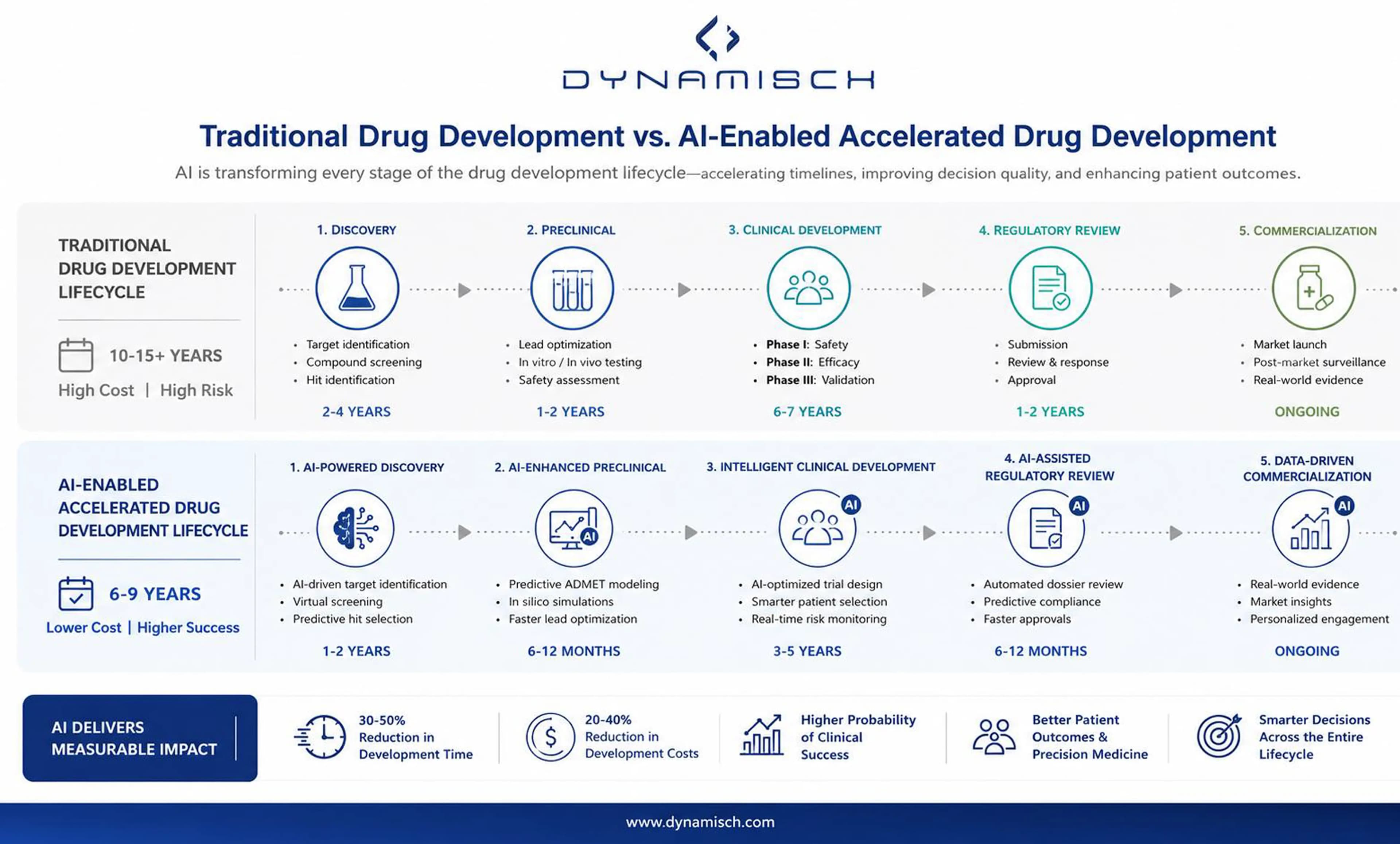
How AI Predictive Analytics Is Accelerating Drug Development Decisions
Traditional R&D decision-making often depends on sequential experimentation and retrospective analysis. AI introduces predictive intelligence that allows teams to make earlier and more informed decisions.
AI models can help predict:
- Which compounds are likely to fail due to ADMET risks
- Which biomarkers correlate with therapeutic response
- Which patient populations may respond best to a therapy
- Which trial protocols may face enrollment or retention challenges
- Which clinical sites are likely to underperform operationally
This shift from reactive analysis to predictive operations is one of AI's most significant strategic advantages. Instead of waiting for failures to emerge late in development, organizations can proactively mitigate risks earlier in the lifecycle.
AI in Clinical Trial Design: Optimizing Protocols, Sites, and Execution
Clinical trials remain one of the most expensive and delay-prone stages of drug development. AI is increasingly being used to improve both trial design, quality, and operational execution.
AI applications in clinical trials include:
- Protocol optimization using historical trial performance data
- Refinement of inclusion and exclusion criteria
- Site selection based on enrollment success and operational metrics
- Forecasting recruitment timelines and site performance
- Real-time monitoring of protocol deviations and data anomalies
- Automated risk detection and operational oversight
Operational execution often determines whether a study is completed on time and within budget. AI enables sponsors and CROs to improve visibility, reduce inefficiencies, and strengthen study performance across the trial lifecycle.
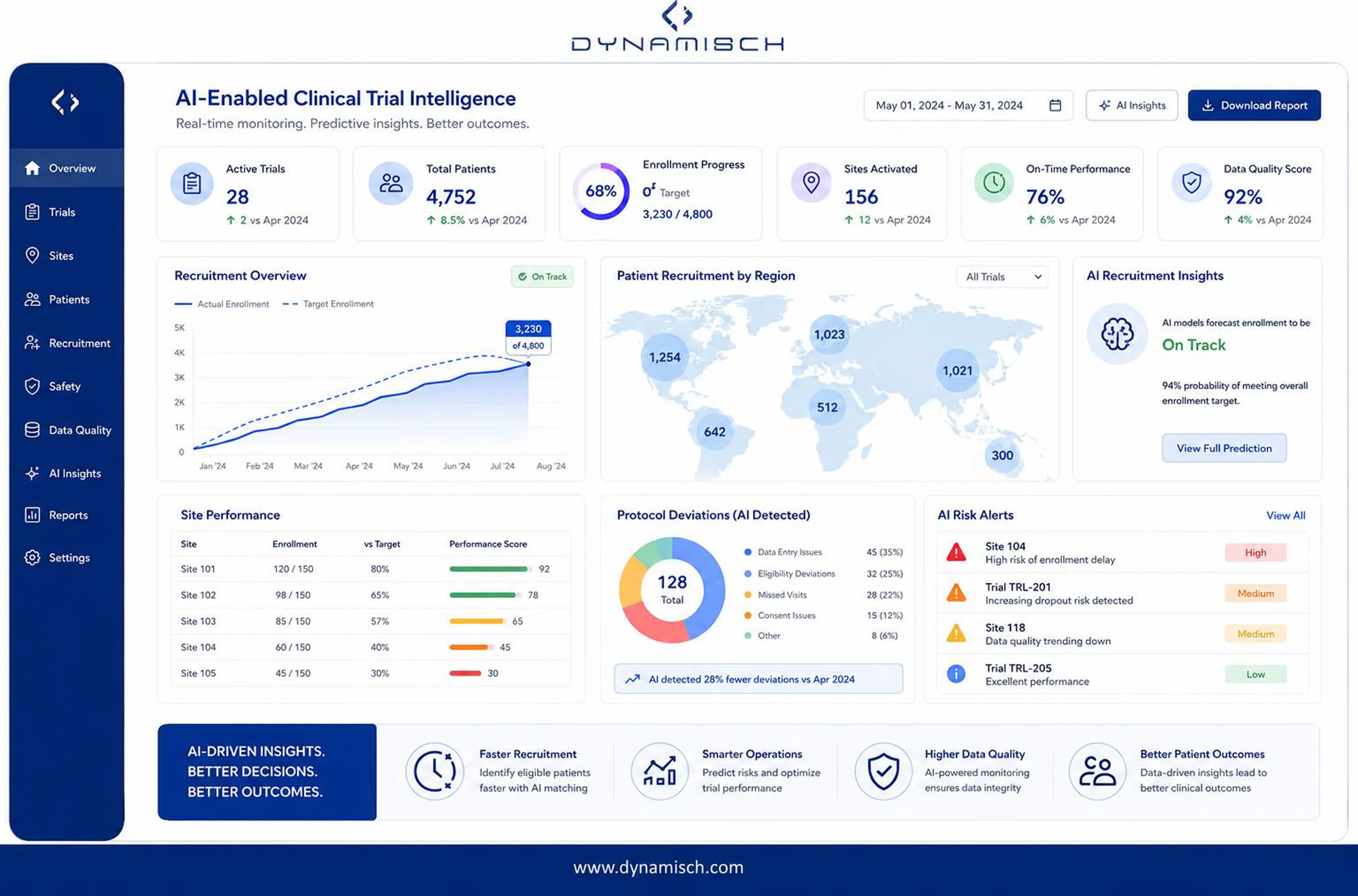
How AI Improves Clinical Trial Patient Recruitment and Retention Rates
Patient recruitment remains one of the leading causes of clinical trial delays. Many studies, particularly in oncology, rare disease, and precision medicine, struggle to identify eligible participants efficiently.
AI helps improve recruitment by analyzing:
- Electronic Health Records (EHRs)
- Claims and insurance datasets
- Disease registries
- Laboratory values
- Geographic and demographic trends
- Historical recruitment patterns
AI-driven matching systems can rapidly identify eligible participants and connect them with appropriate studies. Beyond enrollment, AI also supports retention strategies by identifying participants at higher risk of dropout and enabling personalized engagement approaches.
The result is:
- Faster enrollment cycles
- Reduced recruitment costs
- Improved study continuity
- Better participant engagement
AI and Multimodal Data Integration in Life Sciences R&D
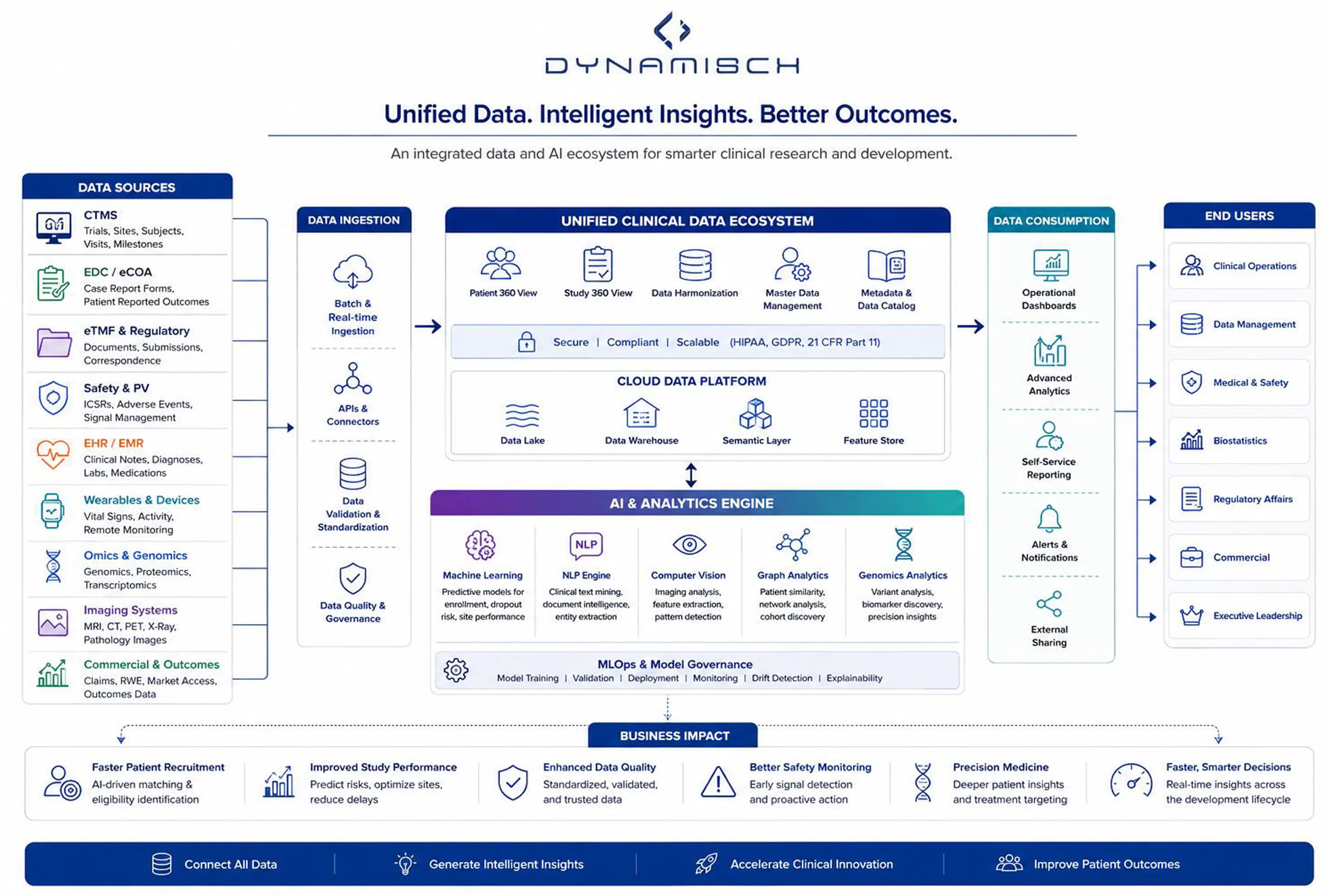
Modern life sciences organizations generate large volumes of data across every stage of the clinical and research lifecycle. However, one of the biggest industry challenges is that this data often exists across disconnected systems, teams, and platforms.
Critical information is typically spread across:
- Clinical Trial Management Systems (CTMS)
- eTMF and regulatory platforms
- Pharmacovigilance and safety systems
- Electronic Health Records (EHRs)
- Omics and genomic platforms
- Imaging systems
- Wearables and remote monitoring devices
- Laboratory systems
- Commercial and outcomes datasets
In many organizations, these systems operate independently, making it difficult for research, clinical operations, medical, and regulatory teams to access a unified view of study performance and patient data.
This is where it creates value not just through advanced models, but by helping organizations connect and interpret fragmented data faster and more effectively.
The strategic opportunity is not simply modeling accuracy; it is enterprise-wide data integration. Organizations that connect research, clinical, operational, and patient data environments are better positioned to generate actionable insights across the entire development lifecycle.
This is one reason why many AI initiatives fail when approached as isolated pilots instead of enterprise transformation programs.
How AI Improves Clinical Outcomes Beyond Operational Efficiency
While efficiency improvements are important, the long-term value of AI lies in its ability to improve clinical outcomes.
According to recent research, AI contributes to better outcomes by enabling:
- More accurate candidate selection
- Precision medicine and targeted therapies
- Stronger trial design quality
- Earlier detection of safety signals
- Better patient stratification
- Faster therapy optimization for specific subgroups
This is where AI moves beyond operational acceleration and begins driving measurable therapeutic impact. Delivering the right therapy to the right patient at the right time benefits both healthcare systems and development organizations.
Key Challenges of AI Adoption in Life Sciences Organizations
Despite its potential, AI adoption in life sciences is not without challenges. Organizations must address:
- Data quality and standardization issues
- Regulatory and compliance considerations
- Model transparency and explainability
- Integration with legacy systems
- Data governance and privacy requirements
- Change management and workforce adoption
AI success depends less on isolated algorithms and more on building scalable digital foundations that support enterprise-wide adoption.
The Future of AI in Drug Discovery and Clinical Development: 2026 and Beyond
AI is expected to play an increasingly central role across the life sciences value chain over the next decade.
Emerging areas of growth include:
- AI-enabled decentralized clinical trials
- Generative AI for regulatory documentation
- Digital biomarkers and remote patient monitoring
- Synthetic control arms in clinical studies
- Real-time adaptive trial management
- AI-powered pharmacovigilance and safety monitoring
As organizations mature their AI capabilities, competitive differentiation will increasingly depend on how effectively AI is operationalized at scale.
Final Perspective
The life sciences industry does not need more disconnected AI pilots. It needs scalable, production-grade AI integrated across the end-to-end R&D and clinical operations ecosystem.
The evidence is becoming increasingly clear: AI can reduce development timelines, improve decision quality, optimize clinical operations, and increase the probability of successful outcomes. Organizations that successfully combine AI with strong data foundations, governance frameworks, and modern digital infrastructure will be best positioned to accelerate innovation and improve patient outcomes.
At Dynamisch, we help life sciences organizations modernize and scale clinical trial operations through intelligent digital solutions across CTMS, eTMF, workflow automation, patient engagement platforms, analytics, and AI-enabled decision support systems. Whether the objective is faster study startup, improved site performance, enhanced operational visibility, or streamlined trial execution, our teams bring the domain expertise and technology capabilities required to deliver measurable business outcomes.
If your organization is evaluating how to apply AI within clinical research or modernize legacy clinical systems, now is the time to move beyond experimentation and toward enterprise execution.
Frequently Asked Questions

Mushtak Gadkari
AI/ML Lead
Mushtak is the AI/ML Lead with extensive experience in Machine Learning, Deep Learning, Natural Language Processing, Generative AI, and Agentic AI. He specializes in delivering robust end-to-end intelligent solutions - from model development and fine-tuning to scalable production deployment.