Enterprise AI is moving beyond chatbots and content generation. They are becoming the systems that can execute tasks on their own, coordinate workflows, and even make decisions with very little human intervention. This is why we are seeing the growing interest in Enterprise Agentic AI, a system designed to complete goals, interact with business apps, and adapt to changing conditions.
However, it requires much more effort to build an effective agentic AI system than to deploy an LLM. Businesses must have reliable data foundations, proper governance control, integrations that are secure, and operational supervision to make sure the agents act accurately.
As more and more enterprises are moving beyond AI experimentation to production-ready AI adoption, it has become more important than ever before to understand how to build an agentic AI system.
In this guide, we'll explore what Agentic AI is, why enterprises are investing in it, the risks organizations must address, and the step-by-step process to build agentic AI systems.
Key Takeaways
-
Agentic AI goes beyond content generation by enabling AI systems to plan, reason, and execute multi-step tasks to achieve business objectives.
-
A successful enterprise Agentic AI system requires five foundational layers: data and knowledge, AI reasoning, agent orchestration, enterprise integrations, and governance.
-
Organizations are adopting AI agents to automate complex workflows, improve operational efficiency, reduce manual effort, and accelerate decision-making across business functions.
-
Security, compliance, governance, hallucinations, and agent sprawl are among the most important risks enterprises must address before scaling agentic systems.
-
Building an effective agentic AI platform requires a phased approach: assess readiness, identify high-value use cases, establish a trusted knowledge foundation, launch pilot agents, and scale with governance.
-
Industries including healthcare, manufacturing, financial services, retail, technology, construction, and education are actively exploring agentic AI to streamline operations and improve business outcomes.
-
The future of enterprise Agentic AI will be shaped by multi-agent architectures, autonomous business processes, and AI-native operating models that combine intelligent automation with human oversight.
What Is Agentic AI?
Agentic AI refers to AI systems that can achieve goals, make decisions, use tools, and execute multi-step tasks with varying levels of autonomy. Agentic AI systems are not like conventional AI applications that can only generate responses. These systems can plan actions, communicate with any enterprise software, and even adapt their behavior based on the context we provide.
Recent research explains Agentic AI as a unique evolution that goes beyond traditional AI agents. From planning and reasoning to tool usage and multi-agent coordination, it has way more capabilities.
Agentic AI vs Traditional Generative AI
Traditional generative AI systems can create content such as text, code, images, or summaries as per the prompt or instructions the user provides. They are very effective for knowledge work but generally reactive.
Agentic AI, on the other hand, widens these capabilities by introducing action and decision-making. An agentic system can break down the objective it has to achieve, decide the steps required to complete it, access the required enterprise data, invoke APIs, and then execute the workflows. In simple words, generative AI produces output, whereas enterprise agentic AI aims to achieve outcomes.
How AI Agents Differ from Chatbots and Copilots
It is important for enterprise leaders who are evaluating AI investments to understand the distinction.
-
Chatbots are conversation-focused systems designed to answer questions and provide information.
-
Copilots assist users within specific applications and workflows but generally rely on human direction.
-
AI agents are goal-oriented systems that can take actions across tools and processes to complete tasks.
Let's take an example of a bulk product purchase. A chatbot can explain what procurement policy is, a copilot might help you draft the purchase request, but an AI agent can collect supplier information, generate all purchase documentation, route approvals, and even track the purchase completion across multiple systems.
Core Characteristics of Agentic Systems
Most of the agentic AI platforms follow similar core characteristics:
-
Goal-driven execution instead of prompt-response interactions.
-
Reasoning and planning to determine the best path to complete a task.
-
Tool and system integration through APIs, databases, and enterprise apps.
-
Memory and context retention across tasks and workflows.
-
Adaptability that allows agents to respond to changing conditions and new information.
These capabilities are the main drivers of growing interest in AI agents for enterprise, specifically among organizations that are looking to automate complex business processes.
Why Enterprises Are Investing in Agentic AI
There's a simple reality that encourages enterprise interest in Agentic AI, that is, many business processes require more than just content generation. Organizations continuously look out for innovations that can ease their complex processes, and agentic AI is the exact system that helps them coordinate tasks, talk with their applications, gather information, and help execute difficult tasks across the digital environment.
The Shift from AI Assistants to AI Workers
We have already experienced the first wave of enterprise AI that largely focused on assistants that help users search for information, draft content, or answer questions. But they still relied on human direction.
Agentic AI works on a different operating model. AI agents can complete a given task following a step-by-step process and make context-aware decisions within predefined boundaries.
Industry analysts view this transition as a move from AI that supports work to AI that participates in work. Researchers from Harvard Business School found that when AI works with any project teams, it can act as a "cybernetic teammate" that can share expertise and improve ideation.
This shift is a vital reason why many enterprises are exploring agentic AI as the next stage of their AI strategy.
Enterprise Challenges Driving Agentic AI Adoption
Every new technology that offers solutions also comes with some challenges and agentic AI is not an exception.
Some challenges that organizations face are:
-
Fragmented data spread across different apps
-
Slow operations due to manual workflows
-
Efficiency improvement pressure without continuously increasing headcount
At the same time, employees spend much time understanding and managing systems, searching for information, and doing repetitive admin tasks.
Enterprises are continuously evaluating AI agents as a way to reduce these operational challenges. By combining reasoning capabilities with access to enterprise tools, agentic systems can automate portions of processes that previously required constant human orchestration.
The growing maturity of LLMs, orchestration frameworks, and cloud-native AI infrastructure has also made enterprise AI automation more practical than it was only a few years ago.
Business Benefits of Agentic AI
Agentic systems can create actual value when implemented responsibly.
Key benefits include:
-
Faster execution of multi-step business processes.
-
Reduced manual effort for repetitive knowledge-work tasks.
-
Improved access to organizational knowledge and data.
-
More consistent decision support across teams.
-
Greater scalability for customer service, operations, compliance, and internal workflows.
But most importantly, a well-built agentic AI platform can help businesses use their human expertise on higher-value activities and assign routine tasks to intelligent systems. Many enterprises know these benefits, and now they are moving towards a broader question of how agentic systems can be integrated into their core business operations.
What Does an Enterprise Agentic AI System Look Like?
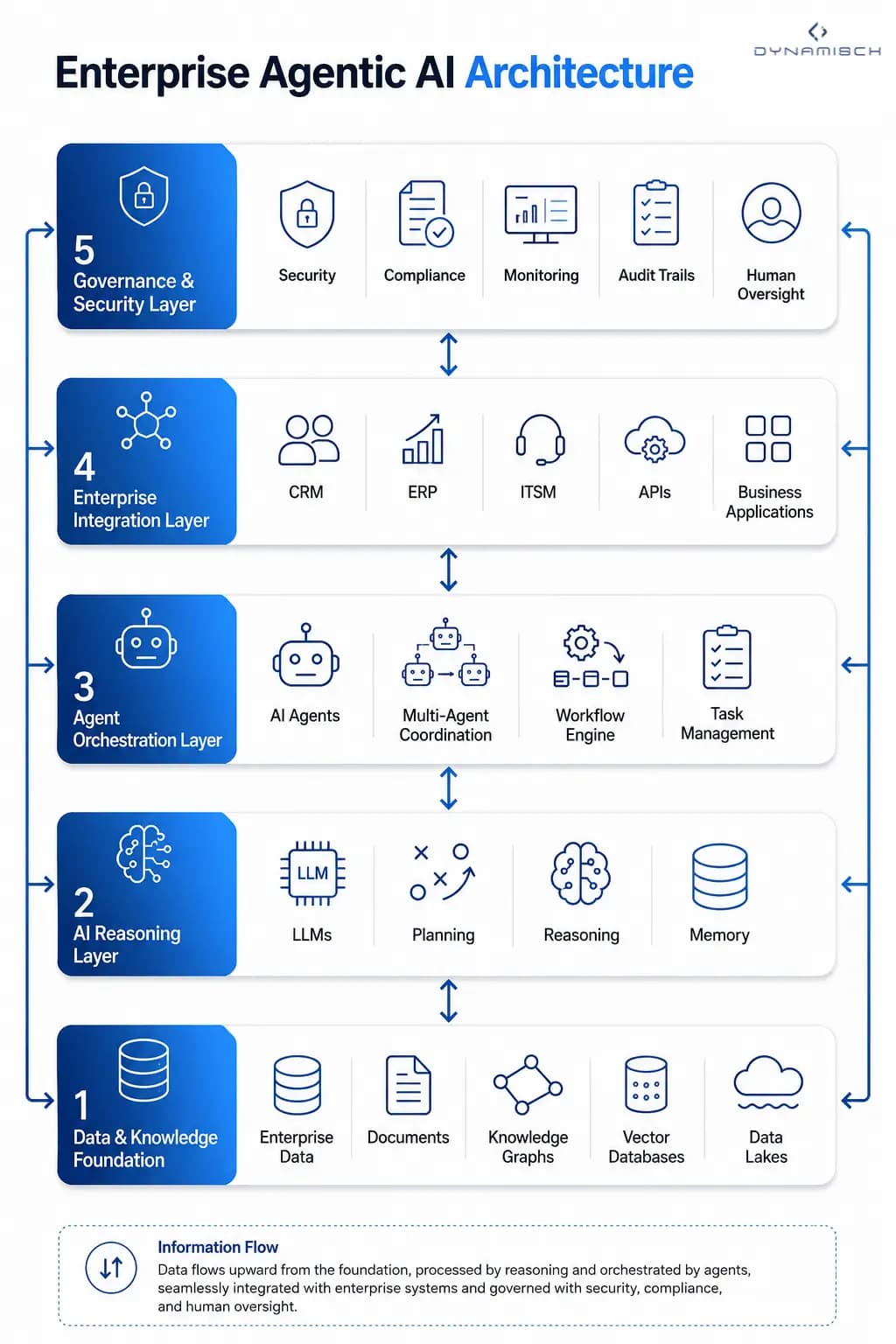
An enterprise agentic AI system is a layered architecture and not a single model or application. It combines data, reasoning, orchestration, integrations, and governance to enable AI agents to work reliably within enterprise environments.
Industry frameworks from organizations such as the National Institute of Standards and Technology (NIST) and leading enterprise AI platforms highlight that AI works best when it operates within clear rules, includes human oversight, and fits into existing business processes instead of making decisions on its own.
The Five Core Layers
The enterprise agentic AI architectures can be understood through five interconnected layers:
-
Data & Knowledge Layer
This is an information layer. It provides data and knowledge that agents need to work properly. It can be any information like enterprise databases, knowledge bases, data lakes, and retrieval mechanisms.
-
AI Reasoning Layer
At the core of agentic AI systems are the large language models and reasoning engines that help interpret objectives, plan and evaluate actions, and generate decisions. This is the layer in which the AI agent decides how to complete a given task.
-
Agent Orchestration Layer
This layer is for proper coordination between multiple tasks, specialized agents, or tools. The orchestration layer manages task sequencing, workflow execution, state management, and agent collaboration.
-
Enterprise Integration Layer
In order to create real value for the organization, AI agents must connect with different business systems like CRM & ERP systems, communication tools, IoT environments, and cloud services. This layer does these integrations through APIs and connectors.
-
Governance & Security Layer
This is the most critical layer in enterprise agentic AI architecture. When deploying agentic AI, it's important to have control over access management, compliance, risk monitoring, identity, and human oversight. This layer helps to keep enterprise AI automation secure and aligned with organizational policies.
These five layers form the foundation of a scalable agentic AI platform. It's a critical step to understand how these components interact while learning how to build an agentic AI system that can support enterprise operations.
Common Risks Organizations Must Address
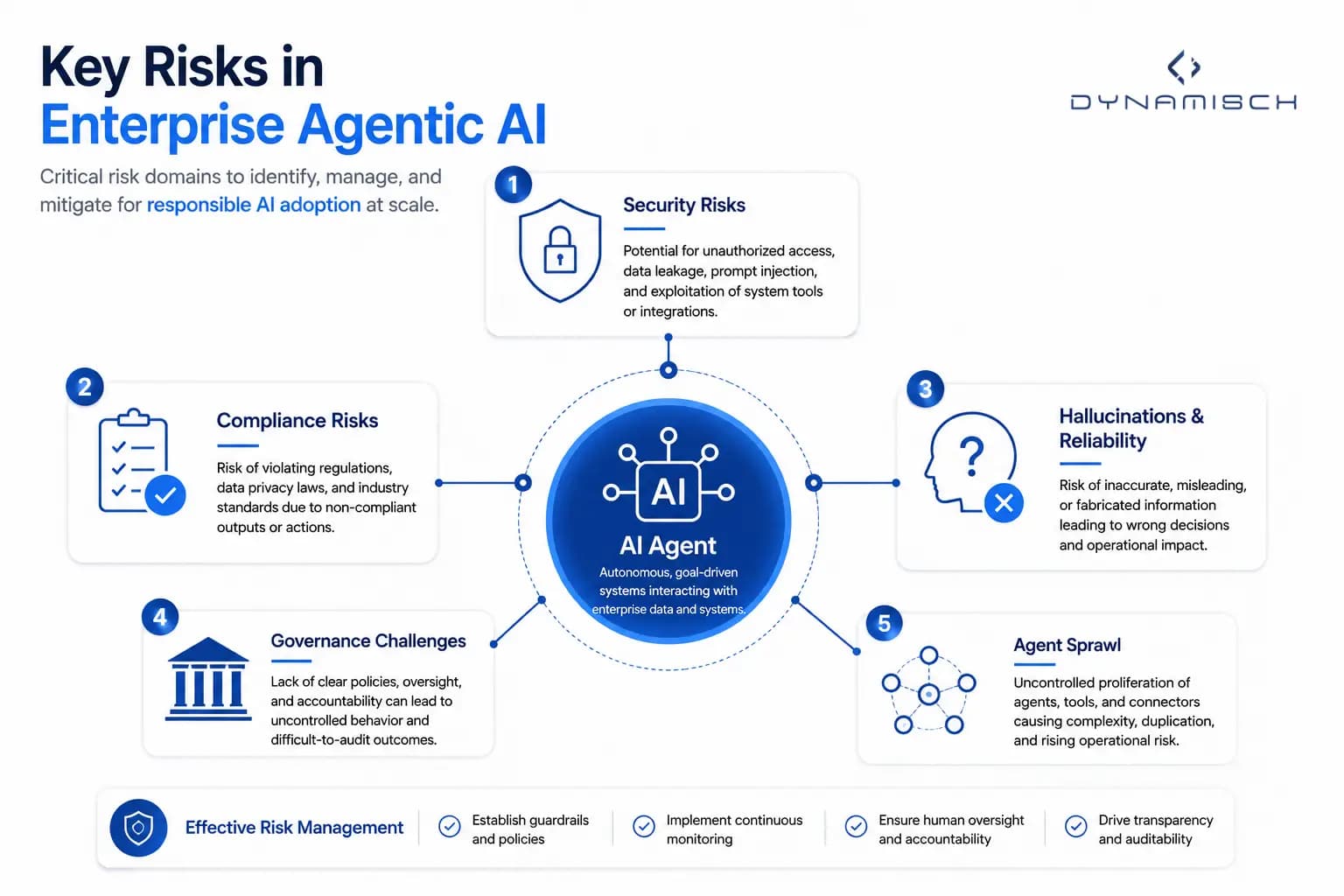
Agentic AI's real value for enterprises comes with a greater operational complexity and governance needs. AI agents may not wait for instructions like traditional software and can make decisions and trigger actions across workflows. If there's no proper safeguard in place, these systems can pose significant business and security risks.
Security Risks
AI agents require access to your databases, APIs, and other internal knowledge sources to work properly. This level of access can create new attack vectors like prompt injection attacks, misuse of credentials, data leakage, and unauthorized tool access.
Security researchers have identified prompt injection and insecure tool usage as emerging risks for agent-based AI systems. Therefore, organizations must apply the zero trust principles: identity controls, least-privilege access, continuous monitoring, and auditability.
Compliance Risks
AI agents access sensitive business information, financial data, or restricted content. Some regulations, like the EU AI Act, impose risk-based governance requirements for AI systems. The agentic workflows that organizations deploy must be transparent and compliant with the applicable industry obligations. The compliance risk becomes more complex when agents use multiple systems and jurisdictions.
Agent Hallucinations
AI hallucination is a very critical risk. We have seen even the advanced language models generate inaccurate information and sometimes give flawed assumptions. These errors can adversely affect the operational efficiency when AI agents are connected to important business processes.
It's really important to have human review, validation workflow, and confidence scoring as safeguards to prevent AI agents from retrieving incomplete information and executing actions based on incorrect reasoning.
Governance Challenges
As AI agents become more autonomous, enterprises need clear accountability structures. It's essential to think about questions such as who approves agent actions, who owns performance outcomes, and how decisions are monitored.
Effective governance typically includes:
-
Human oversight for high-risk decisions
-
Monitoring and observability
-
Audit trails and reporting
-
Policy enforcement and risk controls
-
Defined ownership and accountability
Agent Sprawl
Some organizations are already facing a phenomenon similar to "shadow IT", where some departments of the business deploy AI agents without the approval of the centralized team.
This is called agent sprawl, which can lead to duplicated functionality, incomplete and scattered knowledge sources, inconsistent security, and increased operational risk. Therefore, a successful agentic AI strategy needs proper governance mechanisms to balance innovation with enterprise-wide visibility and control.
It's important to pay attention to these risks to build an agentic AI system that is not only capable of business process automation but also secure and compliant.
A Step-by-Step Enterprise Adoption Framework
Organizations that successfully deploy agentic AI don't often start with large-scale deployment. They follow a phased approach. The approach that aligns the technology capabilities with their business priorities, operational readiness, and governance.
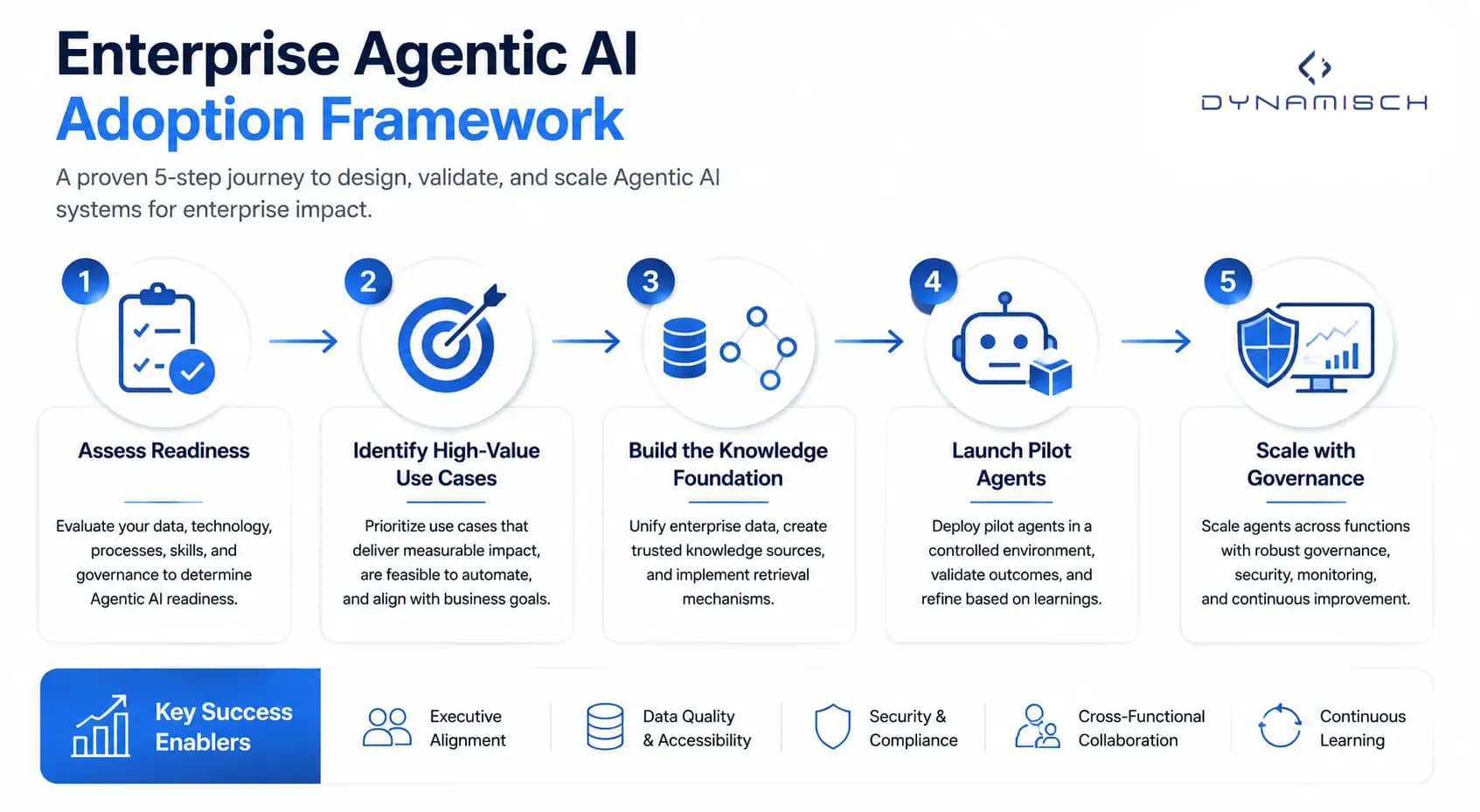
Here's a 5-step approach to build a successful agentic AI system:
Assess Readiness
First and foremost, understand whether your organization has the foundational elements to build AI agents. Check the data quality, security controls, multi-system integration maturity, governance protocols, and cloud infrastructure.
It's equally important to identify where human oversight is necessary. As discussed before, organizations like NIST emphasize governance and risk management as foundational elements of AI adoption.
Identify High-Value Use Cases
It's not always true that every process is good for agent-based automation. Identifying the highly important use cases is necessary.
The best opportunities generally involve workflows that are:
-
Repetitive but knowledge-intensive
-
Dependent on multiple systems
-
Governed by clear business rules
-
Time-consuming for employees
For example, customer support operations, supply chain coordination, internal knowledge retrieval, and procurement workflows.
Build the Knowledge Foundation
It's possible to build the most effective AI agents only if the available information is accurate and effective.
You need to establish a trusted knowledge foundation connecting both structured and unstructured enterprise data. This may include knowledge graphs, data platforms, retrieval systems, governance controls, and operational systems.
Providing this reliable context to agents is necessary to generate accurate recommendations and proper task execution.
Launch Pilot Agents
Launching a pilot program helps you validate the technical feasibility, operational risks, and business value before full deployment.
Build early pilots that focus on narrow and measurable use cases with clear objectives and under human observation. This allows you to analyze the performance, identify failure reasons, and refine the workflows for better efficiency.
Scale with Governance
The last but most important step in building an effective agentic AI system for your organization is governance.
You should establish centralized policies for security, monitoring, model management, access control, and agent lifecycle oversight. Balancing innovation with accountability is the key strategy for a successful agentic AI implementation. This ensures that AI automation remains explainable and aligned with enterprise goals.
This phased approach provides a practical blueprint for organizations seeking to understand how to build an agentic AI system that can scale from experimentation to enterprise-wide adoption.
Industry Applications of Agentic AI
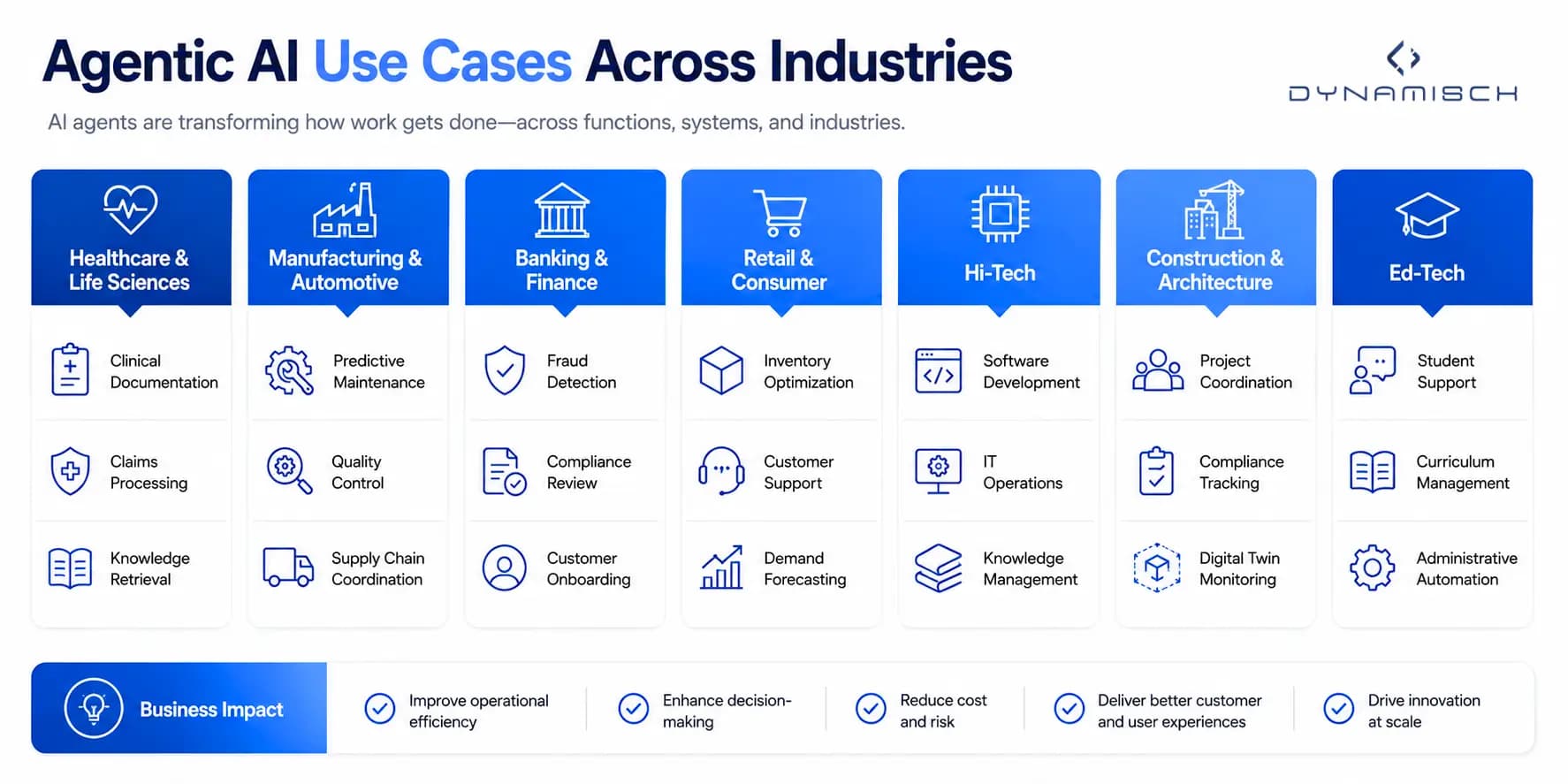
AI agents are being increasingly used in different industries to automate repetitive tasks, make decisions on provided context, and reduce operational friction across complex environments. Rather than replacing employees, these agents assist them in completing tasks more effectively.
Healthcare & Life Sciences
Healthcare organizations can deploy agentic systems for prior authorization workflows, insurance claims management, clinical documentation, and life sciences research support. Recent industry solutions have focused on combining automation with governance, auditability, and compliance controls required in regulated healthcare environments.
Manufacturing
AI agents help manufacturers in production planning, supply chain management, predictive maintenance, factory operations, and quality management. AI agents combined with IoT and digital twins help in monitoring operational conditions, making effective decisions, and coordinating workflows across the manufacturing ecosystem.
FinTech
Financial institutions can use AI agents for customer onboarding, compliance monitoring, risk analysis, fraud investigations, and internal operations. The ability to orchestrate multi-step workflows and simultaneously maintain audit trails makes agent-based systems particularly relevant in these highly regulated environments.
Retail & Consumer
To improve inventory management, demand forecasting, merchandising workflows, and supply chain visibility, AI agents can assist retail organizations. Agents can coordinate actions across commerce platforms, logistics systems, and customer engagement channels.
Hi-Tech
Technology companies can use AI agents to support software development, incident management, IT operations, technical support, and knowledge management. Agentic systems are particularly valuable in environments where hi-tech teams must coordinate across multiple tools and large volumes of technical information.
Construction & Architecture
In construction and architecture, agents can assist with project documentation, procurement coordination, compliance reviews, digital twin-driven project oversight, and schedule management. As built-environment data becomes connected, agentic systems may play a larger role in project orchestration.
EdTech
Educational organizations can deploy agentic workflows for student support and curriculum management. It can also be effective in administrative operations, personalized learning assistance, and institutional knowledge gain. These applications reduce administrative burden and improve responsiveness for students and educators.
The Future of Agentic AI
The future of enterprise agentic AI is about creating systems that can execute processes and make decisions more effectively across the organization.
Multi-Agent Enterprises
Many organizations are already moving toward multi-agent architectures, where specialized agents collaborate to complete complex workflows. According to Gartner, 70% of multi-agent systems (MAS) will use very precisely specialized agents by 2027 to improve accuracy. Instead of relying on a single agent, enterprises can deploy teams of agents responsible for planning, analysis, execution, and monitoring.
Autonomous Business Processes
The next evolution of enterprise AI automation will focus on end-to-end process execution. AI agents will increasingly manage workflows across operations, customer service, finance, and supply chains while operating within predefined business rules and governance controls.
AI-Native Organizations
As adoption matures, organizations may begin redesigning workflows around the capabilities of intelligent agents. In these environments, employees focus on strategy, supervision, and decision-making, whereas AI Agents handle routine coordination and operational tasks.
For organizations exploring how to build an agentic AI system, the long-term goal should be creating a more efficient and intelligent enterprise operating model.
Final Thoughts
Understanding how to build an agentic AI system is no longer just a technical consideration; it is becoming a strategic priority for enterprise leaders. The organizations that lay strong data foundations, clear governance, well-defined business objectives, and secure integrations will create the most value out of agentic AI. Only deploying a larger number of agents won't work.
Agentic AI is shifting enterprise AI from content generation toward operational execution. As the technology matures, success will depend on building systems that combine intelligent automation with human supervision, creating organizations that are more responsive and capable of operating at scale.
Frequently Asked Questions

Mushtak Gadkari
AI/ML Lead
Mushtak is the AI/ML Lead with extensive experience in Machine Learning, Deep Learning, Natural Language Processing, Generative AI, and Agentic AI. He specializes in delivering robust end-to-end intelligent solutions - from model development and fine-tuning to scalable production deployment.