
Choosing among today's offshore software development models is more than just a procurement decision. It has become a strategic choice that decides how quickly an enterprise can access specialized engineering talent, execute digital transformation initiatives, and scale product delivery.
It's the reflection of a backdrop of persistent talent shortages. ManpowerGroup's 2026 Global Talent Shortage Survey found that 72% of employers worldwide struggle to find the skilled talent they need, with AI capabilities now ranking among the hardest skills to source.
At the same time, the global offshore software development market is valued at $204.32 billion in 2026 and projected to reach $347.99 billion by 2030. This reflects sustained enterprise demand for external engineering capacity.
As organizations modernize cloud infrastructure, build AI platforms, launch digital products, and develop data-intensive applications, they are no longer thinking about whether to work with an offshore software development company.
The challenge is selecting the right engagement model. A mismatch, such as using staff augmentation for a multi-year platform initiative or establishing an Offshore Development Center (ODC) for a short-term delivery gap, can reduce delivery velocity, increase management overhead, and raise long-term costs.
In this guide, we'll explain the five core offshore engagement models, how they compare, when each is most effective, and how enterprise leaders can choose the approach that best aligns with their business objectives in 2026 and beyond.
Key Takeaways
-
The five primary offshore software development models are Dedicated Team, Staff Augmentation, Build-Operate-Transfer (BOT), Offshore Development Center (ODC), and Fixed-Price/Project-Based, each designed for different business objectives and levels of operational control.
-
Choosing between staff augmentation vs offshore development or an offshore development center vs dedicated team depends on three factors: how much delivery management you want to retain, how long the engagement will last, and whether you are filling a short-term skills gap or building long-term engineering capacity.
-
Offshore software development can significantly reduce operating costs compared to local hiring, but sustainable value comes from faster access to scalability, specialized talent, and delivery resilience rather than cost savings alone.
-
Industry estimates commonly place labor cost savings in the 40%–60% range, with higher savings possible depending on location and engagement structure.
-
Most offshore delivery challenges stem from governance rather than geography. Effective communication, clear ownership, robust IP and security practices, and strong quality controls are the foundations of successful offshore engagement models.
A Quick Comparison of Offshore Engagement Models
| Model | Control Level | Time to Start | Best For | Typical Commitment |
|---|---|---|---|---|
| Staff Augmentation | High (you manage delivery) | Fastest (weeks) | Filling a specific, short-term skill gap | Weeks to a few months |
| Dedicated Team | Medium (you direct priorities, shared delivery management) | Fast (weeks) | Sustained product development with continuity | Months to years |
| Offshore Development Center (ODC) | Medium-high (your standards, partner's infrastructure) | Slower (months) | Scaling a whole engineering function | Multi-year, strategic |
| Build-Operate-Transfer (BOT) | Highest (you eventually own the entity) | Slowest (setup + transfer period) | Enterprises wanting a captive center without day-one setup risk | 2-5 years to transfer |
| Fixed-Price / Project-Based | Low (scope-bound) | Fast | Well-defined projects with stable requirements | Duration of project only |
What Are Offshore Software Development Models?
Offshore software development models define how an organization structures its relationship with an external engineering partner. They determine who manages the team, who owns delivery, and how responsibilities are shared over the life of a project.
Rather than competing approaches, these offshore engagement models exist on a spectrum. At one end, you retain full control by extending your in-house team. At the other, you delegate delivery or even build a long-term engineering operation that functions as an extension of your business.
The level of governance, ownership, and flexibility your organization requires is the deciding factor in choosing the right model.
Staff Augmentation
Staff augmentation means adding individual software engineers or specialists to your existing team. They follow your processes, work under your management, and fill short-term capability gaps in areas such as cloud engineering, AI, data engineering, or cybersecurity.
This model is best when your delivery organization is already mature but needs additional expertise or capacity.
Dedicated Team
A dedicated team is a cross-functional group that is stable and works exclusively on your product over an extended period. In this model, your partner manages HR, recruitment, and operational support, while your organization sets priorities and product direction.
It offers greater continuity than staff augmentation without the commitment of establishing an Offshore Development Center (ODC).
Offshore Development Center (ODC)
An ODC is a long-term engineering organization established in an offshore location that operates as an extension of your business. The partner manages hiring, facilities, local operations, and payroll. Your company governs architecture, technology, product strategy, and security.
The offshore development center vs dedicated team decision usually comes down to duration, scale, and the need for a persistent engineering capability.
Build-Operate-Transfer (BOT)
The build-operate-transfer model is designed for organizations that ultimately want to own their offshore operation. A partner establishes and operates the team for an agreed period. Then transfers processes, the people, and, where applicable, local entity ownership to the client. BOT often serves as a transition path toward establishing a wholly owned Global Capability Center (GCC).
Fixed-Price / Project-Based
A fixed-price engagement model is built around a predefined timeline, scope, and budget. It works well for projects with stable requirements and clearly defined acceptance criteria, such as proofs-of-concept, application migrations, or clearly defined product releases.
When requirements increase significantly, however, frequent change requests can reduce the predictability that makes this model attractive in the first place.
Why Enterprises Are Rethinking Their Offshore Strategy in 2026
As the challenge has moved beyond simply reducing development cost, businesses are rethinking their offshore strategy. Businesses are facing a new challenge of building access to specialized engineering talent fast enough to support cloud modernization, AI initiatives, cybersecurity, and digital product development.
Hiring locally alone is becoming very difficult. The U.S. Bureau of Labor Statistics projects about 129,200 software developer, tester, and quality assurance analyst openings annually through 2034.
This highlights sustained demand for technical talent. IDC had also predicted that more than 90% of organizations worldwide would be affected by the IT skills shortage by 2026, with quality issues, delays, and lost business becoming significant risks.
As a result, selecting the right offshore software development model has become a strategic decision. A startup extending its runway may benefit from staff augmentation or a dedicated team that scales incrementally.
An enterprise launching multiple digital products or expanding AI capabilities may require an Offshore Development Center (ODC) or a build-operate-transfer model to create long-term engineering capacity.
Offshoring is not the greater risk, but choosing the wrong engagement model is. Overextending staff augmentation can overwhelm internal management; on the other hand, investing in an ODC too early can create unnecessary operational complexity.
The organizations that align their strategy with actual and current business objectives, long-term growth plans, and governance maturity are the most successful ones.
How to Choose the Right Offshore Model
The best model is determined by your operating model, not by company size. Three questions usually lead to the right decision.
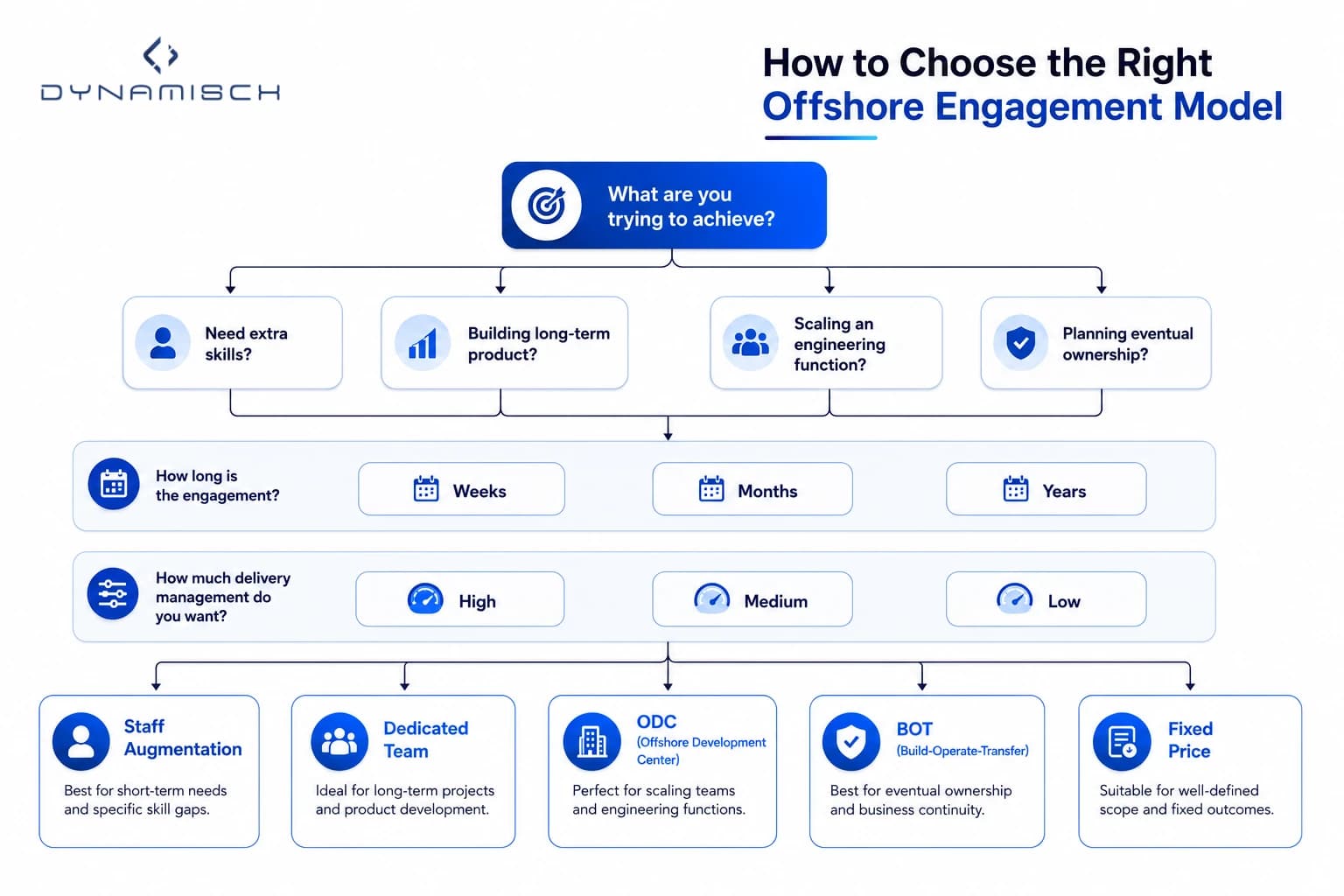
How Much Delivery Management You Want to Own
If you have experienced engineering leadership and established delivery processes, staff augmentation lets you keep full control while adding specialized talent.
If you want a partner to manage day-to-day team operations while your organization focuses on product strategy and priorities, a Dedicated Team or Offshore Development Center (ODC) is a better fit.
How Long the Engagement Will Run
Time horizon matters. Short-term initiatives or targeted expertise are well-suited to staff augmentation or fixed-price engagements. Platform engineering, multi-year product development, and AI modernization programs benefit from a dedicated team.
An ODC or build-operate-transfer model is a better choice when you are building a long-term engineering capability that will continue to grow.
Filling a Gap or Building Capacity?
A temporary skills gap calls for staff augmentation. Building an enduring product organization requires continuity, capacity, and institutional knowledge, making a dedicated team or ODC more appropriate.
For many mid-market SaaS companies, a Dedicated Team strikes the right balance. It provides faster onboarding, stable engineering capacity, and lower operational overhead than an ODC. And it offers greater continuity than staff augmentation.
Ultimately, the right choice depends on balancing three variables: your desired level of control, the duration of the engagement, and the amount of management responsibility your organization is prepared to own.
When Staff Augmentation Still Wins
Many businesses still prefer staff augmentation as they need specialized expertise quickly without changing their existing delivery model.
It works best for short-term requirements, such as adding data engineers, cloud architects, AI engineers, or cybersecurity specialists to accelerate a defined project while your internal team retains full ownership of delivery.
The model is most effective when your engineering organization has the capacity to onboard and integrate external developers, and the engagement is expected to last only a few months. Its lower setup overhead makes it ideal for targeted skill gaps.
However, the choice between staff augmentation and offshore development becomes a different equation for multi-year product roadmaps. As projects grow, relying on rotating individual contributors can increase management effort, reduce continuity, and make knowledge retention more difficult than with a dedicated team or ODC.
Business Impact: Cost, Risk, and Competitive Advantage
The value of modern offshore software development models extends well beyond labor cost savings. For business leaders, the bigger advantages are greater delivery capacity, faster access to specialized talent, and the ability to accelerate product development without permanently expanding internal teams.
When the right offshore engagement model is matched to the business objective, organizations can improve time-to-market, shorten hiring cycles, and scale capabilities in areas such as AI, data platforms, and cybersecurity.
AI-assisted software engineering is improving delivery efficiency across the software development lifecycle. However, leading analysts like Gartner say the biggest gains come from combining AI with strong engineering processes, not from using coding tools alone.
The greater business risk is standing still. Organizations that cannot access scarce technical talent or scale engineering capacity quickly may face delayed digital transformation initiatives, slower product delivery, and a growing competitive disadvantage in high software-driven markets.
The Rise of GCCs and the "Own vs. Rent" Decision
As engineering becomes a strategic differentiator, many enterprises are moving beyond traditional offshore engagement models toward Global Capability Centers (GCCs). India alone is home to more than 2,100 GCCs, and these centers are increasingly focused on AI, product engineering, R&D, and digital innovation rather than back-office support or cost arbitrage.
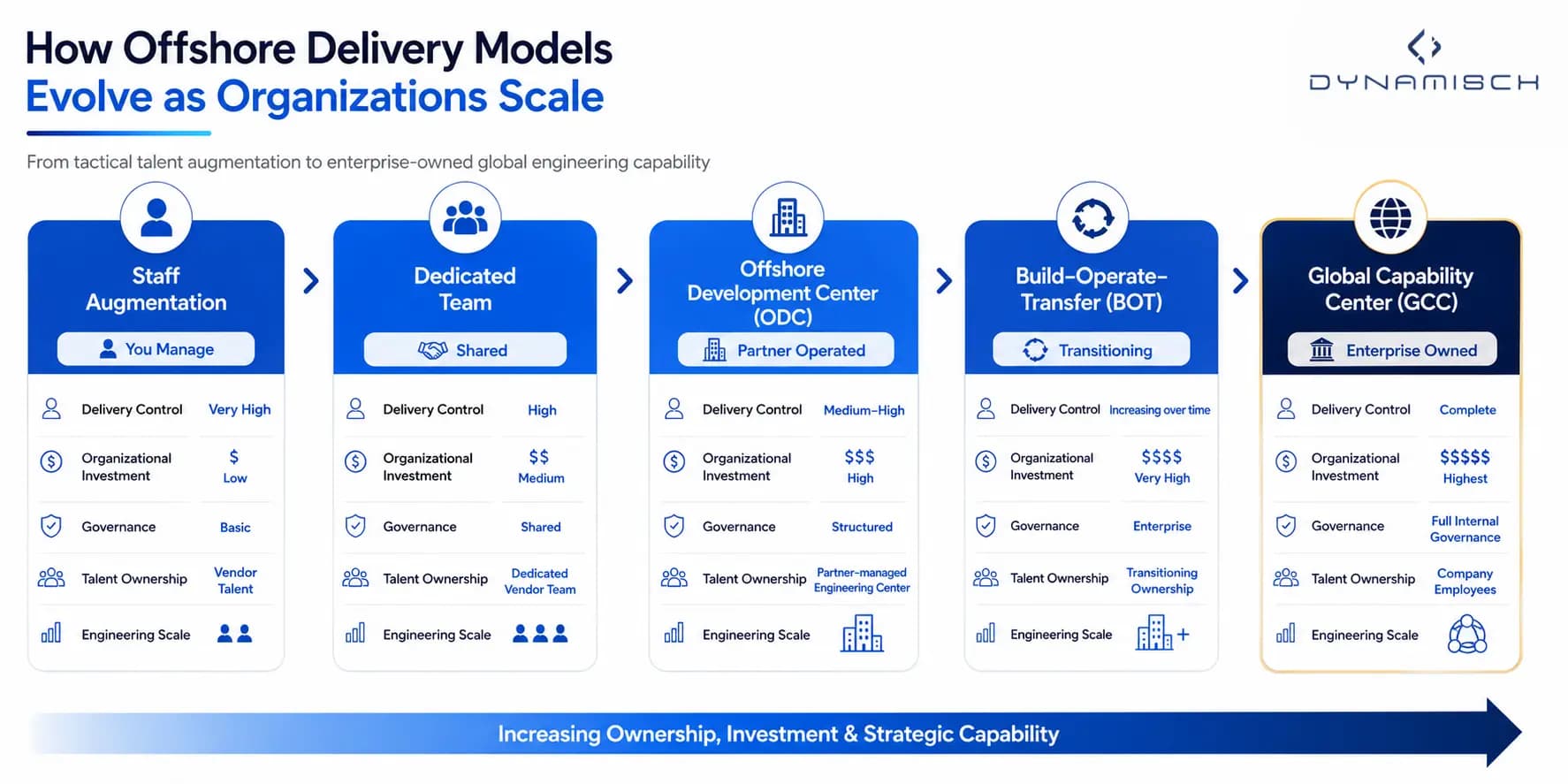
How BOT Bridges Dedicated Teams and GCCs
The build-operate-transfer model offers a practical path between a dedicated team and a fully owned GCC. A partner establishes and operates the offshore organization, then transfers the team and operational ownership once the business is ready to assume responsibility.
This reduces the complexity of setting up recruitment, local entities, and compliance during the early stages of expansion.
Governance as the Real Success Factor
The decision of choosing between GCC and ODC is only part of the equation. Long-term success depends on governance of clear ownership, security controls, consistent engineering standards, executive alignment, and delivery metrics.
Organizations that treat offshore teams as an integrated part of the business consistently achieve better outcomes than those that manage them as isolated vendors.
The Operational and Governance Challenges Shaping Offshore Decisions
Choosing between different offshore software development models is only the first step. Long-term success depends on how effectively the engagement is governed.
-
Communication and Cultural Alignment: Time zone overlap, decision-making styles, and communication practices influence delivery quality more than geography alone. High-performing offshore teams establish clear ownership, regular collaboration rhythms, and documentation standards to minimize misunderstandings.
-
Security Concerns: Protecting source code, intellectual property, and customer data should be a core evaluation criterion when selecting an offshore software development company. You should evaluate identity and access management, assess secure development practices, contractual IP protections, and data segregation, especially for AI, cloud, and regulated workloads.
-
Compliance Considerations: You must ensure the offshore partner complies with applicable regulations and contractual obligations, including data residency, privacy, and industry-specific compliance requirements where relevant.
-
Scalability Limitations: Not every engagement model scales equally. Staff augmentation works well for targeted expertise, while larger product portfolios often require ODCs, dedicated teams, or GCCs with stronger governance structures.
-
Talent Shortages: Global demand for data engineering, AI, and cloud talent continues to outpace supply, making access to skilled offshore teams a strategic advantage rather than simply a sourcing decision.
-
Cost Pressures: A meaningful cost comparison extends beyond hourly rates. Local hiring often includes employee benefits, payroll taxes, recruitment expenses, office space, and retention costs that substantially increase the total cost of ownership.
-
AI Adoption Barriers: Modern engineering teams are largely expected to use AI-assisted development, intelligent DevOps workflows, and automated testing. Offshore partners that have not incorporated AI into their delivery practices may struggle to match enterprise expectations for code quality, productivity, and release velocity.
A 3-Step Checklist for Choosing an Offshore Engagement Model
To get the most out of the offshore engagement, you should follow this 3-step checklist and select the right model.
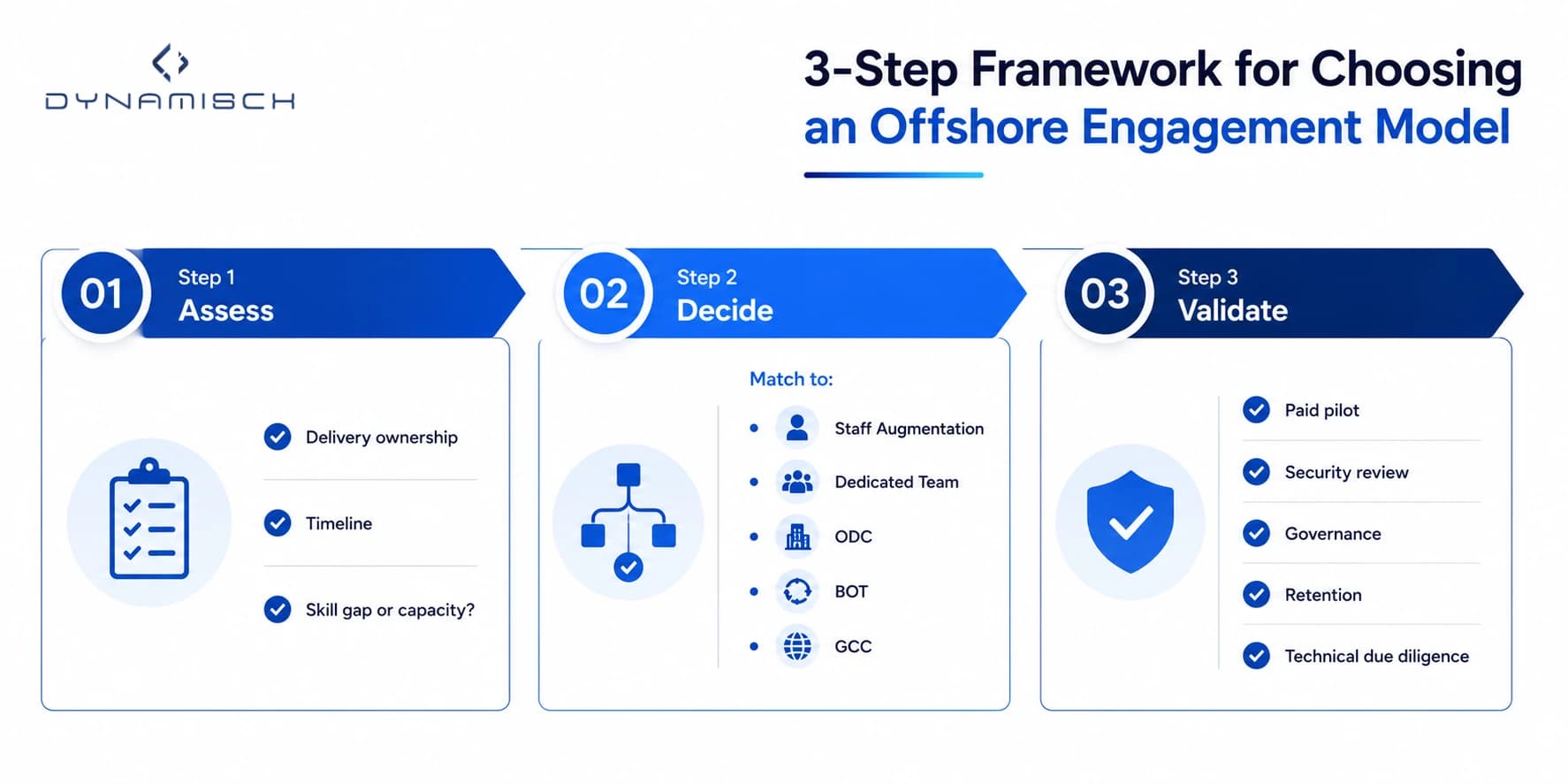
Step 1: Assess
Start by answering three questions: How much delivery management does your organization want to retain? How long will the engagement last? Are you filling a short-term skills gap or building long-term engineering capacity? These answers narrow the choice among available offshore software development models.
Step 2: Decide
Match your needs to the appropriate model. Choose staff augmentation for targeted expertise, a Dedicated Team for ongoing product development, an Offshore Development Center (ODC) or Global Capability Center (GCC) for long-term organizational scale, and a build-operate-transfer model if your goal is eventual ownership of the offshore operation.
Step 3: Validate
Before committing to a large-scale engagement, run a paid pilot with a representative project. Assess delivery consistency, communication, engineering quality, and cultural fit.
Validate governance processes, security controls, compliance capabilities, and retention practices through reference checks, technical due diligence, and documentation reviews before expanding the partnership.
What's Next for Offshore Software Development Beyond 2026
The next generation of offshore software development will be defined more by AI maturity, engineering capability, and operational resilience.
AI as a Co-Developer Rather Than a Support Layer
Generative AI is becoming part of the software delivery lifecycle, from requirements analysis and code generation to testing, documentation, and DevOps. Businesses expect offshore teams to use AI-assisted development responsibly while maintaining engineering quality and governance.
Security as a Competitive Differentiator
Security is evolving from a compliance requirement into a selection criterion. Organizations are placing greater emphasis on zero-trust principles, secure software development practices, supply chain security, and continuous risk management when evaluating offshore partners.
GCCs Moving from Cost Centers to Innovation Hubs
Global Capability Centers are continuing their shift from support functions to strategic engineering organizations. Many now lead AI development, R&D, product engineering, and platform innovation, reinforcing the broader transition from cost optimization to capability building.
Hybrid Offshore-Nearshore Structures
Rather than relying on a single geography, businesses are largely adopting hybrid delivery models. Collaboration-intensive activities often remain in nearshore locations, while large-scale platform development, engineering, and managed operations are distributed across offshore teams to balance productivity, cost, and business continuity.
Market Forecast
The long-term outlook is really strong. The offshore software development market is projected to reach approximately $348 billion by 2030, supported by AI-driven engineering services, enterprise digital transformation, cloud-native development, and demand for globally distributed software teams.
Conclusion
There is no universally "best" choice among the offshore software development models. The right approach depends on three factors: how much delivery ownership your organization wants to retain, the expected duration of the engagement, and whether the objective is to fill a temporary skills gap or build long-term engineering capacity.
Businesses that align their engagement model with business strategy will be better positioned to scale AI initiatives, compete for scarce technical talent, and accelerate product delivery.
Use the 3-step checklist in this guide to evaluate your options before committing to a delivery model. If you're assessing which approach best fits your digital transformation strategy, product roadmap, or long-term engineering goals, consulting with an experienced engineering partner can help you make that decision more efficiently.
Frequently Asked Questions
Manoj Juriasinghani
Chief Strategy Officer
As Chief Strategy Officer at Dynamisch, Manoj drives the company's vision through strategic insight, enterprise collaboration, and a focus on delivery excellence. With more than 28 years of experience in technology leadership and global operations, his career showcases a proven record of establishing Global Capability and Delivery Centers (GCCs/GDCs), scaling high-performing teams across geographies, and leading digital transformation initiatives for global enterprises.